.svg&w=384&q=75 "GoalGist logo")
Gianni Infantino Under Pressure: The Shifting Power Dynamics in FIFA
“Tell Mike it was just business. I always liked him.”
The line from The Godfather lands differently this week. Because for the first time since the Fifa Forward storm broke, it feels as if someone, somewhere, has decided that with Gianni Infantino, it’s now just business too.
For almost six weeks, the Fifa president has sat under a cloud of allegations over a covert plan to sell off football’s biggest shared asset – the World Cup – on terms that would have brought him vast personal reward. The story has rumbled on: columns, denunciations, a drip of outrage. The kind of noise powerful men usually ride out.
This feels different.
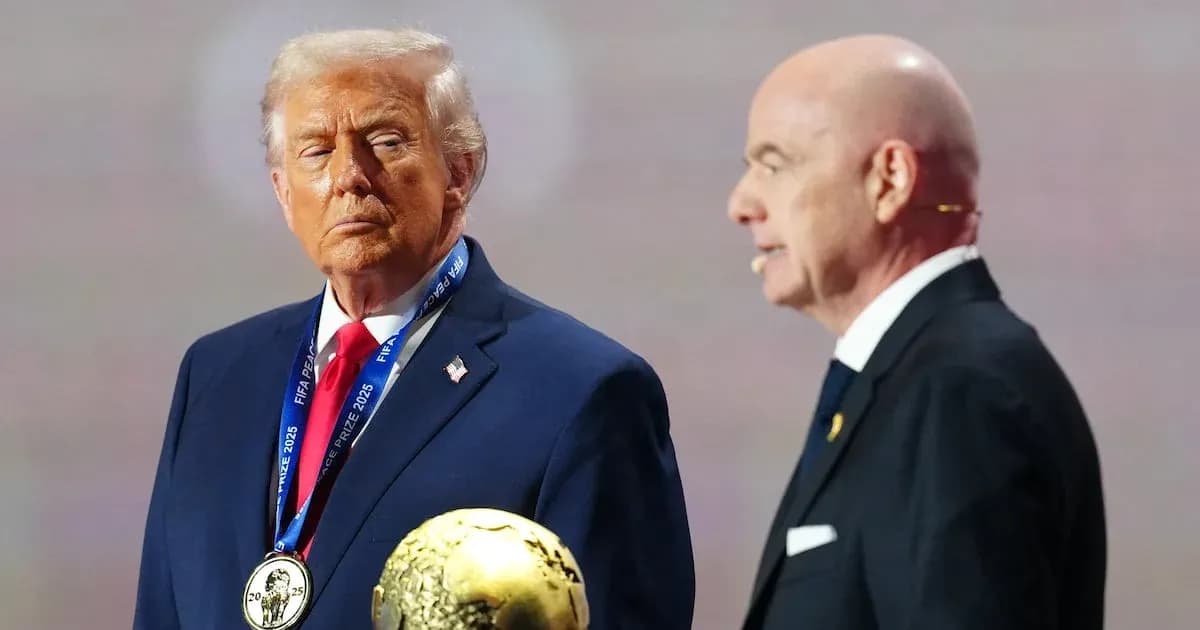
Infantino has long been “the man who sold the world”, once to the game’s usual corporate suitors, more recently to Donald Trump in exchange for proximity to power and the trinkets that come with it – a peace prize bid, a seat at the fringes of global politics, the illusion of statesmanlike heft. The assumption was simple: he was in too deep, too protected, too entrenched to be shifted.
Give it a month, the thinking went, and he’d be back at a lectern, arms windmilling, preaching about unity, development, égalité and fraternité, the familiar script about caring and sharing. The eyes would stay the same: flat, painted-on, unmoved behind the papier-mache mask of presidential gravitas. You don’t buy him out. He buys you out.
Yet something has moved. Not because of the “gnats around his ankles” – the media, the commentators, even the odd ex-pro such as Mikaël Silvestre weighing in – but because real power has entered the room.
Uefa’s legal action, accusing Fifa and Infantino of “criminal mismanagement” over an alleged undervaluing of World Cup rights, may never have been designed to win outright in court. It looks more like a classic piece of pressure play, a zugzwang: force your opponent into a position where every move is bad.
Two events this week underline that shift.
First came Josh Kushner’s statement. Kushner, the financier behind the Fifa Forward deal, just happens to be the brother of Jared Kushner, Trump’s son-in-law. He is not some peripheral figure. He was the money man.
Now he says he “would not have gotten involved” had he known the full picture. He calls the whole saga “regrettable”. On the surface, the words sound calm, almost bland. Underneath, they carve out distance. They say: I’m not standing in front of this bus.
Kushner has also hired Alex Spiro, a heavyweight defence lawyer whose client list includes Elon Musk – during the “pedo guy” defamation case – and Alec Baldwin after the fatal shooting on the Rust set. That is not a casual pick. It is a nuclear-option choice.
Then came Fifa’s own legal counterpunch, filed this week. The organisation dismissed the Uefa move as a “smear campaign”. So far, so predictable. But then the mask slipped. Fifa spelled out what it really fears: discovery.
Discovery is the moment the lights go on. Emails, internal memos, WhatsApp chats fired off from a golf course after lunch – all of it can be dragged into the open. No one in Infantino’s camp wants that. Uefa is asking for discovery not just from Fifa, but from Thrive Capital and from Greg Maffei, the Trump donor and deal adviser who was in the room when Infantino was given intoxicating access to the White House orbit.
That’s the danger. Not rhetoric. Paper trails.
Infantino knows this. So does anyone who has ever swum in Trump’s waters. Being a “worry” to people in that world is not a safe place to be.
Even Trump’s early backing of Infantino, blasted out on Truth Social in August, came with an asterisk. The former president warned that if Fifa removed Infantino “for any reason”, it would be terrible. The tone was supportive. The wording was conditional. And since then? Silence.
The bro-tocracy days, when Trump and Infantino posed together like models in a Brooks Brothers knitwear advert, feel a long time ago. The image lingers: the gleaming bald fixer basking in the glow of a patron who resembles a giant, walking portion of American comfort food, something deep-fried and honey-glazed that has learned to speak in superlatives. “A very tall, very handsome man,” Trump once purred.
Those relationships are always brittle. Trump will usher you in, shout your name across a ballroom, slap your back by the stairwell. But when you fall out of his winning column, you fall hard. His politics has no ideology, no loyalty, just a scoreboard.
Lose, or look like you might lose, and bad things tend to happen. The list of one-time insiders who have ended up under legal or political fire is long. Michael Cohen once vowed he would “take a bullet” for Trump. He ended up imprisoned, disbarred, exiled from the inner circle. Jeff Sessions, the former US attorney general who called Trumpism “a movement”, was later branded weak, confused, dumb, an idiot, a disgrace, even “mentally retarded” by the man he had helped into power.
There is a pattern. You are either useful or you are gone.
This is the shadow hanging over Infantino now. If discovery goes ahead, if those documents start to move into the public domain, the calculation around him changes. Uefa’s accusation is clear: criminal mismanagement, centred on an alleged undervaluing of World Cup rights. Separate from that, though hardly reassuring, is the suggestion that Infantino stood to gain a huge personal salary from the arrangement.
Uefa is not just tugging at a loose thread. It is trying to open the box. To see what sits in those “razor-sharp odd nooks and crannies” of Fifa’s decision-making, the hidden compartments of the Club World Cup trophy made bureaucratic. Does anyone really want to see what’s in there? Is it safe to look?
“Please, Mike, don’t do this, don’t do this to me.”
“Today I settle all family business. So don’t tell me you’re innocent.”
The Godfather dialogue echoes again because the choreography feels familiar: a powerful figure, once untouchable, now walking down corridors where doors that used to open suddenly stay shut.
Infantino is doing the rounds, working his outer provinces, shaking hands, banking promises. Saudi Arabia has offered support, but even that came hedged – “at this time …” – as though everyone is leaving themselves an escape route. There is a Fifa congress in November. On paper, the votes matter. In reality, you wonder how much the ballot box counts when the real jeopardy lies in a courtroom filing cabinet.
Football has seen this movie before. Sepp Blatter and Michel Platini both believed they could ride out the storm, that their networks and their legacies would shield them. One unexplained payment later, they were gone.
Legal cases can drag, stall, fizzle. Uefa’s claim might yet fall short in strict legal terms. It may not need to win. It just needs to keep the coals hot, to make sure everyone knows the raking will continue, that the questions will not stop.
Because once the people who protect you start calculating their own exposure, once the lawyers start talking about discovery, once the Trumps and Kushners of this world begin to edge away from the blast zone, a football president can find out very quickly how alone he really is.