.svg&w=384&q=75 "GoalGist logo")
Germany's Coaching Crisis: Lessons from Löw to Nagelsmann
Germany have been here before. That is precisely the problem.
When Joachim Löw’s world champions crashed out of the 2018 World Cup in the group stage, the diagnosis was brutal and instant: the era was over. Mexico and South Korea had not just beaten Germany, they had ripped away the illusion of invincibility. Twelve years, one World Cup, one Confederations Cup, a World Cup semi-final and a Euro final – all of it suddenly felt like the past tense.
The obvious next step never came. Löw stayed. His credit in the bank, the argument went, had earned him another chance. Germany drifted through three more years, showed no meaningful improvement, and then limped out of Euro 2020 – delayed to 2021 – with a tame last-16 defeat to England. Only then did Löw walk away.
The DFB had waited too long. They told themselves it would not happen again.
Flick, Nagelsmann… and the same mistake again?
Hansi Flick arrived as the antidote. Fresh from his treble at Bayern Munich, he carried Germany to the 2022 World Cup on a wave of optimism. The football was supposed to be front-foot, the culture reset, the scars of Russia 2018 healed.
Instead, Japan happened.
Germany led, then collapsed. Another group-stage exit followed, even with a battling draw against Spain as a minor consolation. Flick survived when many assumed he would not. The same pattern emerged: bad results, loud criticism, but no decisive action. Only in autumn 2023, after another string of failures, did the DFB finally pull the plug and turn to Julian Nagelsmann.
This time, the federation told itself, it had its visionary.
Nagelsmann’s early months felt like a reboot. He picked bold squads, spoke with clarity, and built a connection with a public that had grown tired of excuses. At Euro 2024 on home soil, Germany rediscovered something they had been missing for almost a decade: a functioning tournament team. A quarter-final exit to eventual champions Spain hurt, but it came with a sense that the national side was back on an upward curve.
Nagelsmann, emboldened, set the bar even higher. The 2026 World Cup, he said, would be the target. Germany would go there to win.
Two years later, that ambition looks almost delusional.
A coach who burned through his capital
Nagelsmann has not just lost games. He has lost the room around them.
Public approval that once rivalled Löw at his peak has evaporated at remarkable speed. Press conference by press conference, interview by interview, he chipped away at his own authority. Instead of shielding his players, he dissected them in public. Detailed individual critiques became a regular feature. Some were ill-judged, others flatly contradicted earlier promises about roles and status within the squad.
The impression hardened: this was a coach who craved the spotlight, who could not resist another pointed remark, another correction, another lecture. When the questions turned critical, he too often responded with condescension rather than calm. The World Cup only amplified that image.
The Neuer call, the Kimmich puzzle
After Toni Kroos’ triumphant return at Euro 2024, Nagelsmann made an even more symbolic recall: Manuel Neuer. At 40, the Bayern goalkeeper came out of international retirement for this World Cup, despite repeated public denials from Nagelsmann that such a move was planned.
The fallout was immediate. Oliver Baumann, outstanding and reliable throughout qualifying, saw his path blocked at the last moment. The handling of the decision left a sour taste inside and outside the camp. On the pitch, Neuer did nothing that Baumann could not have done. There was no transformative save, no defining moment to justify the U-turn.
Then came the Joshua Kimmich issue. Rather than settle the captain into a clear role, Nagelsmann turned him into a tactical yo-yo. Right-back one minute, central midfielder the next – sometimes within the same match, as in the damaging defeat to Paraguay. The constant tinkering symbolised a broader uncertainty: Germany looked like a team forever being adjusted, never actually finished.
A World Cup that regressed
The loss to Paraguay in Foxborough was not a freak result. It was the logical end point of a tournament in which Germany looked blunt in attack and brittle in defence.
There had been a brief second-half surge against minnows Curaçao, but that was the exception. Across the group stage and into the knockout defeat, Germany repeatedly laboured against ordinary opposition: Ivory Coast, Ecuador, Paraguay. No control, no conviction, no identity that matched the talent on the teamsheet.
Strip away the nostalgia and the names, and this World Cup stands below 2022 in sporting terms. In Qatar, Germany at least produced a draw against Spain that hinted at a higher level. In 2026, there was nothing of that calibre to cling to.
Nagelsmann’s in-game management did not rescue him. Questionable substitutions against Ecuador disrupted what little rhythm Germany had. The decision to start super-sub Undav against Paraguay blunted one of his few genuine impact options from the bench. The plan, such as it was, never survived contact with the opposition.
The players tried to absorb the blame after the exit. They spoke of collective responsibility and explicitly shielded Nagelsmann. It was admirable. It was also beside the point. The national coach’s job is to give a talented squad a clear structure and a coherent idea. Over this World Cup, he did neither.
Klopp, the analyst – and the obvious successor
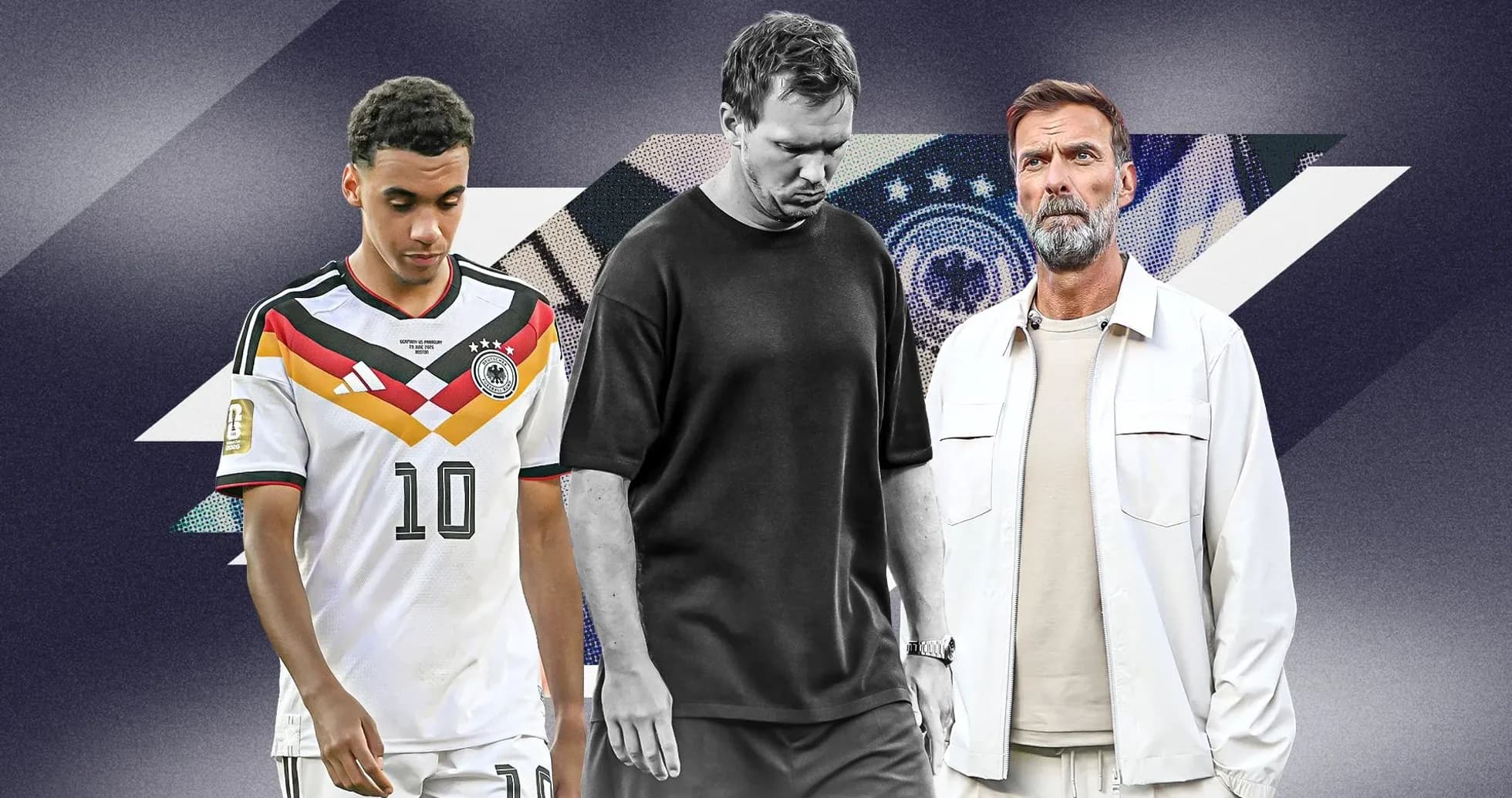
If all that was not painful enough for Nagelsmann, his every misstep was dissected in real time by the man many fans already see as his replacement.
Jürgen Klopp, now Red Bull’s head of soccer, spent the tournament as a television pundit. His analysis cut straight to the heart of Germany’s failings.
“You have to attack down the wings. There’s no alternative,” he told Magenta TV after the elimination. He pointed to the gulf between the quality of players like Florian Wirtz and Jamal Musiala and what they actually produced on the pitch. Paraguay, he said, played with the freedom of a team chasing history. Germany played with the weight of expectation – and never found a way to use it.
“Everyone in the stadium thought: Now they’ll turn it around! But we didn’t. We let them off the hook… We can talk about the DFB. We absolutely have to change a few things.”
Those words landed with the force of an audition, even if Klopp insisted otherwise.
The idea of Klopp in the Germany dugout has hovered over the federation for years. Now it feels concrete. For many supporters, he is the only name that matters: the former Borussia Dortmund and Liverpool manager, the man who would bring charisma, clarity and a sense of mission to a national side that has forgotten what it means to be feared.
Klopp, speaking in Boston, refused to play along.
“I haven’t thought about that yet,” he said when asked about the job. He acknowledged that his name will always surface when the national team is in crisis, but stressed that he already has a role he enjoys – and that it is not a part-time commitment.
The clock is ticking
Inside the Germany camp, Nagelsmann still has public backing. Senior players have defended him. Sporting director Rudi Völler has spoken up on his behalf. The DFB has been here before with Löw. It has been here with Flick.
That is exactly why it cannot afford to hesitate again.
Three tournaments in a row, Germany have clung to continuity long after the evidence on the pitch screamed for change. Each time, the reset came too late. Each time, the next coach inherited not just a team, but a deeper layer of distrust and fatigue around the national side.
Now the federation stands in front of the same fork in the road. Keep faith with a coach whose project has stalled, or act ruthlessly and move on while an elite successor is both available and interested in international football.
One thing is clear: Jürgen Klopp will not wait forever. The question is whether the DFB has finally learned to move before the damage becomes irreversible.