.svg&w=384&q=75 "GoalGist logo")
Gabriel's Future: Manchester United Faces Tough Competition
Real Madrid, Barcelona, Paris Saint-Germain and Bayern Munich are circling. Manchester United’s brightest academy light in a decade is at the centre of a tug of war – and right now, the club are losing control of the situation.
United do not want to sell Gabriel. They do not even want to entertain the idea. Senior figures are scrambling behind the scenes to convince the 15-year-old to stay, fully aware of the storm that would hit if he walks away for nothing more than training compensation.
Sir Jim Ratcliffe, already a lightning rod for supporter anger after a string of unpopular calls, would be savaged if a talent of this scale slipped through his fingers. Gabriel is contracted until next summer, but he is not a full-time scholar and not tied into the usual academy model. When he turns 16 on October 16, he will technically be free to move abroad if he holds a European passport.
United are now digging into that. Gabriel’s father, Joe O’Cearuill, played twice for Ireland, while his mother is of Greek Cypriot descent. Under post-Brexit rules, that heritage could open the door to a dual-national move to an EU club before he turns 18.
United kept him out of Manchester City’s grasp last year. This time, the fight feels far more precarious. The signs are ominous. Gabriel was due to join first-team training on Saturday. He never turned up. He has not been seen at Carrington all week.
He was also in line to be in Michael Carrick’s squad for Wednesday night’s Carabao Cup third-round tie against Brighton at Old Trafford. Had he stepped onto the pitch, he would have become the youngest player in United’s history. That dream is on hold. His involvement has been ruled out.
For a club still waiting for the next Marcus Rashford to emerge, Gabriel has been the great hope. He joined at 11, quickly marking himself out as something different: a two-footed forward with balance, agility and the knack of slipping out of impossible spaces before finishing with cold precision.
The Lionel Messi comparisons are lazy and unhelpful, but the Neymar parallels make more sense. Gabriel plays with that same slinky, street-football swagger. He even wears the same model of Nike boots as the Brazilian, having signed a lucrative extension with the sportswear giant in March 2025.
The numbers back up the hype. At 14, he broke into United’s Under-18s – another record – and tore the league apart, scoring 20 goals in 21 games. He swept the awards: the inaugural Premier League U18s Player of the Year and United’s Jimmy Murphy Young Player of the Year, the youngest winner in the club’s history.
This season, he stepped up to the U21s. On debut against Ipswich, he delivered two assists and a deft chip in a 5-0 rout. A week later, he scored again as United hammered Leicester City 4-1. The pattern is clear. He is operating years ahead of schedule.
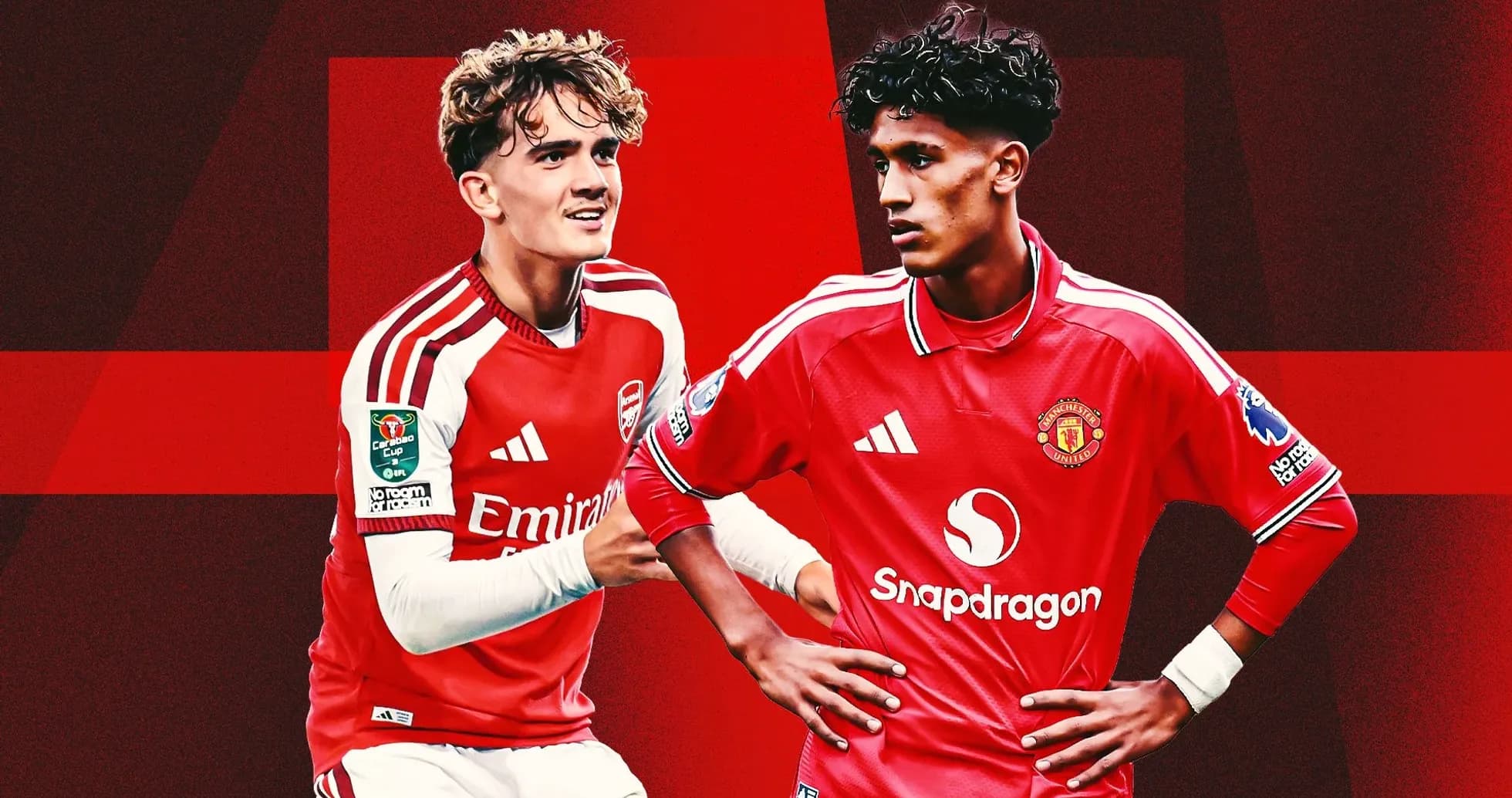
No wonder there is so much noise around him. United’s senior side are desperate for spark in the final third, and fans see what Arsenal have done with Max Dowman and ask the obvious question: why not here?
Dowman has become the modern reference point for teenage breakthroughs in England. Ethan Nwaneri first smashed the age barrier in September 2022, coming on for Arsenal at 15 years and 181 days against Brentford. His path has been uneven – loans to Marseille and Borussia Dortmund – but he already has over 50 appearances for the Gunners and remains only 19.
Arsenal doubled down on the youth-first mantra with Dowman. He became the Premier League’s second-youngest player when Mikel Arteta sent him on against Leeds in August 2025. In March, he produced a stunning solo goal against Everton to become the league’s youngest-ever scorer at 16 years and 139 days.
He did not stop there. In May, he became the youngest title-winner in Premier League history. This week, he matched Wayne Rooney’s feat as only the second 16-year-old to score a brace for a Premier League club in a major competition, firing Arsenal to a 4-2 Carabao Cup win over Ipswich.
Fourteen senior games already, and he looks at home. Dowman combines flair with a physical robustness that makes him hard to ignore. Arteta himself has mentioned him in the same breath as Messi, yet has resisted the urge to overplay him, choosing his moments carefully.
“We have to look after him. He's 16 years old. You don't see that in this league,” Arteta said after the Ipswich tie. He stressed the unique physical and mental demands of English football and the need to manage Dowman’s exposure with care.
This is where Gabriel’s situation diverges. He does not yet have Dowman’s frame. He is slight, often the smallest player on the pitch. His grit and bravery help to compensate, but throwing him straight into the Premier League could backfire badly – especially if he explodes immediately.
If Gabriel came in and lit up Old Trafford, Carrick would face an impossible balancing act. The clamour to start him every week would be deafening. His body, still developing, would be pushed to the limit. Arteta can rotate Dowman because Arsenal are stacked with depth and quality. He can win while resting his wonderkid.
United cannot say the same. The team lurches from one performance level to another. Drop Gabriel after a few games and Carrick would be branded overly cautious as United continue to struggle. Persist with him if he falters and the narrative flips: overhyped, overrated, not ready.
Carrick’s caution has been smart so far. Danny Simpson, a United academy graduate from the Sir Alex Ferguson era, sees it that way too.
Speaking to GOAL via Free Bets, Simpson drew the comparison with Dowman: “You've seen Arsenal do it, haven't you, with Max Dowman. He's come in, then he takes him out, then we don't know about him for a bit, then he might come back in. I think it's easier for Dowman.”
Simpson pointed to the context he enjoyed at United: “I came through United and United were great. I could come on for 10 minutes because most of the time we were 2-0 up, 3-0 up. I would play, I'd get my debut or a second game and I'd be playing with the second XI who could win the Premier League!”
He sees echoes of that in Arsenal now: “That's Max Dowman. He's coming into a team that's flying in confidence, full of top, top talent, winning games. People in the second XI, a bit like United back in the day, just as good. It's easy to come on and have an impact and play well. I think maybe United at the minute is a bit different.”
Simpson understands the excitement around Gabriel, but warns against panic: “I know we all want to see Gabriel play and it's exciting, but it's just a very different situation to Max Dowman at Arsenal. I just think that Michael Carrick will know what to do and when to. We've seen it a little bit with Shea Lacey… Just let him train and be around the team and his time will come.”
The problem is that young players do not live in a bubble. Gabriel only has to glance across Europe to see his peers thriving. Even if he accepts that Dowman’s circumstances are not identical, he cannot miss what Lamine Yamal has done at Barcelona.
Yamal broke through at 15 years, nine months and 16 days in 2023, slight of frame but electric in thought and movement. His speed and decision-making protected him from the physical mismatch. La Liga’s more technical, possession-based rhythm helped too. It is a less bruising environment than the Premier League, with fewer high-octane transitions and more space for gifted technicians to breathe.
Drop Yamal into England at the same age and his trajectory might look very different. Gabriel knows that. So when Barcelona and Real Madrid come calling, the idea of a fast-track to superstardom is seductive.
But timing is everything. When Yamal debuted, Barca were on their way to the La Liga title under Xavi, yet had crashed out of the Champions League in the group stage. Raphinha, Ousmane Dembele and Ferran Torres were not at their current levels. There was room for disruption.
Now, Barca’s forward line is stacked: Yamal himself, a peak Raphinha, Anthony Gordon, Karim Adeyemi and Gabriel Jesus. At Madrid, Jose Mourinho can turn to Kylian Mbappe, Vinicius Junior, Jude Bellingham and Yan Diomande. Gabriel would not walk into those sides. He would wait. And wait.
At United, the path is clearer. The opportunities will come sooner if he stays patient. An “I want it all right now” stance might feel powerful at 15. It can just as easily derail a career before it starts.
United, for their part, cannot allow themselves to be backed into a corner by a teenager still 18 months from sitting his GCSEs. However special he is, the principle matters. Carrick and the academy staff have handled him sensibly so far and will continue to do so if he steps back from the brink. If he refuses, there is little sense in dragging the saga out.
The longer this runs, the more it distracts from a senior side trying to claw its way out of a poor start. Whether nudged by advisers or family, Gabriel is playing a dangerous game, emboldened by a sense of entitlement that has crept into the modern game.
United’s great homegrown figures did not walk this path. George Best, Sir Bobby Charlton, Ryan Giggs, David Beckham, Paul Scholes, Gary Neville – none of them were handed anything. They climbed through setbacks and suffocating standards, on and off the pitch.
Former manager Ruben Amorim, for all his failings and short-lived reign, struck a nerve when he spoke about that culture shift before his sacking in January. “There is a feeling of entitlement we have in our club,” he said. “Sometimes, difficult moments is not a bad thing for the kids. We don't always need accolades in everything. We are not helping.
“Nowadays, they speak and go against the club because they feel entitled. Let's stay. Let's fight. Let's overcome. That is the way we can solve things.”
On that point, he was right. With his current mindset, Gabriel is unlikely to transform United’s fortunes in the famous red shirt. The most important lesson any prodigy must learn is brutally simple: no player is bigger than the club.
If that message does not land, United may have to let him chase the dream elsewhere – and discover, the hard way, how steep the road to the top really is.