.svg&w=384&q=75 "GoalGist logo")
Gabriel's Tug of War Exposes Manchester United's Fragile Era
Manchester United are fighting to keep hold of a boy who has not yet turned 16, while some of Europe’s biggest clubs circle like sharks.
Real Madrid, Barcelona, Paris Saint-Germain and Bayern Munich all want Gabriel. United insist they will not sanction his exit. Behind the scenes, senior figures are scrambling to change his mind.
For Sir Jim Ratcliffe, still in the early days as the public face of United’s football operation and already a lightning rod for fan anger, this is a nightmare scenario. Lose a talent widely viewed inside Carrington as once-in-a-generation, and the protests will only get louder.
Gabriel is under contract until next summer, but there’s a catch. He is not a full-time scholar and not tied into the club’s traditional academy model. On October 16, when he turns 16, he could technically walk away if he holds a European passport.
United are urgently trying to establish whether he does.
His father, Joe O’Cearuill, is a former professional who represented Ireland twice. His mother is of Greek Cypriot descent. Under post-Brexit rules, a dual-national teenager can leave England for a club inside the European Union before turning 18. That loophole is exactly what Europe’s elite are looking to exploit.
United fended off Manchester City to land Gabriel last year. This battle feels far more precarious. The signs are ominous.
He was due to train with the first team on Saturday. He didn’t show. He has not been seen at Carrington all week.
Carabao Cup dream on ice
Michael Carrick had planned to include Gabriel in his squad for Wednesday night’s Carabao Cup third-round tie against Brighton at Old Trafford. If he had stepped onto the pitch, he would have become the youngest player in United’s history to feature for the senior side.
That piece of history is now off the table. His involvement has been ruled out.
Inside the academy, the sense of loss would be huge. Since Marcus Rashford burst through, United’s youth system has not produced a genuine global-level superstar. Gabriel has carried that hope since he arrived as an 11-year-old.
He’s a two-footed forward, slippery in tight spaces, with the kind of balance and agility that makes defenders swing at thin air. Give him a glimpse of goal and he finishes with cold precision.
Lazy comparisons to Lionel Messi do him no favours, but stylistically he’s closer to Neymar – one of Messi’s former Barcelona team-mates. He even wears the same model of Nike boots as the Brazilian after signing a lucrative extension with the sportswear giant in March 2025.
The numbers back up the hype.
Last season, he broke into United’s Under-18s at just 14, another record, and rattled in 20 goals in 21 league games. That haul earned him the first ever Premier League U18s Player of the Year award and United’s Jimmy Murphy Young Player of the Year, making him the youngest recipient of the club’s prestigious youth honour.
This August, he jumped to the U21s and treated it like a kickabout. On his debut against Ipswich he produced two assists and a delicate chip in a 5-0 rout. A week later, he scored again as United hammered Leicester City 4-1.
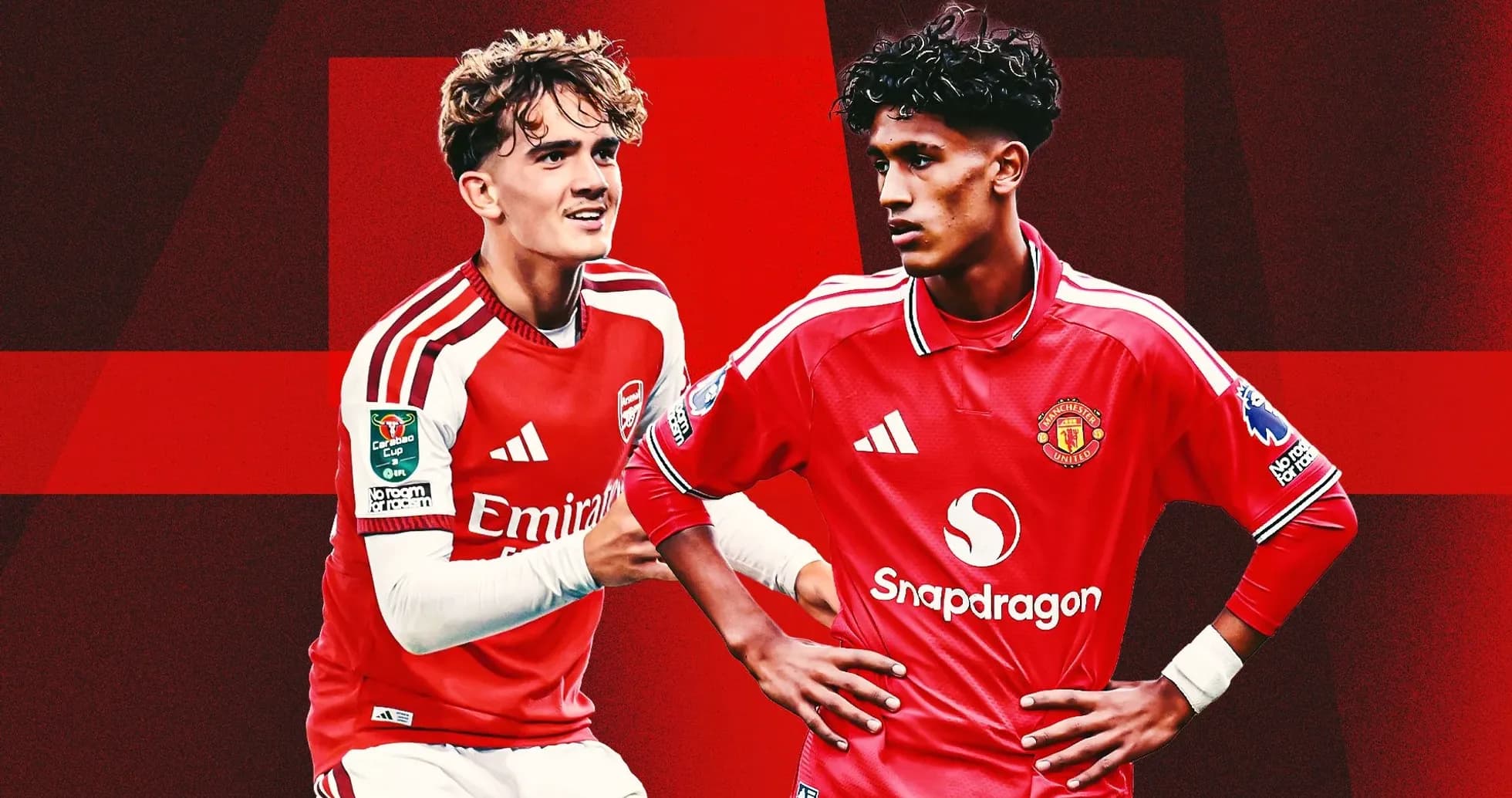
No wonder the clamour has grown. United lack spark in the final third. The fanbase sees Gabriel as the obvious answer, especially when they look at what Max Dowman is doing at Arsenal.
The Dowman benchmark
English football has seen this movie before. In September 2022, Ethan Nwaneri became the youngest player in Premier League history at 15 years and 181 days when he came on for Arsenal against Brentford. His development has not been linear – loans to Marseille and Borussia Dortmund, a few bumps along the way – but he already has over 50 senior appearances for the Gunners and remains only 19.
Arsenal have doubled down on the “if you’re good enough, you’re old enough” mantra with Dowman. He became the Premier League’s second-youngest player when Mikel Arteta threw him on against Leeds United in August 2025. By March, he had broken James Vaughan’s record as the league’s youngest goalscorer, slaloming through Everton at 16 years and 139 days.
He didn’t stop there.
In May, Dowman became the youngest title-winner in Premier League history. This week, he joined Wayne Rooney in a tiny club as only the second 16-year-old to score a brace for a Premier League side in a major competition, helping Arsenal beat Ipswich 4-2 in the Carabao Cup.
Fourteen senior appearances already. A blend of flair and physicality that makes it impossible for Arteta to ignore him.
Arteta has even mentioned Dowman in the same breath as Messi, but he’s careful, almost protective, about how he uses him.
“We have to look after him. He’s 16 years old. You don’t see that in this league,” Arteta said after the Ipswich win, stressing the Premier League’s unique physical and mental demands and his responsibility to choose the right moments to unleash the teenager.
United’s dilemma is that Gabriel is not Dowman, at least not physically.
He is slight, often the smallest player on the pitch. His bravery and determination help bridge that gap, but throwing him into the Premier League too early could backfire badly – especially if he explodes onto the scene.
If he starts brilliantly, the pressure on Carrick to play him every week would be relentless, loading a fragile young body with expectation and minutes. Arteta can rotate Dowman because Arsenal are stacked with quality and winning regularly. He can pick and choose.
United cannot. Not right now.
Carrick’s tightrope
Across the pitch, United look brittle. Performances fluctuate. Confidence swings from game to game. In that context, Gabriel is both an opportunity and a trap.
If Carrick brings him in and then pulls him back out, he’ll be accused of being too cautious, of stifling a generational talent while the team struggles. If Gabriel comes in and fails to impose himself, the backlash will be just as fierce: overhyped, overrated, not ready.
So Carrick has chosen patience.
Former United academy graduate Danny Simpson, who came through at the tail-end of Sir Alex Ferguson’s glory years, believes that’s the right call.
Speaking to GOAL courtesy of Free Bets, Simpson drew a sharp contrast between Dowman’s environment and Gabriel’s. At Arsenal, Dowman is stepping into a side “flying in confidence, full of top, top talent, winning games,” with a second XI “just as good” and able to win titles. That was Simpson’s United. You could come on at 2-0 or 3-0 up, surrounded by serial winners, and grow in the shadows.
United today are different. The margins are thin. The stakes are higher. Every appearance carries a weight it simply didn’t during the Ferguson era.
Simpson pointed to Shea Lacey as an example of how Carrick is already handling youth carefully: let them train with the seniors, let them feel the level, then pick the right moment. His message on Gabriel was simple – his time will come.
But try telling that to a teenager watching his peers light up Europe.
Eyes on Barcelona and beyond
Even if Gabriel accepts that his situation is not identical to Dowman’s, he only has to look to Spain to feel restless. Lamine Yamal’s rise at Barcelona is a powerful lure.
Yamal was just 15 years, nine months and 16 days when he made his senior debut in 2023. He was skinny, vulnerable to rough treatment, but his speed and intelligence allowed him to evade trouble. La Liga’s rhythm helped. The league is less physically punishing than the Premier League, with more emphasis on structure and possession than end-to-end chaos.
It’s a better playground for pure technicians. In England’s relentless tempo, Yamal might not have broken through so quickly.
Gabriel could easily convince himself that Barcelona or Real Madrid offer the fast-track to stardom. On the surface, it makes sense. In reality, timing is everything.
When Yamal debuted, Barcelona were on their way to the La Liga title under Xavi but had crashed out of the Champions League in the group stage. Raphinha, Ousmane Dembele and Ferran Torres were not at their current level. There was space for a gifted teenager to disrupt the hierarchy.
That landscape has shifted.
Now Barca can call on Yamal, a peak Raphinha, Anthony Gordon, Karim Adeyemi and Gabriel Jesus in attack. At Real Madrid, Jose Mourinho has Kylian Mbappe, Vinicius Junior, Jude Bellingham and Yan Diomande. PSG and Bayern are similarly stacked with elite forwards.
Where, in that crush of star names, does a 16-year-old Gabriel get regular minutes?
At United, the path is far clearer. The first team is crying out for creativity and goals. The door is ajar. He just has to accept that walking through it will take time.
The entitlement line
United, though, cannot allow themselves to be held hostage by a player who is still 18 months away from sitting his GCSEs, no matter how gifted.
Carrick and the academy staff have managed Gabriel carefully so far and believe they have acted in his best interests. If he recommits, that will continue. If he doesn’t, they argue there is little point in clinging on to a player whose heart is elsewhere.
The club has seen this all before. Its greatest homegrown icons – George Best, Sir Bobby Charlton, Ryan Giggs, David Beckham, Paul Scholes, Gary Neville – earned everything. Nothing arrived on a silver platter. Standards were non-negotiable, on and off the pitch.
Former United manager Ruben Amorim, heavily criticised during his brief tenure before being sacked in January, touched a nerve when he spoke about that culture eroding.
“There is a feeling of entitlement we have in our club,” he said. Difficult moments, he argued, can be good for young players. They don’t always need applause and instant gratification. They need to stay, fight, overcome.
He got plenty wrong. On that, he was right.
Right now, Gabriel’s stance looks like the embodiment of that entitlement. Acting as if he can dictate terms before he has kicked a ball for the senior side. Emboldened, perhaps, by the interest of Europe’s giants and the success stories of his peers.
United’s decision-makers are adamant on one thing: no one is bigger than the club.
If Gabriel cannot accept that, if he cannot see that his best chance of becoming the player he wants to be lies in earning it the hard way at Old Trafford, then the question almost asks itself.
Is it better to bend to a prodigy’s demands, or let him chase the spotlight elsewhere and back the badge to outlast him?