.svg&w=384&q=75 "GoalGist logo")
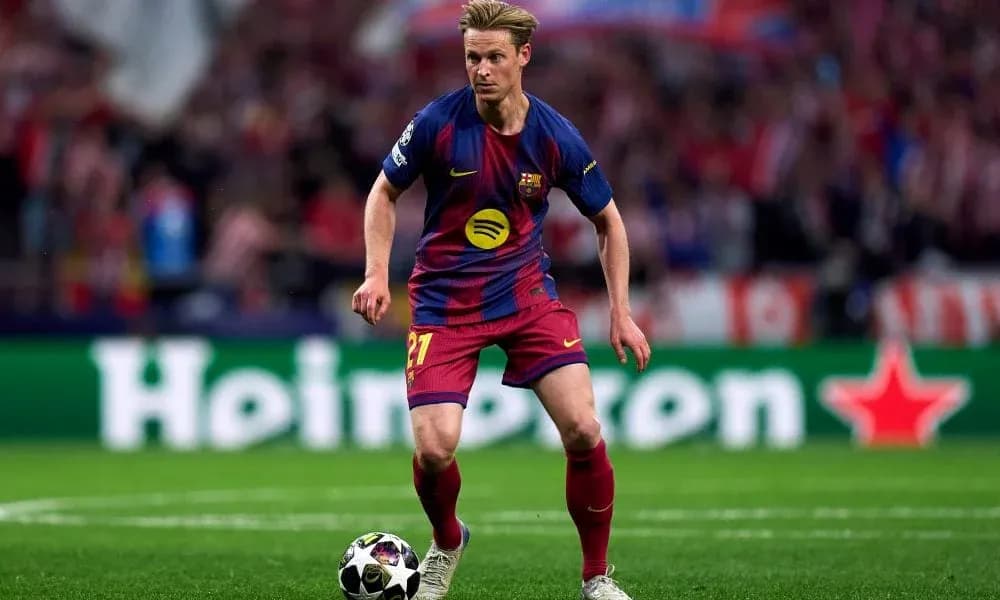
Frenkie de Jong's Uncertain Future at Barcelona
Frenkie de Jong’s Barcelona future is back under the microscope, with a leading Dutch voice suggesting this could be the midfielder’s final act at Camp Nou.
Valentijn Driessen, speaking on De Telegraaf’s podcast, believes the combination of De Jong’s injury problems and the arrival of Rodri has pushed the Dutchman into uncertain territory. In his view, the 2026/27 season may well be the last time De Jong wears Barcelona colours.
“He has been injured a lot; they already tried to get rid of him before, and now they bring Rodri,” Driessen said, pointing to a pattern the club has hinted at more than once.
He does not see Barcelona trying to move De Jong on while he is sidelined.
“I don’t think that now that he’s injured they’re trying to transfer him – I can’t imagine it – but I do think he’s in his last season at Barça,” he added.
Rodri’s arrival shifts the axis
De Jong has never hidden his dream: stay at Barcelona for the rest of his career. That line has been repeated in interviews and press conferences since he arrived from Ajax. But Barcelona now have one of the most complete holding midfielders in world football in Rodri, and Hansi Flick is expected to build his midfield around the Spain international.
That changes the equation.
Driessen does not claim Rodri’s signing is a direct trigger for an immediate sale. Instead, he sees a slower, more subtle shift – a new hierarchy in which De Jong’s status is no longer untouchable.
“He wanted to stay at Barcelona until the end of his career, but that’s a privilege granted to very few players,” Driessen said. “He’s not the sort of player you’d think would remain a first-team regular at Barcelona until he’s 35. In short, he won’t see out the end of his career there.”
The Dutch journalist even doubts whether Flick can regularly field both De Jong and Rodri from the start.
“You always have to perform to keep playing. If an excellent player comes in who plays in your position, I can’t imagine those two playing together,” he argued.
A tactical crossroads for De Jong
That brings the conversation to the pitch. De Jong’s game has been built on taking the ball from deep, dictating rhythm, gliding past the first line of pressure and knitting phases together. It is a role Rodri also commands, with a different profile but similar zones of influence.
If they are to coexist, Driessen believes De Jong must reinvent himself higher up the pitch, stepping into a more attacking role. He is not convinced that switch suits him.
“He might be able to try, but he needs to be more attacking, and that’s usually the point of criticism: that he lacks that. He’s never managed it,” Driessen said.
For now, the key voice is still missing: Hansi Flick’s. The German coach has several midfield options, each offering a different twist – control, verticality, physicality, creativity. How he shapes that puzzle once De Jong returns from injury will say far more than any podcast.
Rodri’s arrival does not automatically push De Jong out of the XI. But it does something just as significant: it strips away any sense of comfort. Every minute will have to be earned. Every role will be up for debate.
If this is indeed De Jong’s last Barcelona season, it will not drift quietly. It will be a battle for relevance in a midfield that suddenly belongs to someone else.