.svg&w=384&q=75 "GoalGist logo")
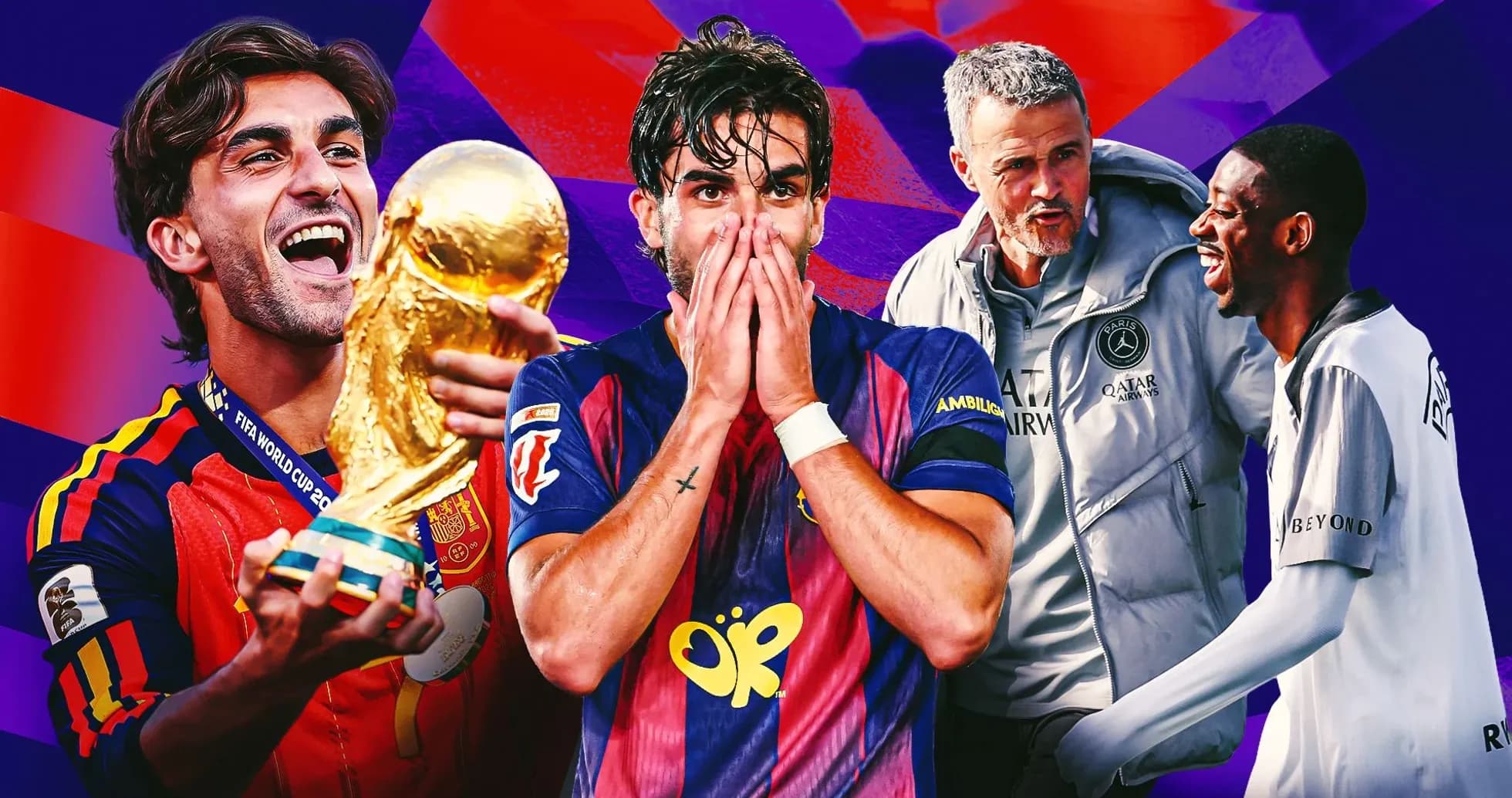
Ferran Torres: Barcelona's Future in Question Amid PSG Interest
Ferran Torres has never spoken more loudly about his future. Or more dangerously.
Asked about Paris Saint‑Germain’s interest, the Barcelona forward told Sportico: “Every time these teams want you it’s a good thing… What do Barca need to do to keep me? They have to show me they want me, come to negotiate, and in the end it’s all about talking.”
At Camp Nou, those words did not land softly. According to The Athletic, the public challenge “raised eyebrows” in the offices and corridors of power. It was not just the tone. It was the timing, and the money.
A contract clause that changes everything
Deco’s reluctance to extend Torres is not born purely of sporting doubt. It is also written into the fine print.
When Barcelona signed Torres from Manchester City in January 2022 for a total package of €65 million, they accepted a clause that now hangs over every meeting. Renew his deal, and City are due another €7m-€8m. Let him run down his contract, and he edges towards free agency with diminishing resale value. Sell him now, especially to a club willing to pay a premium like PSG, and the equation flips.
If PSG meet Barca’s demand to recoup the full €65m, the Catalans not only avoid triggering the extra payment to City, they also arm themselves for a move on a priority target: Julian Alvarez. The message from the sporting department is clear. Torres is valuable, but he is not untouchable.
From the player’s side, that pursuit of Alvarez has been read as a lack of “faith” in him. You can see why. Hansi Flick’s public line has hardly soothed the situation.
“I have complete confidence in Deco and we know we have to do something [about signing a new striker],” the Barcelona coach said. “But it also depends on Ferran, so we will see what happens.”
The subtext is obvious. Barca will act. Whether Torres is part of the plan is up to him — and up to the market.
Numbers that impress, doubts that linger
On paper, Torres has a strong case. With Robert Lewandowski gone on a free to Chicago Fire in MLS, the vacancy at centre forward is glaring. Torres can point to the scoreboard and ask why he should not be the man to fill it.
He scored 21 goals in 49 games across all competitions last season, two more than Lewandowski and second only to Lamine Yamal’s 24 in the Barcelona squad. The year before, he hit 19. Those are not the numbers of a fringe player.
Yet he is rarely mentioned in the same breath as Yamal, Raphinha, Pedri or Lewandowski when the architects of Barca’s back‑to‑back Liga titles are discussed. There is a reason.
Flick has undeniably lifted Torres’ level since arriving in 2024. The forward presses with ferocity, runs channels, stretches defences. But he remains streaky. Between January and April — the heart of the season, when titles are usually won or lost — he went 14 games without a goal. Every miss felt heavier. Every poor touch fed the argument that he is a good forward, not a decisive one.
Barcelona’s transfer business only tightens the squeeze. Anthony Gordon and Karim Adeyemi have already arrived to bolster the attack. If Alvarez also walks through the door, Torres risks being pushed into the shadows. Yes, he can play wide, but those lanes belong to Yamal and Raphinha now. The path to a guaranteed starting role narrows by the week.
The perfect time to cash in?
Inside the club, there is a growing sense this is the moment. Diario Sport report that Barca want to recover the full €65m they invested in Torres. If PSG agree, it would be framed internally as smart, even ruthless, business.
Sell a player whose contract is ticking down, whose value could quickly drop, and whose position is crowded. Reinvest in a younger, more complete centre forward. Protect the wage bill. On a balance sheet, it is almost too logical.
From Barcelona’s sporting perspective, Flick has enough cover up front even if the Alvarez deal stalls. Yamal, Raphinha, Gordon, Adeyemi, plus the tactical flexibility Flick craves. Torres becomes an asset rather than a cornerstone. An opportunity rather than a necessity.
For the player, the picture is different. The idea of a fresh start in Paris, under Luis Enrique, must be intoxicating. PSG have just won back‑to‑back Champions League titles and knocked Barcelona out in Catalonia on their way to lifting the trophy in May. They are Europe’s current benchmark, not a project but a machine.
Torres might feel he is stepping up. The reality is more complex.
A role player in Paris’ superstar carousel
Luis Enrique wants Torres because he fits a very specific profile. The Spaniard prefers forwards who can interchange constantly, drifting between the flanks and a false nine role, dragging markers into dead zones. Torres understands those movements. He has lived them at Barcelona and with Spain.
PSG sold their only orthodox No.9 when Goncalo Ramos joined AC Milan at the end of June. Even before that, Ramos was rotated relentlessly with Ousmane Dembele, with Luis Enrique often trusting Dembele centrally in the biggest games. The message was clear: the system matters more than the traditional striker.
Torres’ versatility should earn him more starts than Ramos managed, particularly if Bradley Barcola completes a proposed move to Liverpool. But the pecking order in Paris’ attack looks brutal.
Khvicha Kvaratskhelia, Dembele and Desire Doue form the front three that terrifies the rest of Europe. They offer chaos, speed, invention, goals. They are the reference point. Torres, if he arrives, slots in as the adaptable piece, the man who can cover, rotate, keep the structure intact.
Ligue 1’s level will not rescue him. The domestic league, weaker in quality and intensity than La Liga, will not define his legacy. At PSG, attackers are judged in the Champions League. That is where reputations are made and broken. Torres has 12 goals in the competition from his four years at Barca — respectable, but not the record of a man who bends Europe to his will.
Yes, he might have a better chance of lifting the Champions League trophy again with PSG than staying put. Barcelona are rebuilding, even if the expected arrival of his Spain team‑mate and Ballon d’Or winner Rodri should push them closer in 2026‑27. But in terms of individual status, a move to Paris does not guarantee elevation. It might simply freeze him in place.
The forward who never quite owns the stage
The list of clubs linked with Torres this summer underlines his market value and his appeal: Atletico Madrid, Tottenham, Aston Villa, Napoli, Juventus. Each of them could have offered something different — a central role, a team built more clearly around his strengths, a chance to prove he can be an elite, self‑sufficient forward rather than a cog.
Choosing PSG, if that is where he ends up, means choosing to be part of a system again. A high‑level system, yes, but one where he will always be sharing the spotlight, rarely owning it.
His limitations are well known to coaches and analysts. When he has to drop deep or hold the ball up under pressure from powerful defenders, his technical ceiling shows. He excels at attacking space, timing runs in behind, finishing moves. He struggles more when asked to create them.
That is why he has drifted in and out of Barca’s XI. That is why, at the World Cup, only one of his eight appearances for Spain came as a starter. Luis Enrique knows those strengths and weaknesses better than anyone. His PSG blueprint will not demand that Torres suddenly becomes a complete all‑rounder. It will, instead, protect him from those weaker areas — but also protect the team from needing him to be more.
That safety net comes at a price. Without being forced to evolve, without being the undisputed reference point, there is a real risk his game simply stays where it is.
A complicated farewell
At Barcelona, the relationship between Torres and the fanbase has always felt slightly uneasy. His work rate is admired. His attitude, on the pitch at least, has rarely been questioned. Yet he has never been embraced like a star. Not like the homegrown prodigies. Not like the marquee signings.
Flirting so openly with PSG will not help. From the stands, it looks like a player who has found form and leverage after a strong season in North America and now wants to cash it in. The power has shifted his way, and he knows it.
But power in football is fragile. If he walks out now, he leaves behind a club that never fully claimed him and a fanbase that will not be heartbroken. If he stays, he risks becoming a rotation piece in a crowded attack, his contract ticking down, his value falling.
In Paris, the lights will be brighter, the stage bigger, the competition fiercer. The grass will not necessarily be greener. The cheers will not automatically be louder. Ferran Torres will not suddenly transform into a global icon because he wears PSG’s shirt.
He will be what he has always been at the elite level: a high‑functioning, hard‑working, tactically useful forward. A luxury utility man in a game that still reserves its true immortality for those who refuse to be just that.