.svg&w=384&q=75 "GoalGist logo")
Fenerbahçe Dominates Sturm Graz 2-0 in Tactical Display
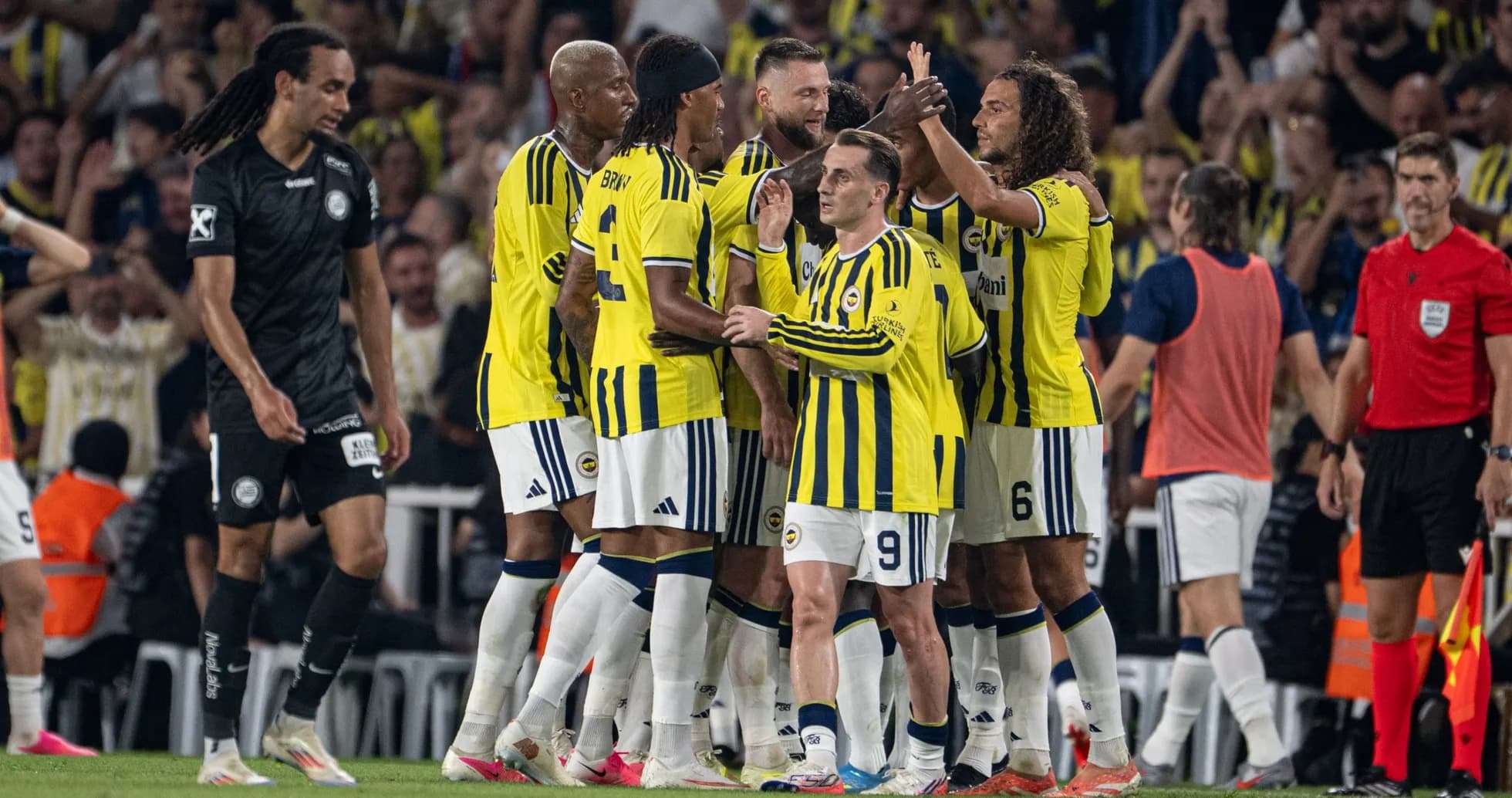
Fenerbahçe’s 2–0 win over Sturm Graz at Chobani Stadium was a tactical domination built on structural control and technical superiority. Across 90 minutes, Ismail Kartal’s 4-2-3-1 imposed itself so comprehensively that the contest became about how much damage the hosts would inflict rather than who would progress. With 72% possession, 17 total shots and 578 passes at 90% accuracy, Fenerbahçe dictated every phase, while Sturm Graz’s 4-4-2 spent long stretches compressed into a low block, surviving more than competing.
The scoreline, with both goals arriving in the first half, only partially reflects the imbalance. The hosts generated 10 shots on goal to the visitors’ single effort, and forced eight saves from D. Khudyakov, underlining how relentlessly they attacked the Austrian penalty area.
Kartal’s 4-2-3-1 was built around a secure base and a fluid attacking band. M. Skriniar and N. Ake formed a physically dominant central pairing, with J. Oosterwolde and N. Semedo initially providing width from full-back. In front, the double pivot of N. Kante and M. Guendouzi controlled tempo and rest defence: Kante screened Sturm Graz’s two forwards, cutting off direct passes into S. Wlodarczyk and S. Jatta, while Guendouzi stepped higher to connect with the three advanced midfielders.
Between the lines, M. Asensio operated as the central playmaker, with M. Greenwood and K. Akturkoglu attacking the half-spaces around him. Talisca, nominally the lone striker, frequently dropped off the last line to combine, creating rotations that Sturm Graz’s flat 4-4-2 struggled to track. The opening goal on 9 minutes – Talisca finishing from an Akturkoglu assist – was emblematic: Fenerbahçe exploited the channel between full-back and centre-back, with the wide midfielder driving inside and the forward timing his run across the defensive line.
Sturm Graz’s 4-4-2 under Fabio Ingolitsch was reactive from the outset. The midfield line of J. Hodl, L. Weinhandl, Jon Gorenc Stanković and S. Seidl tried to stay narrow to protect the central corridor, but this invited Fenerbahçe’s full-backs and wingers to receive freely in wide areas. With only 222 total passes at 74% accuracy, Sturm Graz rarely strung together possession phases; their main route forward was early balls toward the front two, quickly swallowed up by Skriniar and Ake or intercepted by Kante.
The second goal, scored by M. Greenwood just before half-time from an Asensio assist, effectively settled the tie. Again, Fenerbahçe’s structure was key: circulation through the double pivot drew Sturm Graz’s block to one side before a sharp vertical pass into Asensio between the lines created the angle to release Greenwood. It underlined how the 4-2-3-1 constantly generated a free man between or outside Sturm Graz’s compact but passive 4-4-2.
In goal, M. Gunok (Fenerbahçe) had a largely controlled evening, required to make only 1 save as the hosts’ defensive structure suffocated Sturm Graz’s attacks before they reached the box. The back four’s positioning, supported by Kante’s screening, meant shots inside the box for the visitors were limited to three, and only one of those tested the goalkeeper. By contrast, D. Khudyakov (Sturm Graz) was central to keeping the scoreline respectable, making 8 saves under sustained pressure as Fenerbahçe fired 10 shots on goal and 12 from inside the box.
The statistical shot profile reveals how deeply the game was tilted. Fenerbahçe’s 17 total shots included 5 blocked efforts, a sign of how often they forced Sturm Graz into last-ditch interventions inside their own area. Sturm Graz managed just 5 shots in total, with 3 blocked and only 1 on target, underscoring their inability to create clean looks at goal against a settled defence.
Possession and passing metrics further illustrate the tactical story. Fenerbahçe’s 578 passes, with 520 accurate (90%), reflect a side comfortable recycling the ball, switching play and patiently probing for openings. The high accuracy indicates that their dominance was not just territorial but technically secure; they rarely had to force low-percentage balls, instead moving Sturm Graz laterally until gaps opened. Sturm Graz’s 222 passes, 164 accurate (74%), show a team frequently rushed, forced into clearances or long balls rather than structured build-up.
Set-piece and territorial indicators also support the picture of control. Fenerbahçe earned 4 corner kicks to Sturm Graz’s 2, and were caught offside 4 times compared to none for the visitors. Those offside figures are telling: the hosts consistently tried to attack the space behind the back line, a natural consequence of pinning Sturm Graz deep and making aggressive runs beyond. The visitors, by contrast, rarely advanced high enough or quickly enough to threaten in behind.
Discipline highlighted the defensive strain on Sturm Graz. They committed 19 fouls to Fenerbahçe’s 10 and collected 3 yellow cards, all for Foul or Simulation, as they increasingly resorted to disruptive tactics to slow Fenerbahçe’s combinations. The hosts’ ability to maintain control without picking up a single booking speaks to both their positional security and their comfort in the game’s rhythm.
Without explicit xG figures, the shot volume and locations stand in as a proxy: 10 shots on goal and 12 inside the box for Fenerbahçe versus 1 shot on goal and 3 inside the box for Sturm Graz strongly suggest that the 2–0 scoreline was the minimum reflection of their superiority. In the context of a UEFA Champions League 3rd Qualifying Round tie, this performance projects Fenerbahçe as a side with a high overall form and a robust defensive index, while exposing Sturm Graz’s limitations when forced to defend deep for long periods against high-level positional play.