.svg&w=384&q=75 "GoalGist logo")
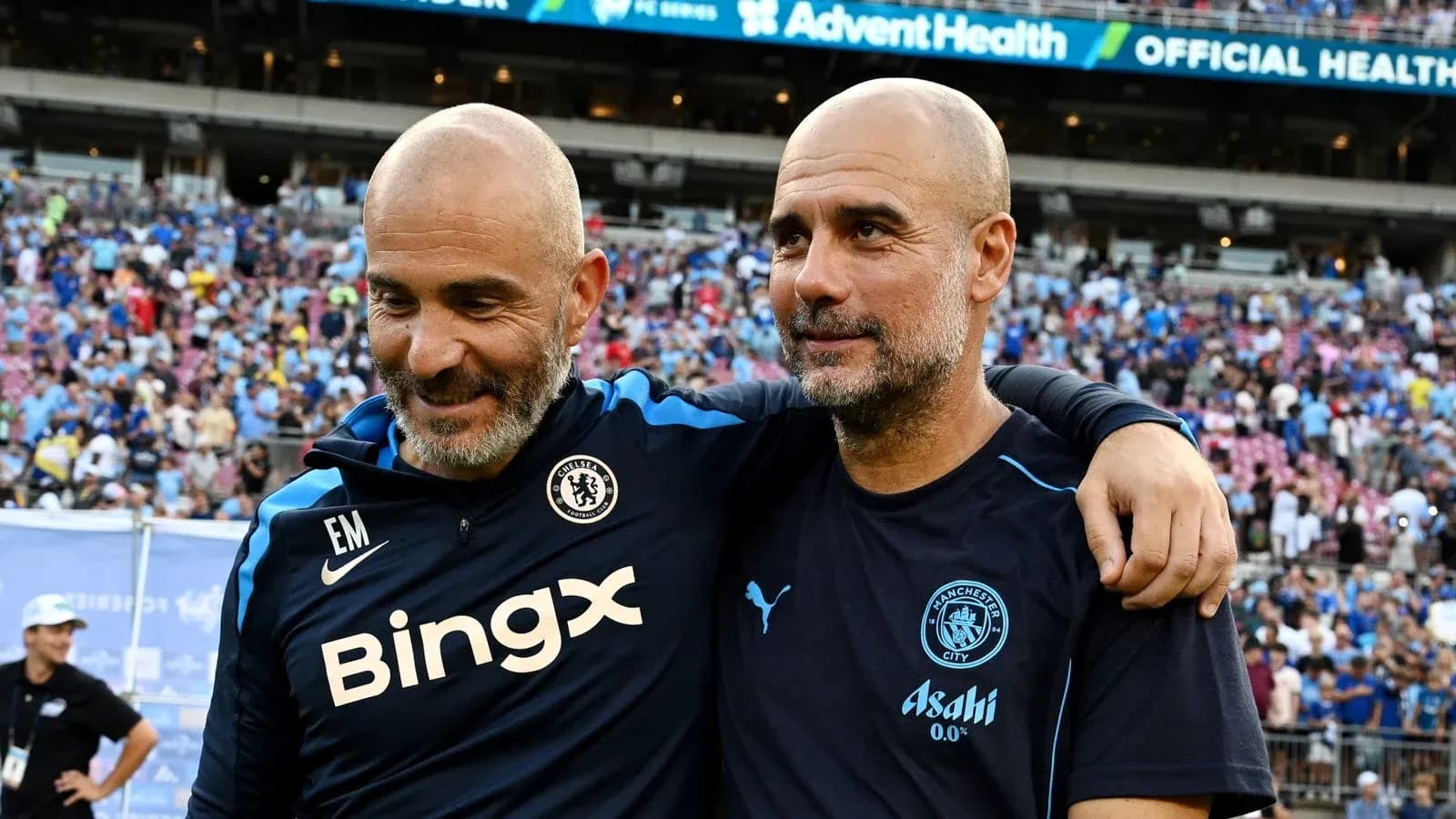
Enzo Maresca Takes Charge at Manchester City: A New Era Begins
Enzo Maresca steps into Manchester City’s dugout with the paint barely dry on the Guardiola era and the expectations already sky-high. This is not a rebuild. It’s a handover of a machine built to win everything, every year.
He knows the building. He knows the people. He knows the standard.
What he doesn’t know yet is what it feels like to carry that weight for nine relentless months.
A gentle start to a brutal job
If you could script an opening for a new Manchester City manager, it might look a lot like this: Bournemouth, Crystal Palace, Coventry City.
No early trip to Anfield. No opening-weekend derby. Instead, a run of fixtures that should allow Maresca to ease himself in, establish patterns, and bank points while the squad shakes off the World Cup hangover.
It matters. Rodri has just come off a draining, near ever-present role in Spain’s triumphant campaign and is the most obvious candidate for fatigue. City can afford to reintroduce him carefully when those first three games still heavily tilt in their favour, even without their midfield metronome.
But a soft landing can quickly become a trap. Those matches look winnable on paper, which means any early slip will be magnified. Maresca cannot afford to gift rivals a head start, not with Manchester United and Liverpool looming in two of the next three league games in September.
Those fixtures carry a weight that goes beyond three points. They are early verdicts on whether City remain the benchmark without Guardiola, or whether the aura has dimmed.
Maresca called it a “dream situation” when he walked back through the doors, inheriting a squad Guardiola has tuned to near-perfection. The Italian has a strong relationship with chairman Khaldoon Al Mubarak and a dressing room stuffed with talent and depth.
The demands, though, are identical to those that faced Guardiola. The job security is not.
Guardiola always operated on his own terms. Maresca will not be granted that kind of immunity.
Same principles, different picture
Maresca is not here to rip up the blueprint. City’s identity is too ingrained for that. Possession, control, aggressive pressing – the core ideas remain.
But the details will change.
Under Guardiola, City became the masters of positional fluidity. Centre-backs stepped into midfield, full-backs inverted, wingers drifted inside to create central overloads. Rodri sat at the heart of it all, orchestrating a constantly shifting structure.
Maresca leans towards something more defined. His preference is a 4-2-3-1, with clearer roles and a No 10 who stitches everything together. At Chelsea, that role belonged to Cole Palmer. At City, he can turn to Phil Foden or Rayan Cherki if he wants to mirror that set-up.
He also likes his wingers high and wide, stretching the pitch, pinning full-backs back. That is a subtle but significant shift from the Guardiola model, where wide players often tucked in to flood central zones.
The adjustment period will be fascinating. These are players schooled for years in Guardiola’s rotations and automatisms. They are intelligent enough to adapt, but habits at this level run deep. The question is not whether they can change, but how long it takes before the new patterns look natural rather than rehearsed.
A younger City, but a thinner leadership group
Behind the scenes, City have already been reshaping the squad for this next phase. Under sporting director Hugo Viana, the average age has dropped from 29 to just over 25 in the space of a few windows.
It is a necessary evolution, but it comes at a cost.
Bernardo Silva and John Stones have gone this summer. Kevin De Bruyne departed before them. Those exits strip away not just quality but personality and presence. There is a leadership gap to close.
Rodri and Ruben Dias remain central pillars, both on the pitch and in the dressing room. Erling Haaland’s influence has grown too, not just as a goalscorer but as a voice. Marc Guehi and Josko Gvardiol bring maturity and stability at the back, while Mateo Kovacic adds experience in midfield.
The spine is still formidable. It just looks and feels younger.
Recruitment has been expensive but targeted. Elliot Anderson, signed for a hefty fee from Nottingham Forest, is a bet on robustness and long-term control in midfield. Jeremy Monga, prised from Leicester, is another nod to the future.
City still want a right-back and another winger. They are also watching Lille’s teenage midfielder Ayyoub Bouaddi closely after his eye-catching World Cup displays for Morocco, though Arsenal are tracking him as well.
On the flip side, the exit door could be busy if valuations are met. Savinho, Omar Marmoush, Nico Gonzalez, Jack Grealish, Tijjani Reijnders and Rico Lewis are among those whose futures are not entirely secure. With the World Cup now over, movement is expected to accelerate.
Maresca’s first season will be shaped not just by his ideas, but by how cleanly this squad transition is managed.
A club built for Guardiola faces life without him
For the first time since the Abu Dhabi takeover, the long-term plan is not crystal clear.
A decade ago, almost every strategic decision pointed towards one goal: make the club irresistible to Pep Guardiola. That mission was accomplished, the trophies followed, and the vision became reality.
Now that chapter is closed. The question is simple and stark: what next?
City’s culture is unforgiving. The club has been hardwired to chase silverware on all fronts. Anything less than a serious tilt at major honours is unlikely to be tolerated for long.
Supporters turn up at the Etihad expecting two things: entertainment and victory. Maresca has to deliver both. His Chelsea spell showed how difficult that balance can be to strike when the margins tighten and patience wears thin.
He does, at least, walk into a league in flux. He is not the only new face in a big job. Andoni Iraola is bedding in at Liverpool. Xabi Alonso has taken charge at Chelsea. Michael Carrick, to a lesser extent, is still defining his Manchester United.
The established order is wobbling. That volatility can be a threat, but it is also an opening. Whoever adapts fastest can seize control of a season that feels unusually open at the top.
For Maresca, it is very simple: this is a sink-or-swim landscape, and he has been handed a speedboat.
The shadow of 115 charges
Hovering over everything is the unresolved issue that no manager’s tactics board can solve: the 115 Premier League charges still hanging over the club.
They will not go away just because Guardiola has. Maresca will have to live with them, talk about them, and be defined in part by how he handles them.
Guardiola was a master of confrontation when he needed to be, comfortable in the glare, experienced in shutting down lines of questioning he did not want to entertain. He knew the Manchester press pack, and he controlled the room.
Maresca’s experience at Chelsea was different. Criticism came, but it stayed largely on footballing ground. This is another level of scrutiny, with legal and ethical overtones that stretch beyond the touchline.
How he fronts up to that, how he protects his players from the noise, will colour his first year almost as much as his substitutions and team selections – especially if a verdict lands within the next 12 months.
He has the squad. He has the platform. He has a league in transition.
Now he has to prove that life after Guardiola at Manchester City can still look like domination, not decline.

