.svg&w=384&q=75 "GoalGist logo")
England Face DR Congo in Crucial Knockout Match
England reach the point of no return on Wednesday night in Atlanta, stepping into the knockout rounds with questions still swirling around a team packed with talent but still searching for a statement performance.
Top of Group L, yes. Convincing? Not yet. The Mercedes-Benz Stadium now becomes the stage where England must show they are more than a collection of elite club footballers navigating their way through a forgiving group. Against DR Congo, the highest-ranked of the third-place qualifiers, there is no room for the lethargy or looseness that crept into earlier displays.
This is where reputations harden or crack.
Right-back roulette and a reshaped defence
The build-up has been dominated by one position. Right-back has turned from a strength into a headache.
Reece James, who arrived at this World Cup carrying both expectation and fragility, saw his tournament effectively end with a hamstring injury that kept him out of the Panama game. Jarell Quansah, the man trusted to step in, then rolled his ankle in that same match. Thomas Tuchel played down the severity afterwards, calling it “a matter of days”, but days are a luxury England do not have at this stage.
No one inside the camp is likely to risk him now.
That leaves Djed Spence. Thrown on in New Jersey when Quansah went down, he is now expected to walk out in Atlanta from the start, charged with patrolling England’s right flank in a knockout tie. For a player whose club career has veered between promise and frustration, it is a remarkable twist: one game to show he belongs at this level, one game where any mistake will be magnified across a global audience.
The rest of the back four stays steady. Ezri Konsa and Marc Guehi continue in the centre, a partnership that has grown into the tournament rather than dominated it, while Nico O’Reilly holds his spot at left-back. Jordan Pickford, as ever, anchors it all from goal, his place never seriously in doubt.
Rice returns, Bellingham drives, Saka grits his teeth
If the defence is patched together on one side, midfield brings a surge of reassurance.
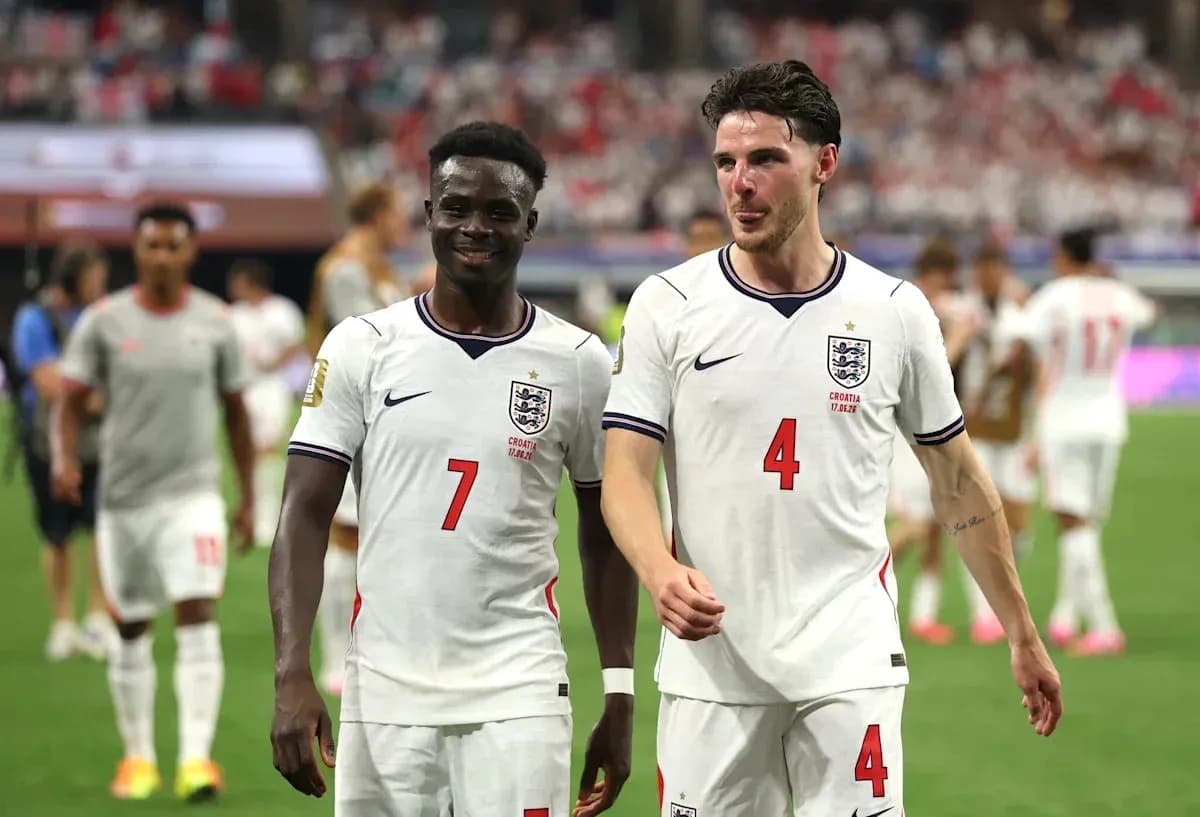
Declan Rice is back. Rested against Panama to protect a calf problem picked up in the draw with Ghana, the Arsenal midfielder is expected to return to the starting XI and with him comes structure, bite and authority. England look a different proposition when Rice is patrolling the centre, screening the defence and setting the tempo.
He will resume his partnership with Elliot Anderson, whose calm use of the ball and willingness to knit play together has quietly impressed. Kobbie Mainoo, for now, waits his turn from the bench, a luxury option rather than the heartbeat.
Ahead of them, Jude Bellingham remains the axis around which England’s attacking ambition spins. Operating in the number ten role, he has been the most decisive figure in this campaign, delivering in the key moments against Croatia and Panama when others drifted. When England need a spark, they look to him. When they need control, he drops in and dictates. At 22, he already carries the air of a player who expects to define nights like this.
Out wide, the story is one of pain management and opportunity. Bukayo Saka continues to nurse the Achilles problem that shadowed his club season with Arsenal and has followed him into this World Cup. Yet he is still expected to start on the right, his blend of industry and incision too valuable to leave out. Every sprint, every change of direction is a small act of defiance against a body that has been pushed to its limits.
On the opposite flank, Marcus Rashford keeps his place. The competition with Anthony Gordon has been one of the quieter subplots of England’s tournament, but Rashford’s work in the group stage has been enough to edge it. His direct running and threat in behind offer a different angle to the more touchline-hugging style of Gordon.
Kane hunts history as England chase rhythm
Up front, there is no debate. Harry Kane leads the line, as he always does.
Three goals in the group stage have put him firmly in the race for the Golden Boot. The numbers matter to him, of course they do, but so does the sense of responsibility. Kane knows knockout football defines centre-forwards. A half-chance taken, a penalty buried, a header glanced in at the back post – these are the moments that live for years.
Behind him, the cast feels familiar. The system is settled: 4-2-3-1, with Bellingham behind Kane, Saka and Rashford stretching the pitch, Rice and Anderson holding the fort. The question is not shape. It is execution, speed, and courage.
England’s predicted XI reads like a who’s who of Premier League and European football:
Pickford; Spence, Konsa, Guehi, O’Reilly; Anderson, Rice; Saka, Bellingham, Rashford; Kane.
On paper, it is enough to go deep into this tournament. On grass, it has yet to fully catch fire.
DR Congo stand in the way
DR Congo arrive as the best of the third-placed finishers, a label that can be deceptive. Teams in that position often play with a freedom and edge that more fancied sides struggle to match. England know this. The margin for error shrinks in the last 32.
This is not a night for half-measures. The questions about whether this squad is being maximised will not go away with another laboured win. They will only quieten if England impose themselves, control the game, and show a level of ruthlessness that has so far flickered rather than burned.
Kick-off comes at 17:00 BST on Wednesday, 1 July 2026, beamed back home on BBC One and BBC iPlayer. A nation will settle in front of screens, waiting to see which version of England turns up.
The group winners still searching for their identity – or the knockout side ready to announce themselves to the rest of the World Cup.