.svg&w=384&q=75 "GoalGist logo")
Declan Rice's Workload: England's Midfield Dilemma
Aaron Cresswell calls Declan Rice “a freak of nature”. It is not a throwaway line. It is the only way a former team‑mate can make sense of a midfielder who seems to live in permanent overdrive.
Since the start of the 2020‑21 season, Rice has played 360 games for club and country. Three hundred and sixty. West Ham’s European runs, England camps that never end, a move to Arsenal and an instant role as the heartbeat of a side chasing both the Premier League and Champions League. The mileage is astonishing.
But in Gelsenkirchen on Wednesday, in England’s wild 4-2 win over Croatia to open their World Cup campaign, the machine spluttered.
Rice finally looks human
This was Rice’s 63rd appearance of the 2025‑26 season. It showed. The 27‑year‑old looked heavy-legged, the usual certainty in his game replaced by hesitation and odd decisions. England’s midfield shape was wrong from the first whistle, with too much empty grass between Rice and Elliot Anderson. Luka Modric, at 40, found pockets with ease and dragged Rice into places he did not want to go.
Rice dropped too deep, then got pulled out of position. England’s protection in front of the back four dissolved. Thomas Tuchel saw the same thing everyone else did and dressed it up as politely as he could afterwards: “Declan had some unusual ball losses.”
That is Rice in a sentence: you notice when he misplaces a pass because it almost never happens.
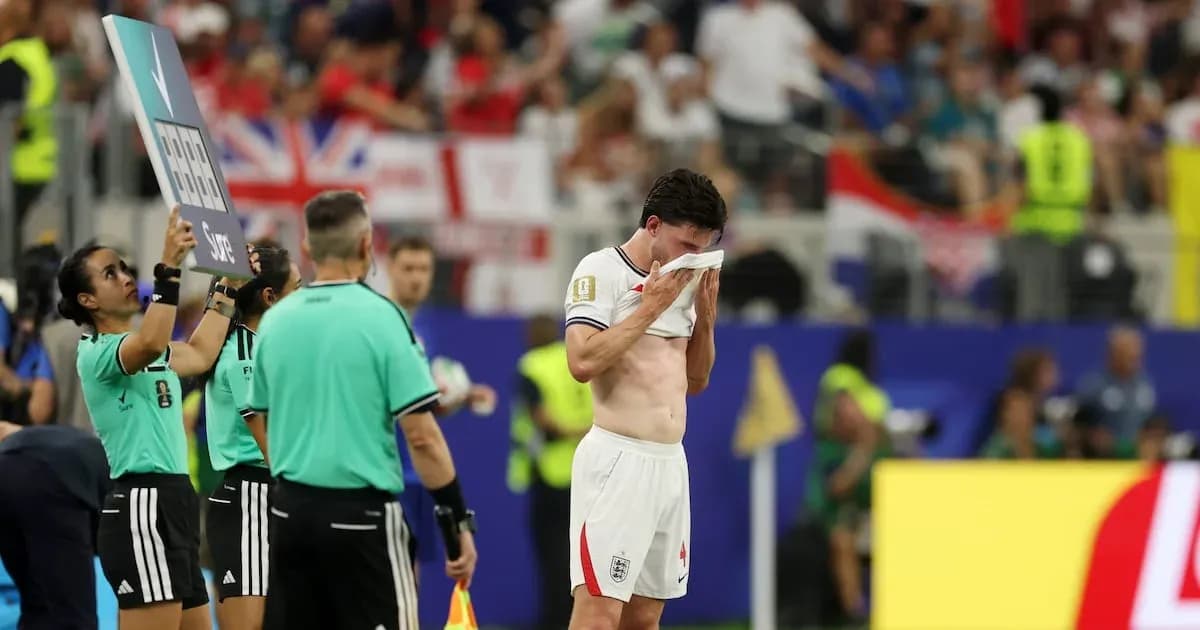
Tuchel can fix the spacing. He has time before Ghana on Tuesday to redraw the lines and recalibrate roles. What he cannot sketch away is the moment, with England clinging to a 3-2 lead in the 72nd minute, when Rice signalled to the bench and went off.
Rice does not come off in that situation. Not when England are under pressure. Not when there are crosses to head away, second balls to win, counters to kill. Yet off he came, with discomfort in his lower back and upper hamstring, and a nation holding its breath.
Tuchel insisted the change was precautionary. Rice was just as quick to say he will be available for Ghana. England, though, are walking a tightrope.
No like-for-like safety net
Strip the emotion away and the cold reality is stark: England do not have another Declan Rice.
Whenever he has been missing over the past six years, the team have almost always dipped. They lack a direct replacement in this squad. The options are talented, but none of them are Rice.
Kobbie Mainoo is a joy on the ball, smooth and brave in possession, but he does not yet have Rice’s frame, his ability to dominate duels or his threat from set pieces. Jordan Henderson brings experience and leadership, but at 36 he was not used when England wanted to keep the tempo high against Croatia. Tuchel clearly has his doubts about leaning on him in the most intense games.
When Rice went off, Tuchel’s first instinct was to pull Jude Bellingham back. It was an understandable move on paper: Bellingham has the engine, the aggression, the passing range. On the pitch, it almost cost England. The balance evaporated, Croatia poured forward and an equaliser felt inevitable.
The experiment lasted eight jittery minutes.
Only when Djed Spence came on for Bellingham and Reece James stepped inside from right back did England look like a side that could function without Rice.
Reece James, the unexpected answer
James in midfield is no longer a novelty. The Chelsea captain played there on loan at Wigan in 2018‑19 and has spent much of the past 18 months operating in the middle under Enzo Maresca. That shift, initially met with raised eyebrows, underpinned Chelsea’s resurgence and culminated in a Club World Cup win over Paris Saint‑Germain last year, with James outstanding.
Tuchel was one of the early sceptics. He worked with James at Chelsea and saw him as an elite right back, not a central midfielder. But Maresca’s insistence and James’s performances forced a rethink. Tuchel now talks about him very differently.
“Reece James can play in the 6 because he does on a high level for Chelsea,” he said when naming his World Cup squad, using that as part of his justification for leaving out Adam Wharton and Alex Scott.
James has the tools for it. He is a physical presence, reads the game quickly, tackles cleanly and passes with purpose. His display alongside Moisés Caicedo in Chelsea’s 3-0 win over Barcelona last November was a statement performance, followed five days later by a dominant showing against Rice’s Arsenal at Stamford Bridge.
Those nights made Tuchel’s calculation easier. Pick versatility. Trust it.
If Rice’s minutes need to be managed, James is the most convincing solution. Move him into midfield, let him anchor and distribute, and rebuild the back four behind him. Tuchel has cover at right back: Spence, Ezri Konsa and Jarell Quansah can all step in. One option is to tuck Konsa in as an auxiliary third centre back alongside John Stones and Marc Guéhi, freeing Nico O’Reilly to surge from left back and give England width.
On paper, it works. On grass, it has already worked for Chelsea.
The fitness gamble
But there is always a catch, and with James it is his body. His hamstrings have betrayed him too often, the most recent injury in March ruling him out for almost two months. Chelsea have had to handle him with care. England must do the same.
This is a squad already patched up. Tino Livramento’s calf injury forced Tuchel to call up Trevoh Chalobah. Several players have come into the tournament after long, draining club seasons. James is first choice at right back, yet he cannot realistically start every game. Asking him to shoulder a double load – locking down one flank and then stepping into midfield whenever Rice needs a breather – is a huge risk.
Tuchel has been worrying about fitness for months. The decision to take England to Florida early for a pre‑tournament camp in the sun was rooted in conditioning, in trying to bank energy before the real strain began.
Rice arrived late, fresh from Arsenal’s Champions League final. He pushed on, as he always does, adding more miles to legs that have already carried too much.
If England reach the World Cup final and Rice plays every possible minute without a proper rest, he will finish the season on 70 appearances. Seventy. It is a number that belongs to another era, when pitches were heavier but the game was slower, when data departments did not flash red warnings about load and soft‑tissue risk.
Now, it feels like a dare.
Tuchel must find a way to protect his vice‑captain without ripping out England’s spine. James offers one route. Mainoo offers another, more daring one. Henderson lurks as the conservative choice. None of them is perfect.
The question is no longer whether England can afford to rest Declan Rice. It is how long they can afford not to.