.svg&w=384&q=75 "GoalGist logo")
Declan Rice's Boot Switch: What It Means for His Career
Declan Rice is changing his boots. And in the world he now lives in, that means far more than just a different feel on the ball.
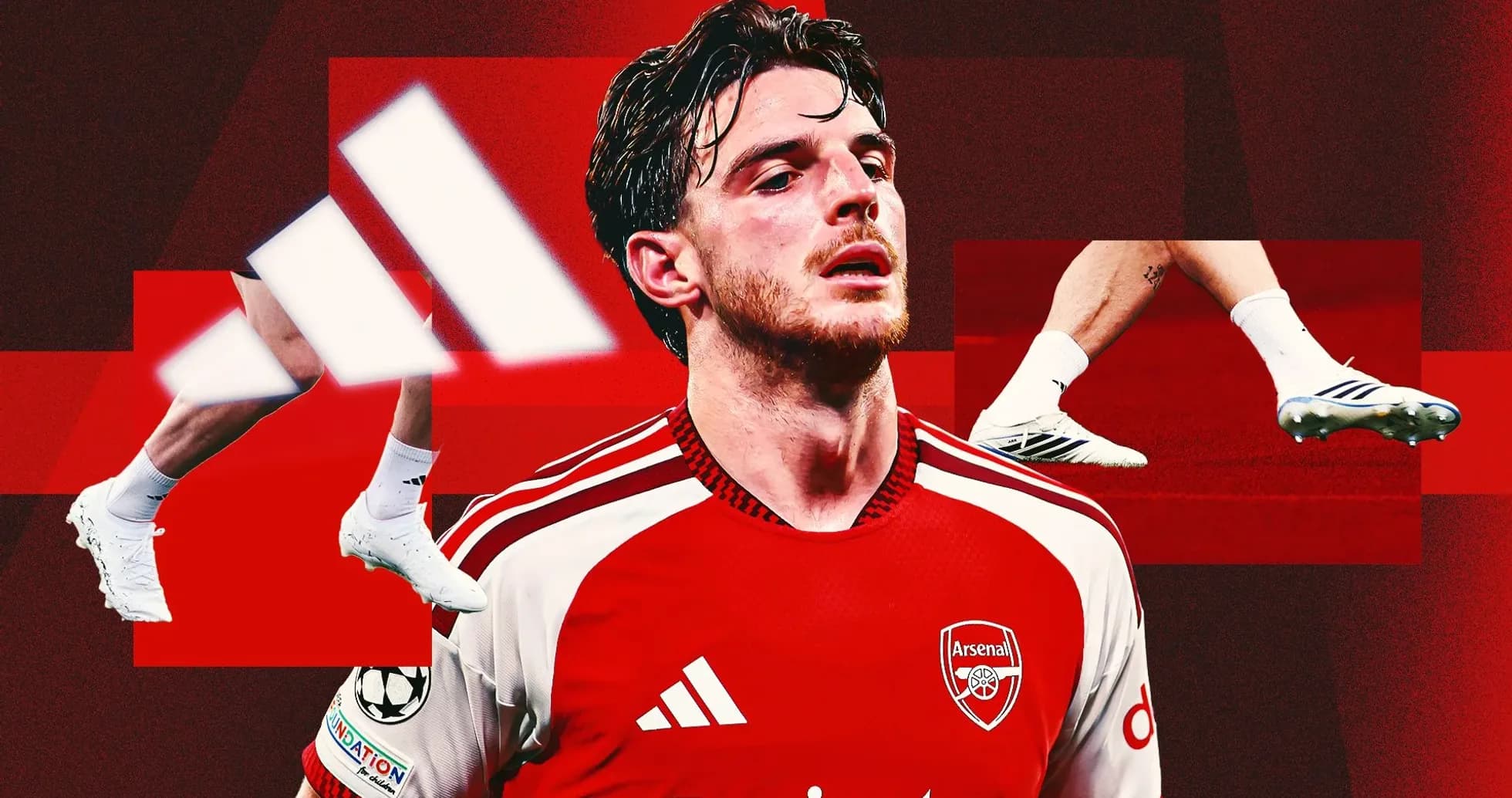
The Arsenal and England midfielder first set tongues wagging in late August when he quietly shelved his usual adidas COPA Pures in training and slipped into Nike’s new white, red and gold Tiempo Maestri. For boot obsessives, that’s a flare in the night sky. Players don’t just switch silos, let alone brands, on a whim.
Rice has been with adidas for seven years. The Three Stripes have been on his feet throughout his rise from West Ham prospect to £100 million midfielder and one of the Premier League’s dominant forces. But before that? He was a Nike man. Tiempos on his feet during his early years at West Ham, the classic control boot for a classic controller in midfield, until he signed with adidas in 2019.
So when those Tiempos reappeared at Arsenal’s training ground, it felt less like an experiment and more like a full-circle moment.
The Tiempo is Nike’s answer to the COPA: soft, comfortable, built for touch and control. If Rice wants familiarity with a twist, it fits perfectly. Yet this isn’t simply a straight shootout between Nike and adidas. Rice looks like a player doing his homework before signing the next big commercial chapter of his career.
After that first Nike sighting in August, he briefly went back to his COPA Pures. Then came the real curveball. Earlier in September, at London Colney, Rice turned up in an unbranded whiteout pair of boots. No logos. No stripes. Nothing. In matches, he’s still in adidas – almost certainly down to existing contractual obligations – but training has become a test lab.
Boot experts quickly pored over the photos. The shape, the lines, the detailing. The verdict was not Nike at all. Those mystery whiteouts are believed to be Under Armour’s new Magneto 6, a far more left-field choice than another mainstream Nike or adidas model.
Whiteouts and blackouts rarely lie. When a player hides the branding, it usually signals the endgame of a contract: deals running down, extensions not yet agreed, or a clean break already decided. Rice’s recent rotation – adidas in games, Nike and then unbranded boots in training – looks very much like a man weighing up his next move and edging away from the German giant.
What exactly has pushed him towards the exit remains unclear. After seven years, he might simply want a change. Or it might run deeper – a question of money, status, visibility.
Rice has been one of the faces of adidas’ more understated COPA line and has fronted several campaigns. But he is not one of their headline acts. On the men’s side, that space belongs to Lionel Messi, Lamine Yamal, Jude Bellingham and a handful of others. The spotlight is bright, but it does not always land on him.
The recent campaigns underline that. Rice was nowhere to be seen in adidas’ glossy five-minute World Cup short film, “Backyard Legends”, which featured Timothee Chalamet alongside Messi, Yamal, Bellingham, Ousmane Dembele, Pedri, Raphinha and Florian Wirtz. Ahead of Euro 2024, it was again Bellingham who fronted the pre-tournament push. Rice, a key England midfielder, watched that stage from the wings.
Domestically, he is a huge personality: loud, charismatic, central to everything Arsenal do. Globally, his profile hasn’t quite hit the same level as some of his peers. A new boot supplier, with Rice as a marquee name rather than a supporting act, could change that calculus.
With Nike or Under Armour, that’s exactly what he would become: one of the biggest names on their roster overnight. That kind of status can shape a deal – more marketing weight, more campaigns, more input, more money.
There is also another angle. The decision to move on is not always driven by the player. Brands can walk away too. If adidas feel Rice does not deliver enough commercial return, they may have chosen not to renew on previous terms. Standard practice is that a player is informed in the final year that an extension will not be offered, and funding and promotion often start to taper off once that call is made. His absence from recent campaigns would fit that pattern.
This is not new territory in the post-Covid landscape. Nike, for example, cut ties with several elite footballers as they streamlined their focus on their biggest commercial assets: Cristiano Ronaldo, Kylian Mbappe, Marcus Rashford and a select few others.
At the same time, some top players have started to push back. Sources have spoken of footballers who feel they “require more attention and promotion than they have sometimes received from the largest brands”. Given Rice’s standing on the pitch and his relatively modest marketing spotlight, that description would not be hard to apply to his situation.
Money sits underneath it all. At the top end, boot deals can be worth the equivalent of 10-15% of a player’s club salary. For someone in Rice’s bracket, that is a major revenue stream. If Nike, Under Armour or another brand offers better terms – more cash, more bonuses, more creative control – it would be no surprise if his head is turned.
There is also a broader shift in how players see themselves. The modern elite doesn’t just want a cheque; they want autonomy and a say in how their image is built.
Vinicius Junior made that point brutally clear in 2022 when he blacked out his Nike boots in a very public show of displeasure over fresh terms after his contract expired. At the time, a source said he wanted a partner “willing to invest in his brand through campaigns and activation worldwide”. Nike eventually paid up.
Mbappe’s situation takes that trend to another level. Despite being the new face of Nike Football with Ronaldo in the twilight of his career, he has been linked with a sensational switch to an “unknown” disruptor, widely rumoured to be Swiss running specialists ON. The reported package? A stake in the company, influence over product strategy, and the chance to co-design his own signature line.
Below that superstar tier, others are making similar, if slightly smaller, moves. PUMA, Under Armour, New Balance and Mizuno have all built impressive rosters by prising talent away from Nike and adidas. Neymar, Kai Havertz, Bukayo Saka, Eberechi Eze and Ibrahima Konate are among those to have jumped ship in recent years, often for more prominent roles and highly lucrative terms.
Some players have gone even further and stepped outside the system entirely. Michael Olise at Bayern Munich famously has no boot deal at all. Hector Bellerin once simply bought his own online. For them, freedom outweighs the cheque.
Rice is unlikely to follow that route, given his profile and earning power, but the principle is the same: control, visibility, value.
And yet, an adidas renewal cannot be dismissed. This dance is familiar. Players often test the market, black out their boots or trial other models before circling back to their original supplier on improved terms. Erling Haaland did it. Vinicius Junior did it. It would not be a shock if Rice did too.
For now, though, his feet are telling the story. COPAs in matches. Tiempos, then whiteout Magneto 6s, in training. A carousel of boots that signals one thing: the next contract is in play.
Declan Rice is keeping everyone guessing. The brands are circling. The cameras are zooming in on his laces. The only question left is whose logo he’ll be carrying into the heart of midfield when the ink finally dries.