.svg&w=384&q=75 "GoalGist logo")
Cristiano Ronaldo's World Cup Struggles: A Harsh Reality for Portugal
Cristiano Ronaldo walked out in Houston as captain, 41 years old, a record sixth World Cup on his shoulders and the usual spotlight fixed squarely on him. The night before, the new era had already made its statement: Kylian Mbappé scored twice, Erling Haaland found the net, Lionel Messi helped himself to a hat-trick.
Ronaldo’s answer?
Twenty-nine touches.
One shot.
No goals.
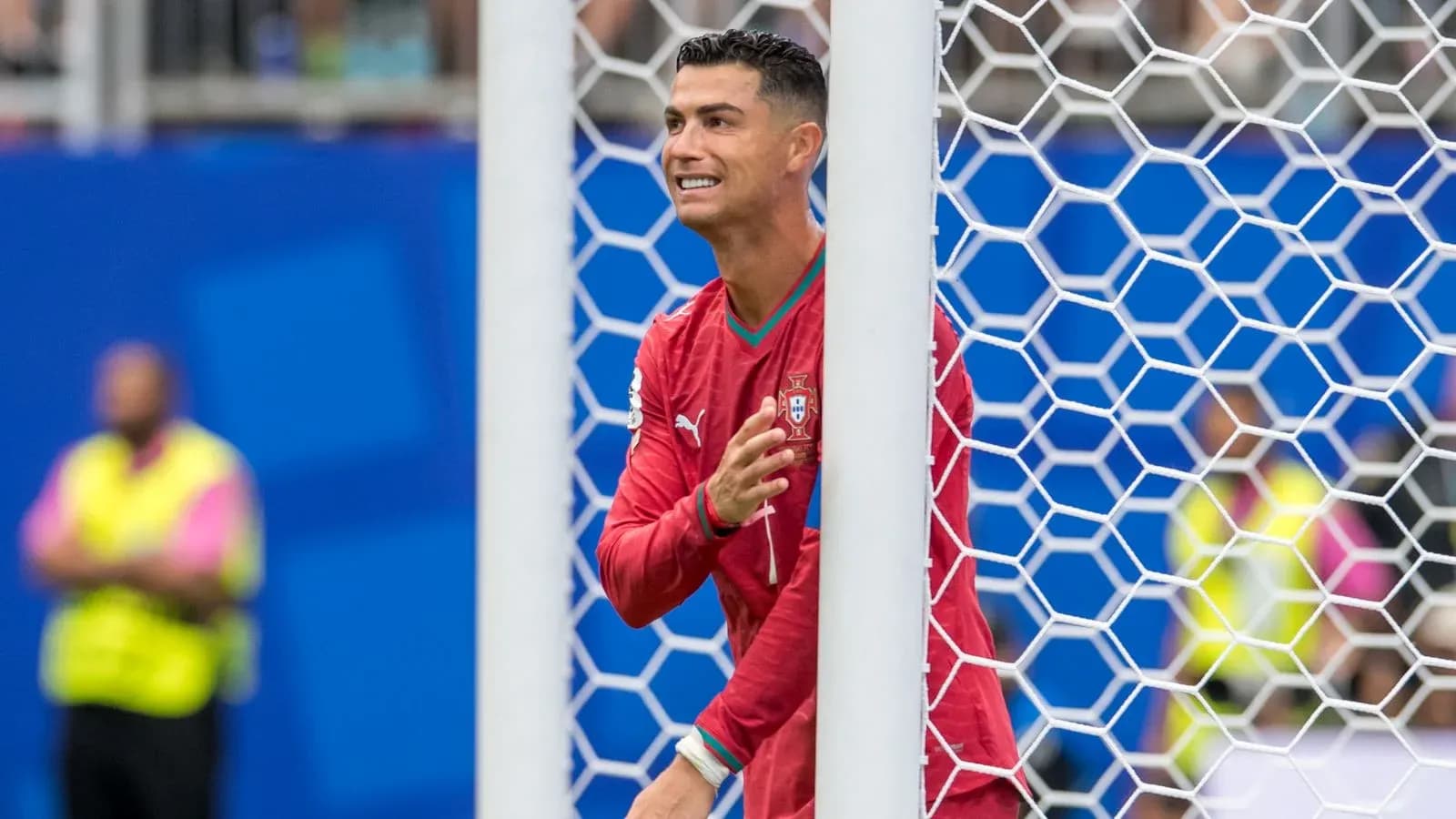
A scowl that said plenty as Portugal laboured to a drab draw with DR Congo.
Again, he was the story. Not for another miracle, but for a barren run that now stretches to 10 games without a goal in major international tournaments. Messi, over his last 10, has nine.
For a decade and a half, the conversation around Portugal started with Ronaldo. Now, it’s starting to sound like it should be about him.
The Numbers Don’t Lie Anymore
Strip away the nostalgia and you’re left with data that paints a harsh picture.
Against DR Congo, only Bernardo Silva – taken off at half-time – had fewer touches than Ronaldo in Portugal’s starting XI. His touch map was a study in isolation: small clusters on the left, often occupying spaces where Pedro Neto and Nuno Mendes should have been attacking, rarely in zones that stretched or disrupted the defence.
This is not the all-action forward of old. It’s a specialist, waiting for moments that no longer arrive as often, and when they do, not being finished with his old certainty.
Roberto Martinez isn’t having the criticism. He moved quickly to protect his captain.
"It makes no sense to get the best goalscorer in world football out in a game that you need goals," he said. For Martinez, Ronaldo’s value lies in his presence: the way he occupies defenders, the gravity he exerts in the box, the space he supposedly frees for others. "When you look for goals, you need to have Cristiano."
On paper, that argument has support. Behind Ronaldo, Martinez can call on Bernardo Silva, Bruno Fernandes, Pedro Neto, Vitinha, João Neves, João Cancelo, Nuno Mendes – a creative armada, many of them among the best in the world at what they do.
So if the chances aren’t flowing, is it really on Ronaldo? Or are his team-mates failing him?
Is the Service Letting Ronaldo Down?
Look across to his peers and the picture gets more nuanced.
Over each of their last 10 competitive international matches, Ronaldo, Messi, Mbappé and Harry Kane have all carried the attacking burden for their nations. In that stretch, only Kane has taken fewer shots than Ronaldo’s 30. On volume alone, he’s still getting into some positions.
The quality of those chances, though, tells another story.
Ronaldo’s expected goals (xG) over those 10 games sits at 5.36. Kane’s is 7.15. Mbappé’s is 8.76. Messi’s detailed xG data isn’t available in this comparison, but the gap to the other two is already clear. The calibre of opportunities Ronaldo is seeing simply doesn’t match what Kane and Mbappé are being fed.
Zoom out to the team level and the contrast sharpens. While Ronaldo has been on the pitch across those 10 matches, Portugal have generated a combined xG of 12.76. England, with Kane, created 16.39. France, with Mbappé, an imposing 21.99.
Per 90 minutes, that works out to 1.32 for Portugal, 1.34 for England, and a hefty 1.72 for France. Portugal are not a barren side, but they’re not creating at the same clip as the very best.
Look even closer at the source of Ronaldo’s chances. His xG from team-mate-assisted shots during this goalless spell is just 2.55. Kane’s is 3.2. Mbappé’s explodes to 5.78.
For a player surrounded by such a gifted cast, that’s a striking number. It suggests that, yes, he is feeding off thinner scraps than his rivals. The ball isn’t being laid on for him in the same volume or quality.
So Martinez has a point. But only up to a point.
When the Finishing Edge Goes
Because the story doesn’t end with supply. It turns, brutally, on what Ronaldo does with what he gets.
Bruno Fernandes, Bernardo Silva, João Neves and the rest could fairly argue they have still created enough for their No 7 to have changed the narrative. One or two clinical finishes, and we’re not talking about droughts and dilemmas. We’re talking about longevity and legend.
Instead, the numbers show a finisher in decline.
Post-shot xG – which measures the quality of the effort after it leaves the boot – is damning. Kane and Mbappé are outperforming expectation here. Kane’s post-shot xG overperformance stands at 2.05, Mbappé’s at 2.25. They’re scoring more than the underlying chances suggest they should.
Ronaldo? He’s at -2.8. Nearly three goals fewer than expected given the shots he’s taken.
For a man once regarded as the most ruthless poacher in the game, that’s a stark reversal. The instincts are still there, the movement still occasionally sharp, but the final touch isn’t what it was. The shots that used to fly into corners are now within reach of goalkeepers or drifting the wrong side of the post.
And unlike Messi, Kane or Mbappé, Ronaldo offers little outside those finishing moments. He doesn’t drop into midfield to knit play, he doesn’t regularly pull wide to create overloads and then drive the game from deeper zones. His heatmap against DR Congo showed a narrow, predictable footprint, often stepping on the toes of his own left-sided players rather than opening the pitch.
In short, when the goals dry up, there’s not much else to fall back on.
Martinez’s Gamble with a Golden Generation
This is where the conversation becomes uncomfortable for Portugal.
Martinez cannot and will not rip up his entire creative structure to suit one man, however iconic. Yet he also shows no sign of taking that man out of the firing line. His faith in Ronaldo’s aura, his belief in the power of his presence, remains absolute.
The consequence is a tactical compromise. The attack bends around a 41-year-old striker who no longer presses, no longer roams, and no longer finishes at an elite rate. The team narrows to feed him, even as the data screams that the return on that investment is shrinking.
And this is not a transitional Portugal side looking for an identity. This is a squad packed with peak-age talent, arguably a golden generation in its own right. Fernandes dictating from midfield. Bernardo drifting into half-spaces. Vitinha and João Neves offering control and energy. Cancelo and Mendes flying from full-back. Neto stretching defences.
All of them, in theory, built to play a modern, fluid, high-tempo game. All of them, in practice, adjusting to accommodate a centre-forward whose game has barely changed while his body has.
The question is no longer whether Cristiano Ronaldo deserves respect for what he has done. That’s beyond debate. The question is whether Portugal can keep shaping their future around a version of him that belongs to the past.
Martinez has nailed his colours to the mast. He believes that when the next big moment comes, Ronaldo will still be there, still decisive, still the man for the box.
If he’s wrong, this generation may not just be remembered for what they won, but for what they never quite dared to change.

