.svg&w=384&q=75 "GoalGist logo")
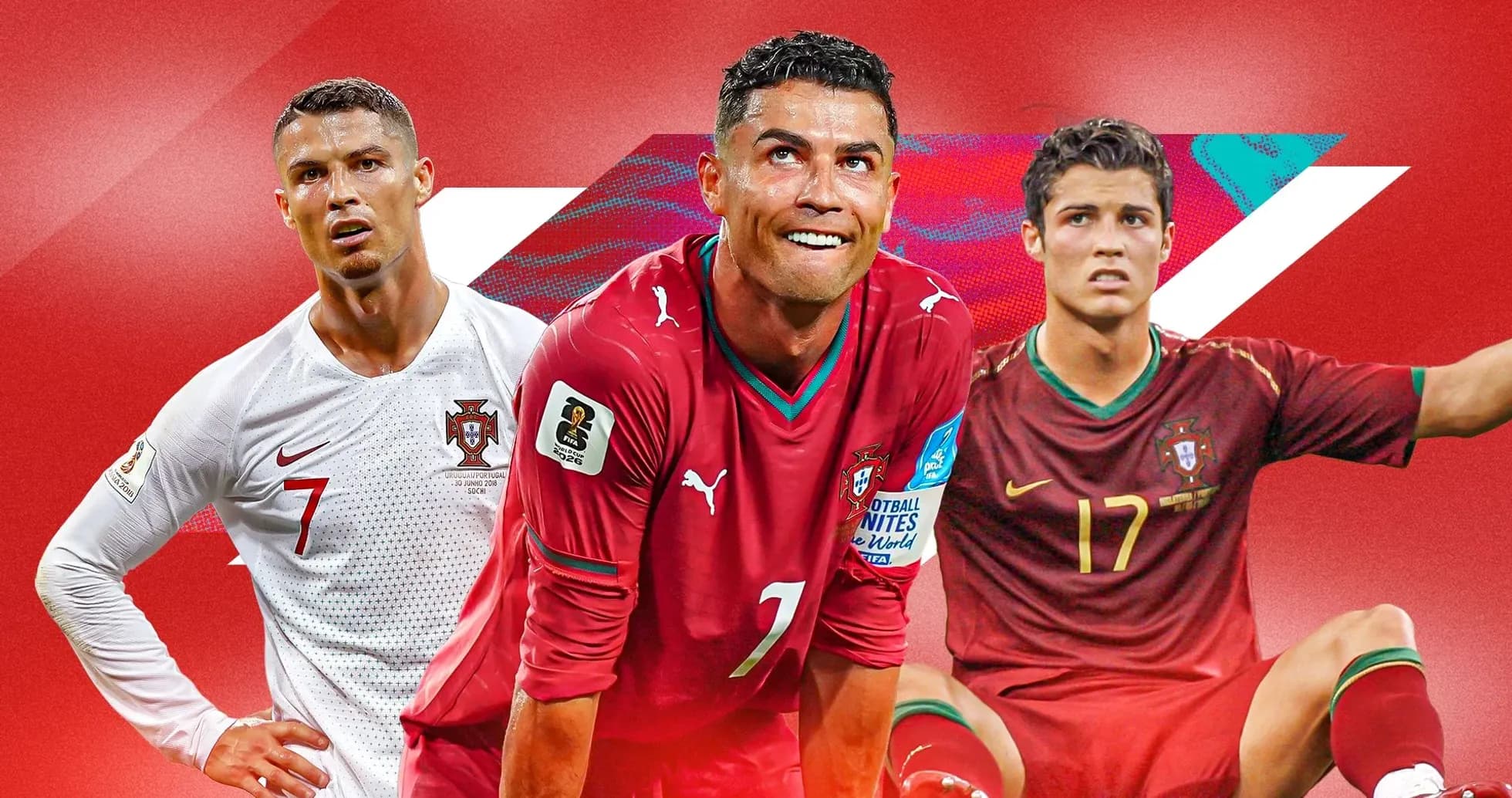
Cristiano Ronaldo's World Cup Journey: Brilliance and Controversy
Cristiano Ronaldo’s World Cup story has always been a collision of brilliance, controversy and unfinished business. Six tournaments in, one truth still hangs over him: for all the goals, for all the noise, the knockout stages remain his great unsolved riddle.
The boy who scored – and was booed
It began in 2006, in Germany, with a penalty against Iran. Ronaldo was 21, a whirring winger rather than the penalty-box predator he would become, and that spot-kick made him Portugal’s youngest-ever scorer at a World Cup. It was his only goal of the tournament, but nobody was demanding more. Not yet.
The real storm came later.
Portugal reached the semi-finals, Ronaldo played four knockout games without scoring, and that might have been a footnote. Instead, his role in Wayne Rooney’s red card against England in the quarter-finals turned him into the villain of a global soap opera.
Every touch in the semi-final against France drew a wall of boos. English anger crackled far beyond the stadiums. Steven Gerrard accused him of being “bang out of order” for his reaction to Rooney’s dismissal. Frank Lampard said it “wasn’t nice” to see a Manchester United team-mate behave that way. The wink towards the Portugal bench became a symbol, fair or not, of a ruthless streak many felt crossed the line.
Ronaldo insisted he had done nothing wrong. FIFA’s technical study group took a different view. In the name of sportsmanship, they handed the young player of the tournament award to Lukas Podolski instead. Holger Osieck, head of the group, admitted they had been critical of Ronaldo’s behaviour. Talent alone, even then, was not enough.
Captaincy, frustration and the weight of the shirt
By 2010, Ronaldo had the armband and the burden that came with it. Portugal’s campaign in South Africa never caught fire. He scored once – the sixth goal in a 7-0 demolition of North Korea – his first international strike in 16 months. For a player of his standards, that drought felt jarring.
Spain knocked Portugal out 1-0 in the last 16. Ronaldo walked off carrying more than just disappointment.
“I feel completely disconsolate, frustrated and an unimaginable sadness,” he said. The words matched the pictures: a captain drained.
Then came the flashpoint. Asked to explain the defeat, he was caught on camera saying, “How can I explain this? Ask that question of Carlos Queiroz.” In Portugal, that line landed heavily. It sounded like blame.
Ronaldo later clarified that he meant only that Queiroz was holding a press conference and was better placed to analyse the game. He spoke of being human, of suffering, of accepting his responsibilities as captain. Queiroz’s response cut through the noise: he would never tolerate anyone placing himself above the national team.
“Portugal needs Ronaldo, and Ronaldo needs the national side,” the coach said. “But if this shirt unnerves some players, they have no grounds to be there.”
The message was clear. The shirt comes first.
Brazil 2014: the body betrays the superstar
Four years on, Ronaldo dragged Portugal to the 2014 World Cup almost single-handedly, scoring all four of their goals in a gripping play-off against Sweden. He arrived in Brazil insisting he was “100 percent fit” despite knee and thigh concerns. The evidence on the pitch told another story.
Germany ripped Portugal apart 4-0 in their opening game. Ronaldo drifted through it, a muted figure. He created a late equaliser for Silvestre Varela in a 2-2 draw with the United States and scored an 80th-minute winner against Ghana, but the Seleccao still finished third in Group G and went home early.
The criticism was inevitable. He had chances he would normally bury and didn’t. Yet Paulo Bento refused to let the spotlight narrow onto one man.
“I don’t think it’s fair to make things individual,” the coach said. He took responsibility himself and stressed that the team had made “a set of mistakes” across three games. Ronaldo, he insisted, would not be made the scapegoat.
The numbers were modest. The scrutiny was not.
Russia 2018: a hat-trick and another dead end
In 2018, in Russia, Ronaldo exploded out of the blocks. A hat-trick in a wild 3-3 draw with Spain, capped by his first free-kick goal at a major tournament, looked like the opening chapter of a defining World Cup.
He spoke afterwards with the authority of a man who believed this might finally be his stage.
“It is a personal best, one more in my career,” he said, before quickly turning to the team. Portugal had gone toe-to-toe with one of the favourites. They had led twice. They had earned their point. “The team is doing very well and we are going to do well for sure.”
They didn’t.
Ronaldo led them out of the group, but when the tournament tilted into the knockout rounds, the familiar pattern returned. No goals. No assists. A 2-1 defeat to Uruguay in Sochi, and another World Cup ended without him deciding a game when it mattered most.
At 33, the question came naturally: was this the end of his World Cup story?
He refused to be drawn. “It is not the right time to talk about it,” he told FIFA, but he backed the future of the national team – a “fantastic group” with “big ambition to triumph”. He left his own next step hanging in the air.
Qatar 2022: the fall, the fury and the tears
By the time Qatar 2022 arrived, Ronaldo’s club career had lurched into chaos. His second spell at Manchester United had ended in acrimony. He flew into the World Cup with a familiar sense of mission: silence the critics, chase the one trophy that had always eluded him.
Instead, the tournament became another chapter in a turbulent late career.
He scored from the spot in the opening win over Ghana. That was it. As the games grew tougher, the goals dried up and the frustrations boiled over. His reaction to being substituted in the shock defeat to South Korea was furious. Fernando Santos, long seen as an ally, had seen enough.
Ronaldo was dropped for the last-16 tie against Switzerland. His replacement, Goncalo Ramos, scored a hat-trick in a 6-1 win that felt like a changing of the guard. Reports emerged that Ronaldo had threatened to leave the camp. His image, already bruised, took more hits.
He denied any suggestion of betrayal in a social media post after the quarter-final loss to Morocco. “My dedication to Portugal has never wavered for an instant,” he wrote. He insisted he was always “just one more player” fighting for the same goal, that he would never turn his back on team-mates or country.
“For now,” he added, “there’s not much more to say. Thank you, Portugal. Thank you, Qatar... Now, we have to let time be a good adviser and allow everyone to draw their own conclusions.”
The conclusion most people drew was stark. At 37, with just one penalty goal in the tournament, benched in the knockouts and walking down the tunnel in tears after Morocco, many believed the World Cup had finally slipped beyond him.
On Instagram, he sounded like a man saying goodbye to a dream.
“To win a World Cup for Portugal was the biggest and most ambitious dream of my career,” he wrote. Over five tournaments and 16 years, he said, he had given everything, never shrunk from a battle, never stopped chasing that dream. “Unfortunately, that dream ended yesterday.”
“I’m back!” – but how far can he go?
And yet, here he is again.
After Portugal’s 5-0 win over Uzbekistan, the final whistle had barely blown when Ronaldo turned to a nearby camera and yelled, “I’m back! I’m back!” It was classic Ronaldo: defiant, theatrical, a message to those who had written him off.
Not everyone bought it.
He had struggled in the opening draw with DR Congo. Uzbekistan, ranked 60th in the world, were hardly a benchmark. He scored twice, but caution felt wise. Then came Colombia in Miami, a sterner test. Ronaldo laboured again, and Portugal were held 0-0, surrendering top spot in Group K.
Now comes Croatia. Luka Modric still pulls the strings, even as his own career edges towards its final act. This is a team past its peak, but still capable of punishing any lapse. Dangerous, in a different way to the heavyweights of old, but dangerous all the same.
The same description fits Ronaldo.
At 41, he has already proved he can still find the net at a World Cup. The instincts remain. The movement, in bursts, still unsettles defenders. The name alone changes the temperature of a stadium.
Yet one line on his record refuses to move. Across all these tournaments, all these storylines, he has never scored in a World Cup knockout game.
That is the gap he has to close. Not for his legacy – that is already immense – but for himself.
Croatia await. The stage is set again. After everything, after the boos, the winks, the tears, the posts, the proclamations, one question lingers over the greatest goalscorer of his generation.
Can Cristiano Ronaldo finally bend a World Cup knockout tie to his will?

