.svg&w=384&q=75 "GoalGist logo")
Cristiano Ronaldo's World Cup Exit: A Legend's Final Bow
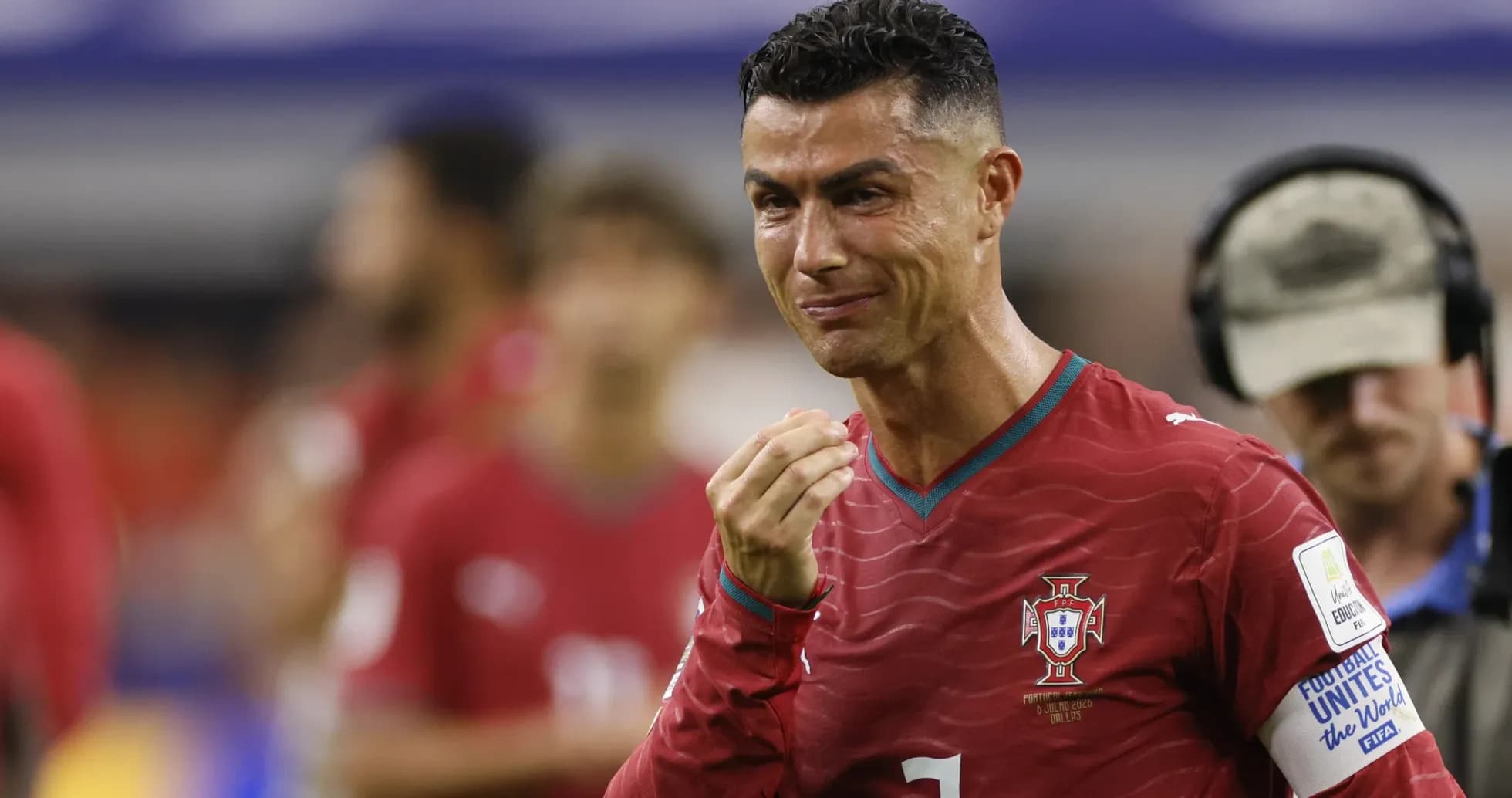
Cristiano Ronaldo walked off alone, head bowed, into the bowels of the Dallas Cowboys’ stadium. No lap of honour, no grand farewell, no Hollywood ending. Just a 41-year-old legend fighting back tears after Spain slammed the door on his final World Cup with a 1-0 win in the last 16.
The dream is over. The World Cup will be the one gap that never closes in his glittering career.
He spoke quietly afterwards, his voice barely rising above the weight of the moment. "That's football, that's the life of a footballer. Sometimes you win, sometimes you lose, and you have to move on."
He said he would now step away and think about what comes next. The decision, like the night, felt heavy.
A Giant Without the One Prize
Ronaldo has lived almost every footballer’s fantasy. League titles in multiple countries. Champions League crowns stacked across eras. Five Ballon d’Ors. A European Championship with Portugal in 2016, the trophy he still holds close to his heart.
"The truth is, the biggest title I won with the national team was in 2016, which for me is just as significant as a World Cup, honestly," he said. It was the one note of contentment on a night otherwise framed by regret.
Yet the World Cup has always been the stage where his legend never quite matched his club dominance. His best run will forever be the semifinals two decades ago, back in 2026. Since then, it has been a story of near-misses, frustration, and this final, subdued exit in Texas.
A Shadow of the Old Fear
This match against Spain underlined the harsh truth. Ronaldo is no longer the whirlwind who once terrified defenders. He is now a fixed point, a penalty-box presence, a classic No 9 stripped of the explosive pace that used to separate him from everyone else.
He had three attempts at goal. None truly carried the inevitability that once followed every swing of his right foot. He drifted on the fringes of the game, a peripheral figure at the centre of an attack that never really sparked.
At one point he flung his arms in the air as a teammate’s pass went astray, a familiar gesture of frustration, but this time it felt tinged with resignation rather than rage.
No assists in the tournament. Three goals – two in the 5-0 demolition of Uzbekistan, one from the penalty spot against Croatia in the last 32 – were not enough to drag Portugal deeper into the competition or to reshape the narrative of his final World Cup.
The Billionaire From Madeira
The scale of the journey remains staggering. From a tough childhood on Madeira, with an alcoholic father and few comforts, to becoming football’s first billionaire. From a skinny winger at Sporting Lisbon to a global icon at Manchester United, Real Madrid, Juventus, back to United, and now the face of Al Nassr and Saudi Arabia’s push for footballing relevance.
His obsession with records, his relentless training, his refusal to accept the normal limits of age kept him at the top into his 40s. Off the pitch, 671 million Instagram followers and a "Siuuu!" celebration copied on playgrounds across continents tell their own story of cultural reach.
But none of that could bend the World Cup to his will.
A Career Stretched to Its Limits
In recent years, the debate around Ronaldo has grown louder. As his pace ebbed and his dribbling threat dulled, he shifted from the flanks into the box, rebranding himself as a pure finisher. The goals kept coming, but the arguments did too.
Had his international career been stretched too far? Was his presence still an asset, or a burden that Portugal could not quite escape?
Ronaldo and coach Roberto Martinez have both faced accusations of clinging on too long. In Texas, the pattern held. Martinez threw on two double substitutions late in the game as Portugal chased an equaliser, but Ronaldo stayed on, the immovable star in a team increasingly built around his legacy rather than his output.
On the eve of the match, he tried to strip away the mythology. "I am not going to be more Cristiano Ronaldo or less because I win the World Cup," he insisted.
That line now hangs over his exit. The World Cup will not define him. It never could, not with the mountain of medals and records already in his name. Yet as he trudged off into the Texas night, alone, it was impossible to ignore the emptiness of the one space in his trophy cabinet that will never be filled.
He says he leaves the World Cup stage "with a clear conscience." The question now is not what he has left behind, but how much more he believes he still has to give.