.svg&w=384&q=75 "GoalGist logo")
Cristiano Ronaldo: Facing Age and Legacy at His Last World Cup
Cristiano Ronaldo sat back, listened to the question and did what he has done his whole career: went straight at it.
"I am not the player I used to be."
No dodging, no softening the blow. On the eve of Portugal’s World Cup last-16 tie against Spain in Texas, the 41-year-old captain met the conversation that has been circling him all tournament – age, decline, legacy – and dragged it into the middle of the room.
This is his last World Cup. He confirmed it again. Seven months from turning 42, the end of his time as Portugal’s captain, standard-bearer and obsession is no longer a distant concept. It is here, staring him in the face at a knockout game in the United States.
And still, he fights.
"You have been trying to kill me for the past 23 years," he told reporters on Sunday, as cameras snapped and the room leaned in. "But you must have seen that is not worth it, it's a waste of time, but you try and try and try and try and try.
"As I said before, [I will stop] when I choose, not when you choose. You always ask the same question.
"This will be my last World Cup, but let's hope tomorrow isn't my last game."
A legend under the microscope
Ronaldo’s World Cup has split opinion. Three goals on the board, yet long spells where he has floated on the fringes of matches. He is still the all-time leading scorer in international football with 146 goals. He has scored at all six World Cups he has played in. But the numbers inside this tournament tell a different story.
He has taken 15 shots – almost double that of any of his team-mates – yet has not created a single chance. No other player at this World Cup has shot so often without carving out an opportunity for someone else.
Touches? In three of Portugal’s four games, Ronaldo has finished with fewer than 25, one of those appearances from the bench. These are the lowest figures of his World Cup career. He is averaging fewer touches per match than at any of his previous five tournaments.
Against Croatia in Toronto, in that wild, draining last-32 tie, his only touch inside the opposition box was the winning penalty.
His movement tells its own tale. He is averaging just 4.4 runs in behind the defence per match, a sharp drop from the previous two World Cups, when he led the line as a lone striker and constantly threatened the space behind.
He knows the criticism. He hears it. He even leans into it.
"I am not going to be more Cristiano Ronaldo or less because I win the World Cup," he said. "I even say thanks for the attacks I feel after I turned 40... the criticism is how you grow, so thank you for doing this.
"Whatever happens tomorrow, Cristiano Ronaldo will leave with a clear conscience -- not 100% but 1,000% because in life and football I gave everything."
He was applauded out of the press conference. Respect, even from those who question his place in the team, is non-negotiable.
The ‘last dance’ that nearly ended
Ronaldo’s sister had called this World Cup his "last dance". For a few minutes in Toronto, it looked like the music might stop early.
When Ivan Perisic put Croatia ahead in the 53rd minute, Ronaldo’s 232nd appearance for Portugal suddenly felt like it might be his last. The stadium tightened. The cameras hunted for his reaction.
He responded the way he has built his legend: from 12 yards, with pressure thick in the air. His equaliser from the penalty spot was his first goal in the knockout stages of a World Cup, a strange quirk for a man whose career has been defined by big nights and bigger goals.
Then came Roberto Martinez’s decision.
With the game in the balance, the head coach took off the national icon. Ronaldo walked off unhappy, face set, the competitor inside him raging against the call. On came Goncalo Ramos, widely seen as his natural heir.
The risk paid off. Ramos delivered the decisive blow in a chaotic finish and Portugal went through. The debate exploded.
Should Ronaldo start against Spain in Texas? Or has the moment finally arrived for Ramos to take the stage from the first whistle?
Martinez has nailed his colours to the mast so far.
"His leadership and that work in the final third is still one of the best in the world," the coach said when asked why he keeps starting Ronaldo.
Since taking over in 2023, Martinez has used Ronaldo in 36 of Portugal’s 44 games, with most absences down to injury or suspension. The team’s two biggest wins of the cycle, though, came without him: a 9-0 demolition of Luxembourg in Faro and a 9-1 thrashing of Armenia in Porto.
Each time, the same question resurfaced: are Portugal a better team without their captain?
Hero, burden, or both?
The argument is not just tactical. It is emotional, generational, almost existential for Portuguese football.
Ronaldo has not simply scored goals. He has reshaped the country’s footballing identity. From the moment he emerged, Portugal stopped seeing themselves as plucky outsiders and started behaving like a nation that belonged among the elite.
"He doesn't play to win, he plays to be the main figure," said Antonio Simoes, a member of the Portugal side that finished third at the 1966 World Cup. "Do you understand that it's the opposite of Eusebio? Let's call things by their name. I have nothing against him. I can still see, I can still hear and I can still think. But I can't run away from the reality of the facts."
The reality is layered.
Ronaldo has scored at every World Cup he has attended. A penalty against Iran in 2006. A goal against North Korea in Cape Town in 2010. His lone strike in 2014, against Ghana in Brasilia. The unforgettable hat-trick against Spain in Sochi in 2018, then the winner against Morocco in Moscow five days later. A penalty against Ghana in Qatar in 2022. Two more in a 5-0 win over Uzbekistan in Houston on 23 June. Then the spot-kick against Croatia.
He keeps finding the net. Yet the team around him has evolved, faster and more fluid when he is not there, some argue. Younger legs, sharper pressing, more movement.
And still, for many, he has earned the right to choose his exit.
"I feel he should dictate whether he wants to stay on or not," said supporter Angelo before the Croatia match. "What he has done for Portugal as a nation, he should dictate that 100%."
Global icon. National treasure. Tactical dilemma.
A country that still belongs to Ronaldo
If there were any doubts that Ronaldo-mania might be fading, they have been crushed by this World Cup’s North American leg.
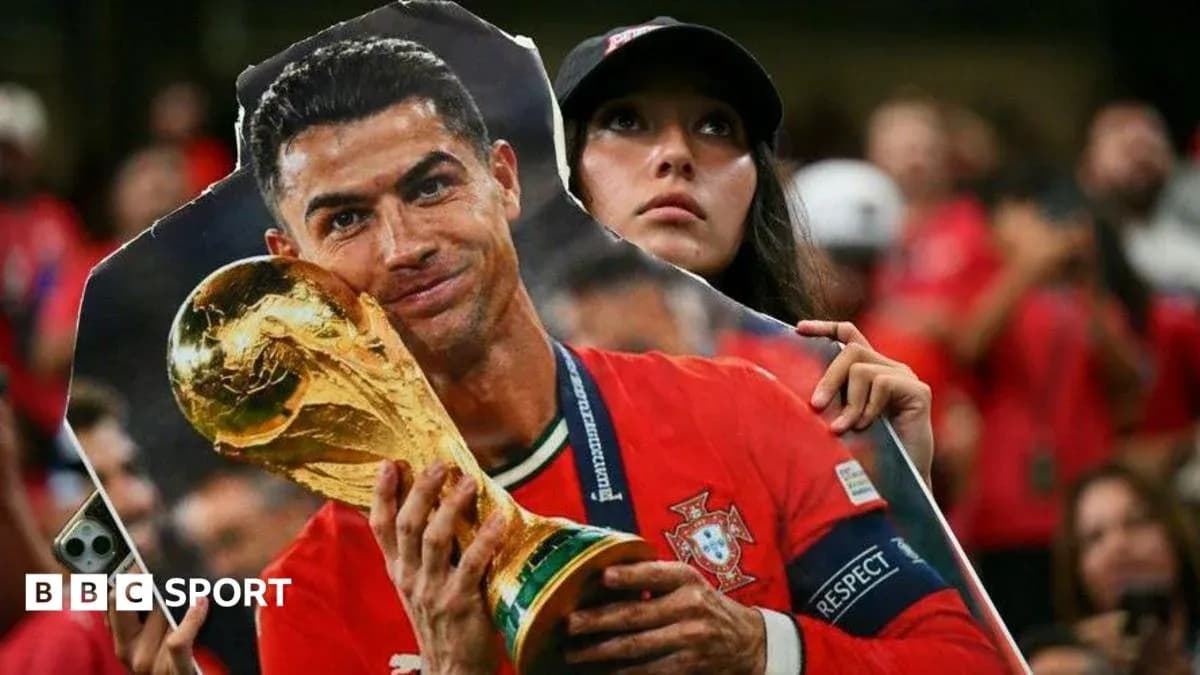
In Toronto, it was genuinely rarer to spot a Portugal shirt without his name on the back. Streets around the stadium turned into a moving tribute to No. 7. Before the Croatia game, excitement spilled onto the roads, with fans briefly bringing one of the city’s main highways to a standstill just to try to catch a glimpse of him.
Even those who do not live and breathe the sport have been swept up.
My taxi driver from the airport to the hotel was not a football fan. But he knew Ronaldo was in town.
"The local TV and radio have been going nuts about him for days," he said. "He must be special."
One local supporter said she had spent an entire month’s wages on a ticket, just to see him play at a World Cup with her own eyes.
Among Portugal’s fans, the sense of gratitude is overwhelming.
"On the world stage we didn't really have anyone after Eusebio," said Joao. "Ronaldo came in and made us dream."
Lucilia put it in blunt, political terms.
"People talk about Portugal because of him. He doesn't forget where he's from, he remembers the people. I love him. Ronaldo means more to Portugal than any politician."
Diana is already steeling herself for the day he finally walks away from the national team.
"Of course I'm going to be sad," she said. "The whole world will be sad because it doesn't matter who you support. Ronaldo has had a wonderful career and been an exemplary player.
"I would say to him: 'Well done, Cristiano. Enjoy your retirement. You deserve it after entertaining the world.'
Spain, Texas, and the next decision
Now comes Spain, and with it a choice that will define not only this World Cup for Portugal, but the closing chapter of one of football’s greatest careers.
Start Ronaldo, and Martinez leans again on experience, on a man who has made a habit of bending nights like this to his will. Turn to Ramos, and he signals a new direction, trusting youth and mobility against a Spanish side that can suffocate opponents if given the chance.
There is no hiding place. Not for the coach. Not for the captain.
Ronaldo insists he will walk away with his conscience "1,000%" clear, whatever happens. He has given everything, he says. The numbers, the trophies, the memories scattered across Europe and now North America, all stand as evidence.
But World Cups are unforgiving. They care little for what came before.
On Monday night in Texas, with the lights up and Spain on the other side of the halfway line, the question hangs over the tunnel.
Is this another chapter in Cristiano Ronaldo’s World Cup story – or the final page?