.svg&w=384&q=75 "GoalGist logo")
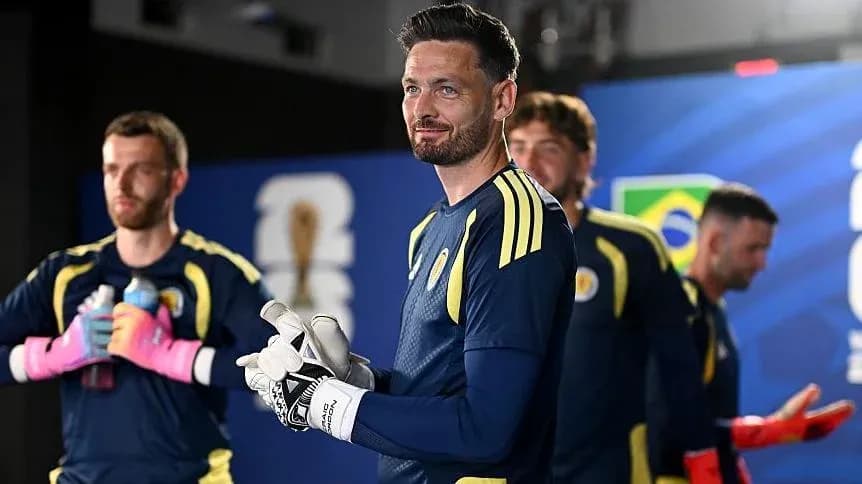
Craig Gordon's Scotland Farewell: An Incredible Comeback
By the time Craig Gordon announced his retirement on Thursday, the headlines had already been written in the minds of most Scotland supporters. World Cup on the horizon, a final chapter in dark blue, and the end of a career that has refused, time and again, to accept its own limits.
For Rory Loy, the story runs even deeper than admiration from afar. It runs through the same hospital corridors.
The former striker knows exactly what Gordon dragged himself back from. The same injury. The same brutal snap.
“I did the same thing,” Loy said on the BBC’s Scottish Football Podcast, recalling his own double leg break. “But I did it when I was 20, 23.” Gordon’s came at 39.
That difference matters. At 23, you still feel bulletproof. The body heals quicker, the mind is wired for the climb, not the descent. You tell yourself there is time, that this is a detour, not the end.
At 39, the picture is harsher. A double leg break at that age is often a full stop, not a comma.
Loy did not sugar-coat it. The shin bone “just snaps basically,” he said. Then the real work begins. The healing. The endless rehab. The doubts that creep in when the cameras are gone and the room is quiet.
It is not just about the bone knitting back together. It is about everything that follows.
“Your whole biomechanics, the way you walk, the way you move, the way you do everything, it just changes,” Loy explained. He needed orthotics in his shoes just to adapt to the new way his body moved. Every step a reminder that things were no longer the same.
For a goalkeeper, whose game depends on split-second footwork, explosive dives, and total trust in his own body, that shift can be fatal to a career. One hesitation, one fraction of doubt, and the edge goes.
Gordon refused to let it.
To come back from that injury in his late 30s, to fight through the psychological scars as much as the physical ones, and then to climb all the way to a World Cup with Scotland, is the kind of arc that usually belongs in a documentary, not a squad list.
“For him to go through that type of thing at the age he was at and still have the motivation to come back and play football just sums up the type of mindset he had,” Loy said.
That mindset has framed Gordon’s entire career. From Hearts to Sunderland to Celtic and back to Tynecastle, he has lived through long spells out of the game, been written off more than once, and still found ways to re-emerge at the top level. This last recovery, though, sits apart.
Because this time, the reward was not just another contract or another clean sheet. It was a place at a World Cup with Scotland, the chance to close his international career on the biggest stage the sport can offer.
Loy, who has felt the same injury and the same lonely grind of rehabilitation, did not reach for clichés. He reached for the only word that really fits.
“Incredible.”
And behind the story of the comeback, there is still the simple truth of Gordon the goalkeeper. The saves. The reflexes. The command of his box that never seemed to age, even as the years stacked up and the scars deepened.
“But, away from all of that,” Loy added, “the level of goalkeeping and saves he had was incredible.”
The injury, the orthotics, the altered biomechanics – they tell you what he endured. The World Cup with Scotland tells you what he achieved in spite of it.
For a player who refused to let a double leg break define his ending, there could hardly be a more fitting final act.

