.svg&w=384&q=75 "GoalGist logo")
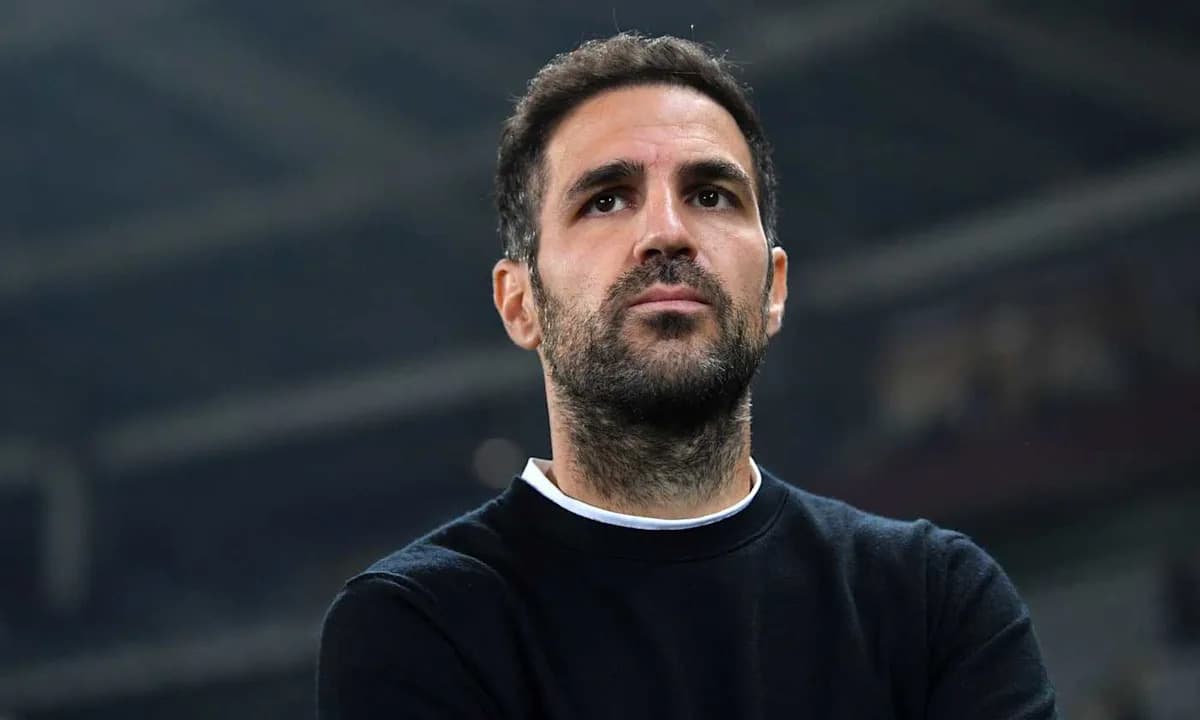
Cesc Fàbregas: Coaching Ambitions and Real Madrid
Cesc Fàbregas grew up in La Masia, wore the Barcelona shirt in some of its most demanding years and still speaks about the club with the ease of someone who knows every corridor at the Camp Nou. Yet when the idea of one day coaching Real Madrid was put to him, he didn’t slam the door. He didn’t even reach for it.
No red lines there.
Speaking to Cadena Cope after a landmark weekend for his Como side, Fàbregas left the Madrid question hovering in the air rather than crushing it. The 37-year-old has just led the Italian club to their first ever European qualification, a remarkable rise that has inevitably drawn admiring glances from some of Europe’s heavyweights, including Chelsea and Real Madrid.
He insists, though, that he is in no rush to leave.
“I’m a shareholder in the club (Como), I saw a project to start coaching, I have a contract and I’m very relaxed… I’m in a place that helps me grow and I’m very happy. I’m the one who makes the signings,” he explained, underlining just how embedded he is in the project. This is not a coach passing through; it is a coach who helped design the blueprint.
No assistant, no compromise
Where Fàbregas does draw a line is on his role. He will not be anyone’s number two.
“I don’t have a red line. One red line, and I’ve been very clear about this from the beginning, is that I wouldn’t want to be an assistant… for example. I’m clear that I want to be a head coach,” he said.
The message is sharp. He is not looking for a soft landing at a superclub or a sentimental return as a supporting act. If he walks into a big dugout, it will be through the main door.
As for the idea of Real Madrid, he refused to dress it up as a burning ambition or a forbidden fantasy. He simply parked it.
“The other thing (the possibility of Real Madrid)? I haven’t even thought about it or considered it. I haven’t had time for anything.”
It is a pragmatic answer from a man who has lived long enough at the sharp end of elite football to know how quickly situations change. He knows his name is circulating. He also knows he has work to finish on the shores of Lake Como.
Admiration for Ancelotti, respect for Enrique
Asked which coaches have shaped his thinking, Fàbregas pointed to the recent work of Luis Enrique, whose bold, high-tempo football with Spain and Paris Saint-Germain has clearly caught his eye over the last two years.
Yet if there is one coach he wishes he could have played under, it is Carlo Ancelotti. Not for the tactics alone, but for the man.
Fàbregas highlighted Ancelotti’s human side, the quality that so many players cite when explaining why they would run through walls for the Italian. It is no coincidence that a young coach trying to build a culture at Como looks towards a serial winner who keeps dressing rooms united at clubs where the pressure never drops.
How he’d handle a Vinicius-style flashpoint
That emphasis on the human element came through again when Fàbregas was asked about one of the defining images of Real Madrid’s miserable season: Vinicius Junior’s angry reaction to being substituted by Xabi Alonso during El Clásico. Some in Spain have pointed to that moment as the start of a deeper unraveling.
Fàbregas didn’t dwell on the drama. He went straight to the principle.
“What happened with Xabi Alonso and Vinicius… it’s a moment where you have to be prepared to make a good decision, and above all, what makes you a better coach is that you have to think about the team first. Nobody is better than the team, nobody is stronger than the team, and nobody is above the team.”
That is the spine of his coaching creed. The badge, the star, the transfer fee – all secondary. The group comes first.
“If you have a united and strong group, whoever wants to mess things up can do whatever they want, you’ll have the group’s respect and you’ll always do better in the long run.”
It is the kind of line that resonates in any dressing room, from a promotion-chasing side in Italy to a Champions League contender in Spain or England. It also hints at how Fàbregas would carry himself if that theoretical call from the Bernabéu ever did arrive.
For now, he is building quietly, winning loudly and talking like a man who knows exactly what kind of coach he wants to be. The question is no longer whether Cesc Fàbregas will manage at the very top, but which giant will decide his time has come.