.svg&w=384&q=75 "GoalGist logo")
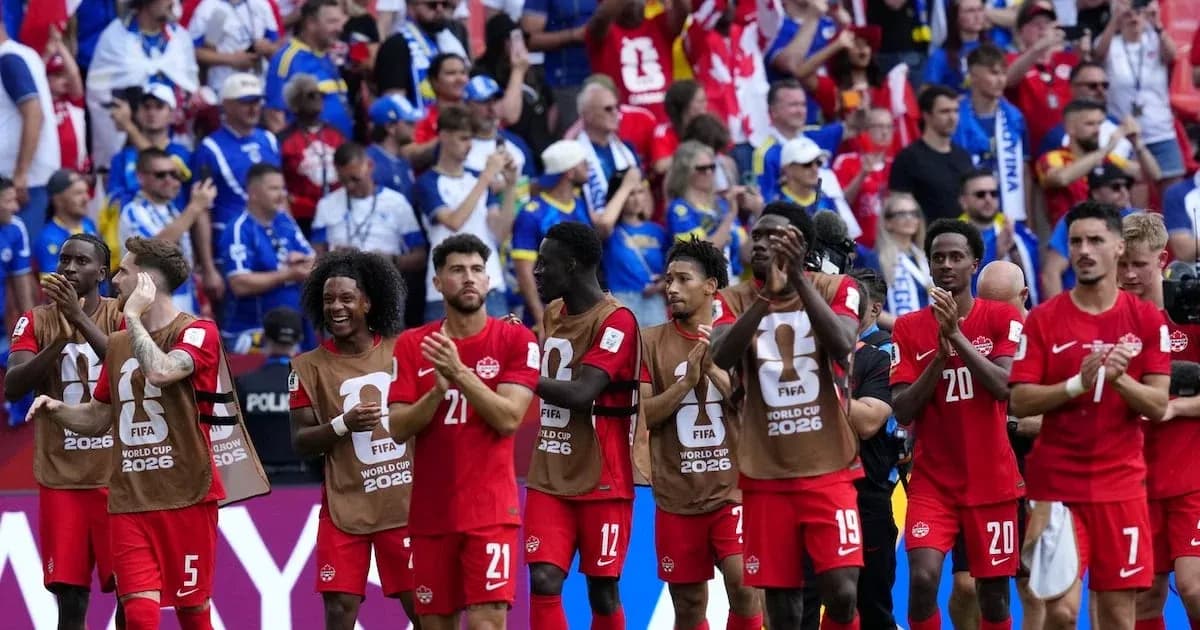
Canada Faces South Africa in Historic Knockout Match
Canada’s World Cup path is finally coming into focus. First, though, comes a moment they’ve never faced before: a knockout match on the world’s biggest stage.
On Sunday, against a stubborn, scarred, and suddenly dangerous South Africa, history is on the line.
A Favourable Draw – On Paper Only
The numbers lean heavily Canada’s way. They arrived at this World Cup ranked 31st in the world by FIFA, 30 places clear of South Africa at No. 60. ESPN’s pre-tournament model painted a similar picture, slotting Canada 25th out of 48 nations and South Africa way down at 46.
That’s the theory. The reality is a South African side that refused to die in Group A.
Two red cards and a 2-0 defeat to Mexico in their opener left their campaign in tatters. Hope flickered, then almost vanished, before Teboho Mokoena buried a late penalty against Czechia to salvage a crucial point. With their tournament on the brink again, they then stunned South Korea 1-0, Thapelo Maseko delivering the decisive blow despite South Africa seeing just 31 per cent of the ball.
That kind of resilience travels. Canada ignore it at their peril.
Still, Jesse Marsch’s team head into the Round of 32 with a body of work that explains why they’re favourites. A 1-1 draw with Bosnia and Herzegovina to open, a ruthless 6-0 dismantling of a nine-man Qatar, and then a narrow 2-1 defeat to Switzerland that was closer than the scoreline for long stretches.
Canada trailed 2-0 early in the second half against the Swiss and then threw everything at them. A point would have flipped the entire bracket, handing Canada top spot in Group B and a different opponent, in a different city, on a different day. Instead, they chased the game deep into stoppage time, living on nerves and instinct.
Striker Jonathan David called those final minutes “kind of intense” as Canada swarmed forward in waves, desperate to steal the group.
“You try not to look at the clock, because the more you look at it, the quicker time goes. But it’s garbage time,” he said. “You have to just have to crash the box and get the crosses and make sure you make your chances happen, and put shots on target, and hopefully something falls. And we came really, really close.”
They fell short of first place. They did not fall short of belief.
The Alphonso Davies Question
Hanging over Sunday’s tie is the most important selection question in Canadian football: does Alphonso Davies finally step onto this World Cup stage?
The captain hasn’t played a minute in the tournament, sidelined by a hamstring injury. His absence has hovered over every lineup graphic, every tactical debate, every conversation about how far this team can really go.
Marsch lifted the curtain slightly after the Switzerland match. Davies, he revealed, had been a “decoy” throughout the group stage, a name on the teamsheet meant to live in opponents’ heads rather than hurt them on the pitch.
“Alphonso wasn’t ready yet, but I wanted Switzerland to think about him and if you heard their press conference yesterday, they spoke about him a lot,” Marsch said. “He was never ready to play today, but I used him as a decoy.
“He will be ready for the next match, though. We didn’t want to be in a situation where he could be in danger, but he will be ready for the next match.”
Is that a promise or more gamesmanship? Canada shut down injury updates before the win over Qatar, and little has leaked out since. The uncertainty suits Marsch. It doesn’t help South Africa.
Beyond Davies, Canada will hope to restore some of their usual spine. Midfielder Stephen Eustáquio, eased back with a 58th-minute introduction against Switzerland, is pushing to return to the starting XI. At the back, centreback Moise Bombito is another candidate to step in from the first whistle if he’s passed fit.
If those three are available and close to full speed, Canada’s ceiling rises sharply.
The Road Ahead: Heavyweights Waiting
Beat South Africa, and the picture changes again.
Canada and South Africa open the Round of 32 on Sunday, with the winner earning six days to reset before a Round of 16 clash on Saturday, July 4. Waiting there will be no soft landing, just a European-African collision of the highest order: the Netherlands against Morocco.
Both arrive unbeaten at 2-0-1. Both came into the tournament ranked inside FIFA’s top eight. Morocco, seventh in the world, carry the aura of Qatar 2022 semifinalists. The Dutch, eighth, still wear the scars of a penalty shootout defeat to eventual champions Argentina in the quarter-finals of that same tournament.
The Netherlands have been a World Cup constant: hard to beat, harder to finish off. They haven’t lost in regulation time on this stage since falling 1-0 to Spain in the 2010 final.
Their form in Group F underlined that pedigree. A 2-2 draw with Japan showed their attacking teeth. A 5-1 demolition of Sweden and a 3-1 win over Tunisia reinforced it.
Morocco have been just as efficient, if in a different register. A 1-1 draw with Brazil in their opener, a cagey 1-0 win over Scotland, then a more open 4-2 victory over Haiti. They manage games, then strike.
Whoever emerges from that tie will be a formidable obstacle for Canada or South Africa. And the gauntlet doesn’t stop there.
At the top of the bracket, the quarter-final likely brings Germany or France. Germany have already wrapped up Group E. France will seal Group I with a result against Norway on Friday. That would set up a Round of 16 clash between the third-ranked French and the 10th-ranked Germans, a meeting that feels more like a final than a first knockout hurdle.
The winner of that war would then be on track to face whoever survives the Canada–South Africa–Netherlands–Morocco gauntlet.
This is the company Canada now keep. Not in theory, not in some distant future, but in the cold reality of a knockout bracket.
One Step Into the Unknown
For now, they stand at the edge of something new.
This World Cup has already delivered a series of firsts: first point, first win, first escape from the group. Each box ticked has shifted the conversation from “can they belong?” to “how far can they go?”
South Africa, battered early and reborn late in Group A, will have something to say about that. They’ve already shown they can survive chaos and punish complacency.
Canada, under Marsch, have made a habit of responding to setbacks with aggression rather than retreat. The loss to Switzerland hurt, but it left them exactly where they needed to be: still alive, still dangerous, still writing new chapters.
Is a knockout-round win next?
“We’re going to focus on the response,” Marsch said after that Swiss defeat. “We’re exactly where we want to be.”
On Sunday, for the first time at a World Cup, Canada find out what that really means.

