.svg&w=384&q=75 "GoalGist logo")
Brazil's Olympic Gold: A Historic Night at Maracanã
Ten years ago to the day, the Maracanã exhaled.
On August 20, 2016, under the weight of a century of expectation, the Brazilian National Team finally claimed the one prize that had always slipped away: Olympic gold in football. More than 63,000 fans packed into the stadium, carrying the noise, the nerves and the history of a country that treats the sport as a birthright.
The opponent could hardly have been more symbolic. Germany. The nation that had humiliated Brazil 7-1 at the 2014 World Cup in the very same city. The script demanded drama. It got all of it.
Neymar’s free-kick and a nation on edge
The final itself never turned into a rout or a carnival. It was tight, tense, and played on a knife-edge.
Midway through the first half, the tension cracked. In the 26th minute, Neymar stood over a free-kick, just outside the box. One swing of his right foot and the ball arced over the wall, kissed the underside of the crossbar and dropped in. The Maracanã exploded. Brazil led 1-0, and the dream felt real.
Germany, though, refused to fold. They grew into the second half, and the anxiety inside the stadium grew with them. In the 60th minute, Max Meyer arrived to level the match, finishing a move that silenced the stands and reset the contest at 1-1.
From there, it became a battle of will. Ninety minutes weren’t enough. Extra time came and went, heavy legs chasing a moment that never quite arrived. The gold medal would be decided from the spot.
Weverton’s save, Neymar’s penalty, history made
The shootout mirrored the match: relentless pressure, no mistakes, no margin for error.
Brazil’s first four takers were flawless. Renato Augusto, Marquinhos, Rafinha and Luan all converted. Germany matched them kick for kick through Ginter, Gnabry, Brandt and Süle. Each goal ratcheted up the tension. Each walk from the centre circle felt longer than the last.
Then came Nils Petersen, one of the tournament’s leading scorers. He stepped up for Germany’s fifth penalty. Weverton guessed right. A strong hand, a clean save. The stadium shook.
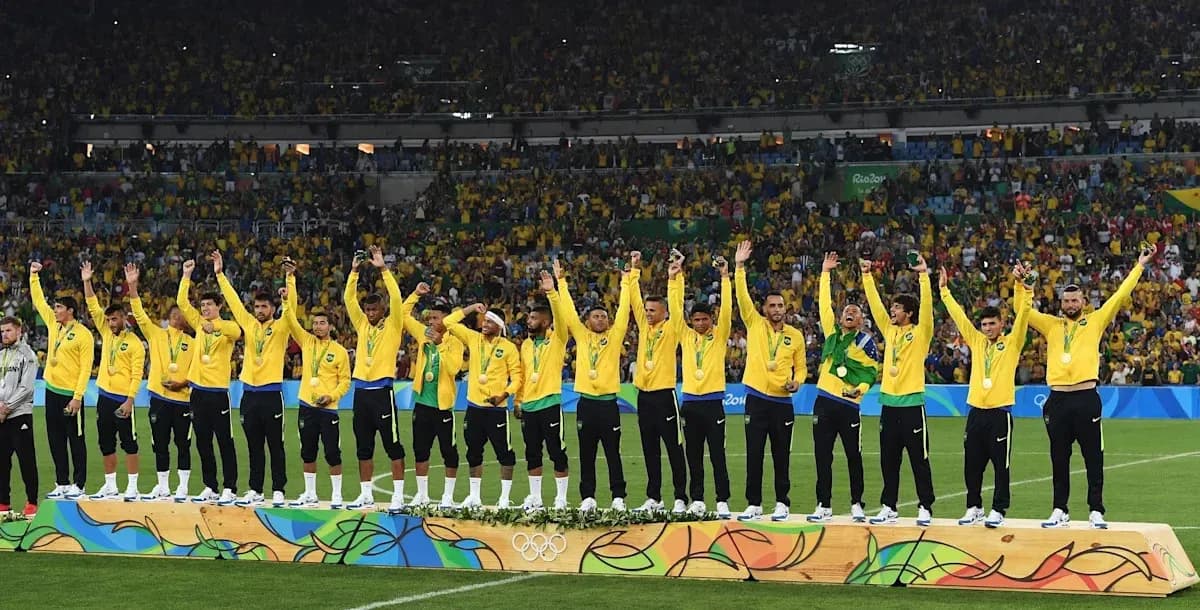
That stop handed Neymar the moment every Brazilian kid imagines. Fifth penalty. Gold on the line. He walked up, paused, and buried his shot. The net rippled, the noise became a roar, and Brazil were Olympic champions for the first time.
Neymar collapsed to his knees. Team-mates Walace, Gabriel Jesus, Gabriel Barbosa and Rafael Alcântara sprinted to him, the celebrations spilling across the Maracanã turf. A wound from 2014 didn’t heal that night, but something else finally did: the Olympic gap in Brazil’s football story.
A rocky start, a ruthless finish
The road to that final was far from smooth.
Brazil’s campaign opened in Brasília, and the early signs were worrying. Two matches, two 0-0 draws — first against South Africa, then against Iraq — and a chorus of doubts around the team. The hosts were misfiring, the pressure was mounting, and qualification suddenly looked complicated.
Everything changed in Salvador.
Needing a win to top Group A, Brazil dismantled Denmark 4-0 at Arena Fonte Nova. Gabriel Barbosa struck twice, Gabriel Jesus added another, and Luan completed the rout. The goals flowed, the confidence returned, and the knockout rounds arrived with the Seleção finally resembling contenders.
The quarterfinal brought Colombia at Arena Corinthians in São Paulo. Colombia had battled through Group B with 2-2 draws against Sweden and Japan and a 2-0 win over Nigeria. Brazil shut that momentum down. Neymar opened the scoring, Luan added the second, and a 2-0 win booked at least a shot at the medals.
Then came the performance that turned belief into certainty.
In the semifinal at the Maracanã, Brazil tore through Honduras. The Central Americans had already eliminated Argentina and Algeria in the group stage, advanced alongside Portugal, and then knocked out South Korea 1-0 in the quarterfinals. Against Brazil, they were swept aside.
Neymar and Gabriel Jesus both scored twice. Marquinhos and Luan joined the party. The scoreboard read 6-0, and the hosts marched into the final with momentum, swagger and a nation fully behind them.
The 18 who climbed the podium
Eighteen names went into the history books as Brazil’s first Olympic football gold medallists — with one more who lived the journey, even if injury kept him from the pitch.
- Goalkeepers
- Weverton (Athletico-PR)
- Uilson (Atlético Mineiro)
- Full-backs
- William (Internacional)
- Douglas Santos (Atlético Mineiro)
- Zeca (Santos)
- Center-backs
- Rodrigo Caio (São Paulo)
- Luan Garcia (Vasco da Gama)
- Marquinhos (Paris Saint Germain, FRA)
- Midfielders
- Thiago Maia (Santos)
- Rodrigo Dourado (Internacional)
- Rafinha Alcântara (Barcelona, ESP)
- Renato Augusto (Beijing Guoan, CHI)
- Felipe Anderson (Lazio, ITA)
- Walace (Grêmio)
- Forwards
- Neymar (Barcelona, ESP)
- Luan (Grêmio)
- Gabriel Barbosa (Santos)
- Gabriel Jesus (Palmeiras)
One more name deserves its own line. Fernando Prass was called up as one of the overage players but never made it to the group stage. An elbow injury in the warm-up for a friendly against Japan at Serra Dourada in Goiânia ruled him out before the tournament began. The medal ceremony went on without him, but his place in that story remains.
A decade later, the images still feel fresh: the free-kick off the bar, Weverton’s outstretched arm, Neymar’s final penalty and the release that followed. For a country obsessed with World Cups, that night at the Maracanã carved out its own space.
The question now is simple: when will a new generation write a moment to match it?