.svg&w=384&q=75 "GoalGist logo")
Boavista: A European Name Fades to Black
Boavista are gone. Not relegated, not restructured, not bumped down a division with promises of a rebuild. Extinct.
A court order on 16 July 2026 instructed the Porto club to cease all activities by 31 July and hand over its premises, the final act in a long, messy financial collapse. Years of unpaid debts, failed restructurings and broken obligations finally closed the door on a club that once broke Portuguese football’s glass ceiling.
For Celtic supporters, the news lands with a jolt of nostalgia. Boavista were never a giant, but they were part of the story.
The First Meeting: Hoops, History and Numbers
Celtic first crossed paths with Boavista in the 1975 Cup Winners’ Cup. It was a different era, a different Europe, and a very different Celtic Park.
The tie opened with a 0-0 draw in Porto, a tight, hard-fought first leg that left everything hanging on the return in Glasgow. Two weeks later, under the lights at Celtic Park, the Hoops finished the job with a 3-1 win and a 3-1 aggregate victory.
Kenny Dalglish scored. Shuggie Edvaldsson scored. Dixie Deans scored. The names still echo through Celtic folklore.
That night carried another small but striking footnote: it was the first time Celtic wore squad numbers on the back of those famous green and white hoops. A modest detail in the grand sweep of history, yet the kind of moment supporters remember when they look back at old photographs and grainy footage of Edvaldsson and Deans finding the net against the Portuguese visitors.
Boavista left Glasgow beaten but not insignificant. They would return to Celtic’s orbit almost three decades later, on a much bigger stage.
Larsson, Porto and a Semi-Final to Remember
For most Celtic fans, Boavista will forever be tied to the 2003 UEFA Cup run, a campaign that carried Martin O’Neill’s side to the brink of European glory.
The semi-final first leg at Celtic Park finished 1-1. Boavista were stubborn, organised, and awkward, the kind of side that tests your patience as much as your talent. Celtic pushed, roared on by a restless crowd, but left with only parity.
The second leg in Porto tightened the screw. A place in a European final dangled in front of Celtic; Boavista stood in the way, disciplined and determined. The tie felt like it could slip away at any moment.
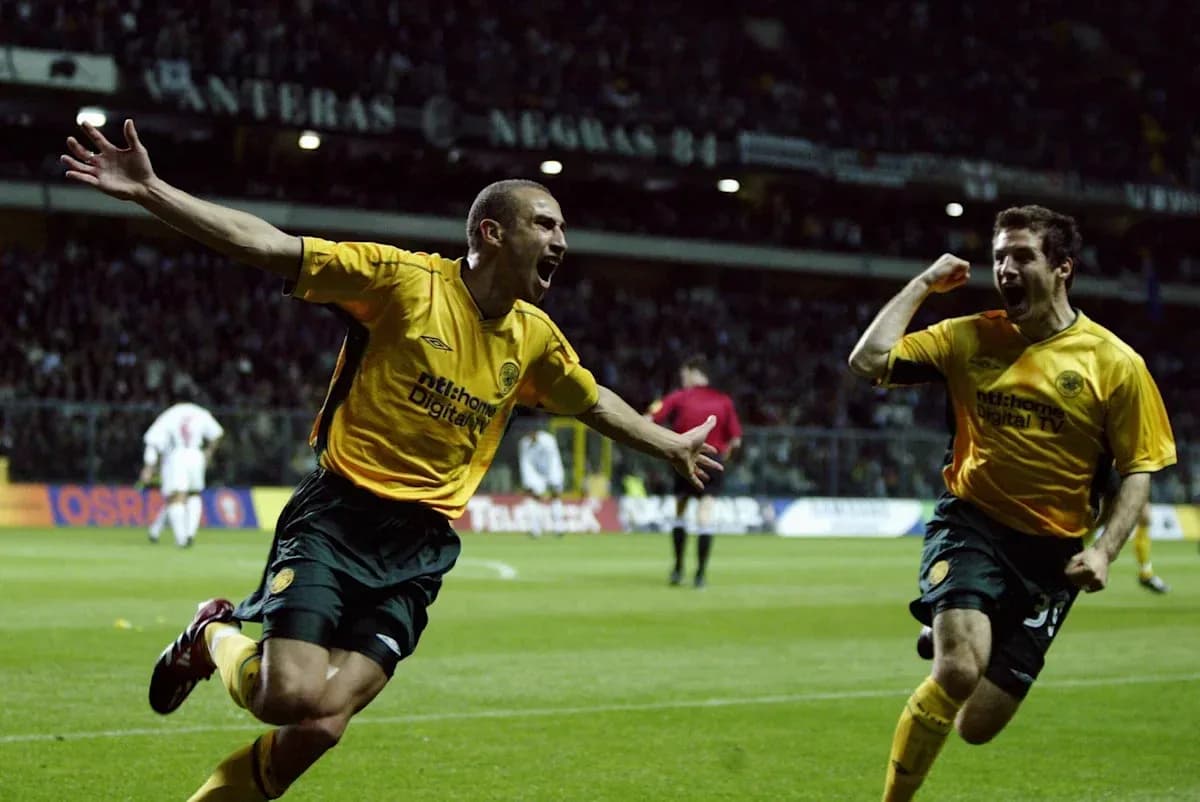
Henrik Larsson refused to let it.
The Swede scored in the first leg. He scored again in the second, delivering the decisive goal in a 1-0 win at the Bessa Stadium. Celtic took the tie 2-1 on aggregate and booked a historic final against Boavista’s city rivals, Porto.
The less said about that final, the better, but the semi-final remains etched in Celtic’s European story. Boavista, in their black-and-white chequered shirts, were the last barrier before Seville, the final test before O’Neill embraced Larsson in celebration on that April night in Portugal.
A Champion Outside the Cartel
Boavista were never meant to be ordinary. Founded in 1903, they spent most of their existence in the shadow of Benfica, Porto and Sporting. Yet they broke the mould in 2001, winning the Primeira Liga and becoming the first – and still only – club outside Portugal’s big three to be crowned champions.
Nine major honours in total. A league title that shook the established order. A stubborn, streetwise side that made life difficult for anyone who underestimated them.
That made the manner of their fall all the more brutal.
From Transfer Bans to Oblivion
The decline did not happen overnight. Boavista’s troubles had been simmering for years, but the past couple of seasons turned crisis into catastrophe.
After being banned from signing players across five transfer windows, the club tried to swing the pendulum back in February 2025 by signing nine players in a single day. It felt desperate, a club throwing everything at survival.
It didn’t work.
In 2024/25, Boavista finished bottom and were relegated after a 4–1 defeat away to Arouca on the final day. Around 2,000 travelling fans watched their team collapse, some spilling onto the pitch in a raw, emotional invasion that summed up the chaos.
Relegation usually brings a chance to reset. Boavista never got it. The Portuguese league authority barred them from playing in Liga Portugal 2, handing a reprieve to Oliveirense, who had been set for the drop.
The fall continued. The club were refused registration in 2025 for both the third-tier and the fourth-tier Campeonato de Portugal. That forced a change of company structure, with a new entity starting out in Liga Pro, the elite competition of the Porto Football Association.
The original club tried to keep a foothold in the game by entering a team in the fourth division of the district leagues. They failed to turn up for fixtures, lost matches by default and eventually withdrew from competition altogether at the end of October.
Each step felt smaller, sadder, more detached from the Boavista that once stared down Europe’s elite and toppled Portugal’s giants. By the time the court order arrived this July, the club had already been hollowed out. The legal ruling simply made it official.
Boavista, as a professional force, no longer exist.
A Name, a Memory, and What Comes Next
The insolvency process was rooted in unpaid debts to creditors, the kind of cold financial language that never captures the human cost. This was a club that had shared European nights with Celtic, that had lifted a league title in a country dominated by three superpowers, that had built a reputation as a snarling, awkward, utterly competitive opponent.
Now it’s a cautionary tale.
Boavista failed to pay their debts and paid the ultimate price. Their name, their crest, their chequered shirts are now confined to memory and archive, unless a reborn version – a “The Boavista FC” – emerges from the wreckage somewhere down the line.
For Celtic fans, the images remain vivid: Edvaldsson and Deans scoring in 1975, the first squad numbers on the hoops, Larsson wheeling away in 2003, O’Neill’s embrace at the Bessa.
Boavista are gone from the fixture lists. They’re not gone from the stories.