.svg&w=384&q=75 "GoalGist logo")
Beşiktaş Dominates FC Midtjylland in Tactical Display
Beşiktaş’s 1-0 win over FC Midtjylland at Tüpraş Stadyumu in this UEFA Europa League 2nd Qualifying Round tie was a tactical siege: a dominant home side using structure and circulation to relentlessly stress a numerically inferior opponent that defended deep after an early dismissal. The scoreline stayed narrow, but the underlying patterns were one-sided and clear.
Vincenzo Italiano set Beşiktaş up in a 4-1-4-1 that functioned as a high-possession, territorial control system. The single pivot, S. Ozcan, anchored behind a line of four advanced midfielders – V. Cerny, J. Olaitan, O. Kokcu and I. Fakili – supporting lone striker Oh Hyeon-Gyu. With 75% possession and 685 total passes, Beşiktaş built a stable structure in which the back four spread wide, Ozcan dropped to connect, and both interiors frequently occupied the half-spaces to pin Midtjylland’s midfield.
Against that, Mike Tullberg’s FC Midtjylland began in a 4-3-3 but were forced into a reactive low block almost immediately. The red card for Friday Etim at 15 minutes flipped the game-state: from that point, Midtjylland’s 4-3-3 became more of a 4-4-1 without the ball, with one forward sacrificed later and wide midfielders dropping to the full-back line. Their 25% possession and only 237 total passes underline how little time they had to construct attacks; the priority became compactness and survival.
Beşiktaş’s dominance with the ball was not sterile. They generated 28 total shots, with 15 from inside the box and 13 from outside, illustrating a dual-threat approach: constant attempts to work the ball into central areas, complemented by frequent efforts from range when Midtjylland’s block refused to open. The 5 blocked shots show how often the visitors’ last line had to throw bodies in front of efforts, especially with the central defenders Lee Han-Beom and M. B. Sorensen under continuous pressure.
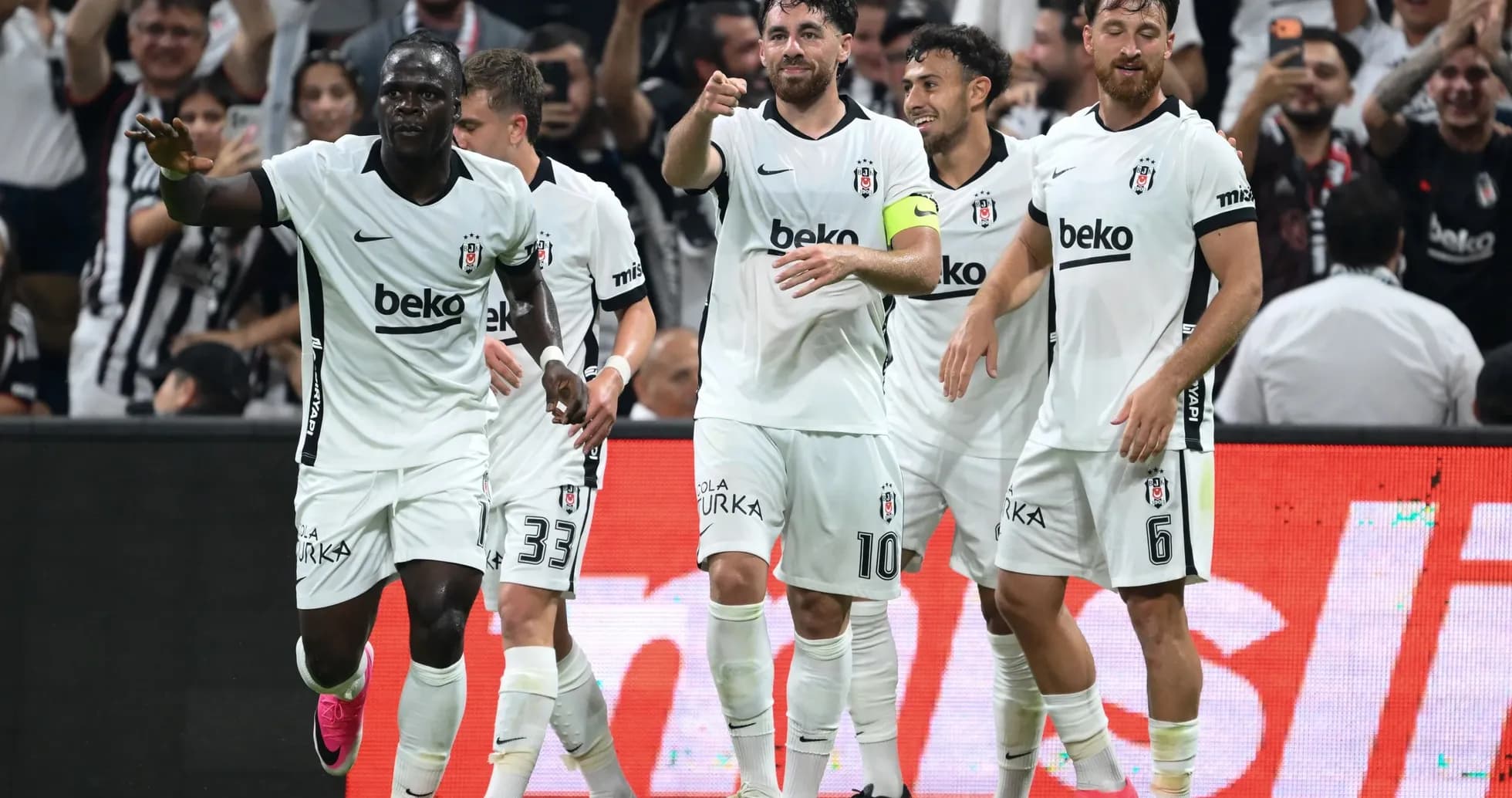
The decisive moment came from the exact pattern Italiano’s shape was designed to create. At 26 minutes, O. Kokcu scored the only goal, assisted by V. Cerny. The 4-1-4-1’s advanced line enabled Cerny to receive between lines and combine centrally, with Kokcu arriving from midfield into the space just ahead of the pivot. That timing run and combination reflected Beşiktaş’s positional superiority: they consistently had an extra man between Midtjylland’s midfield and defence once the visitors dropped deeper after going down to ten.
Out of possession, Beşiktaş’s structure was aggressive but controlled. With so much ball, their defending was largely counter-press oriented: immediately upon loss, the nearest midfielders squeezed, while Ozcan protected the centre and the back four held a high line. The shot profile they conceded – only 5 total shots against, with just 3 inside the box and 2 from outside – confirms how rarely Midtjylland could break into dangerous zones. When the visitors did manage to progress, they lacked numbers due to their inferiority and the need to keep a low, compact block.
In contrast, Midtjylland’s tactical response after the red card was to compress space in front of their box and accept territorial concession. Their 9 fouls versus Beşiktaş’s 12 show they were not over-aggressive; instead they relied on positional defending, narrow lines, and forcing Beşiktaş wide. The 2 corner kicks they earned versus Beşiktaş’s 5 further underline how seldom they could sustain pressure in the final third.
The substitutions from Tullberg were clearly reactive and structurally motivated. At 18 minutes, V. Byskov (OUT) was replaced by D. Castillo (IN), a move that rebalanced midfield after the dismissal and tried to restore some control in central areas. At 46 minutes, Franculino (OUT) made way for M. Erlic (IN), effectively sacrificing an attacker to reinforce the back line and shift further into a conservative, defence-first posture. Later, at 62 minutes, D. Osorio (OUT) was replaced by Cho Gue-Sung (IN), a change that refreshed the lone forward role, hoping to offer an outlet for long clearances and sporadic transitions. At 83 minutes, K. Watjen (IN) entered without a specified outgoing player, another sign of late-game reshaping to add legs in midfield.
Italiano’s substitution pattern was about maintaining intensity and protecting the structure rather than changing it. At 63 minutes, I. Fakili (OUT) was replaced by M. Rashica (IN), and Oh Hyeon-Gyu (OUT) by S. Kilicsoy (IN), injecting fresh energy into the wide and central attacking roles to keep pressing Midtjylland’s tiring back line. At 73 minutes, S. Ozcan (OUT) was replaced by K. Kayra Yilmaz (IN), ensuring the crucial pivot role remained physically sharp to guard against counters. Simultaneously, R. Yilmaz (OUT) was replaced by K. Ouattara (IN), refreshing the defensive line. At 78 minutes, T. Djalo (OUT) was replaced by E. Agbadou (IN), another defensive rotation to preserve concentration and aerial dominance late on.
Goalkeeper usage was almost symbolic of the game’s flow. A. Nubel (Beşiktaş) was largely protected by the structure in front of him and was required to make just 1 save, reflecting how effectively the high line and counter-press restricted Midtjylland’s shot volume and quality. On the other side, E. Olafsson (FC Midtjylland) made 6 saves, a key figure that kept the visitors alive despite the territorial onslaught. His interventions, combined with the 3 blocked shots from his teammates, were central to limiting the damage to a single goal.
Discipline also framed the tactical narrative. The single red card for Friday Etim at 15 minutes was the hinge on which the entire match turned. With no yellow cards for either side, the contest was not defined by repeated stoppages or cynical fouling; rather, it was that one decisive dismissal that forced Midtjylland into a survival mode and allowed Beşiktaş to install their positional game almost uncontested.
The statistical verdict is emphatic: 75% possession, 685 total passes with 606 accurate for Beşiktaş versus 25% and 237 passes (146 accurate) for Midtjylland underline a match of almost total control. Beşiktaş’s 28 total shots to 5, with 7 on goal to 1, and a 5–3 edge in blocked shots, show a home side that repeatedly created shooting opportunities from a variety of zones. The foul count (12 for Beşiktaş, 9 for Midtjylland) and free kicks (9 versus 12) indicate a game where the home side could press aggressively without losing structural discipline, while the visitors relied on set-pieces as rare chances to advance.
In tactical terms, this was a textbook example of how a possession-dominant 4-1-4-1 can suffocate a ten-man opponent: constant occupation of the half-spaces, a secure rest-defence behind the ball, and enough rotation in advanced roles to keep the block moving. Midtjylland’s resilience and E. Olafsson’s (FC Midtjylland) performance kept the tie alive, but the underlying patterns strongly favoured Beşiktaş heading into the return leg.