.svg&w=384&q=75 "GoalGist logo")
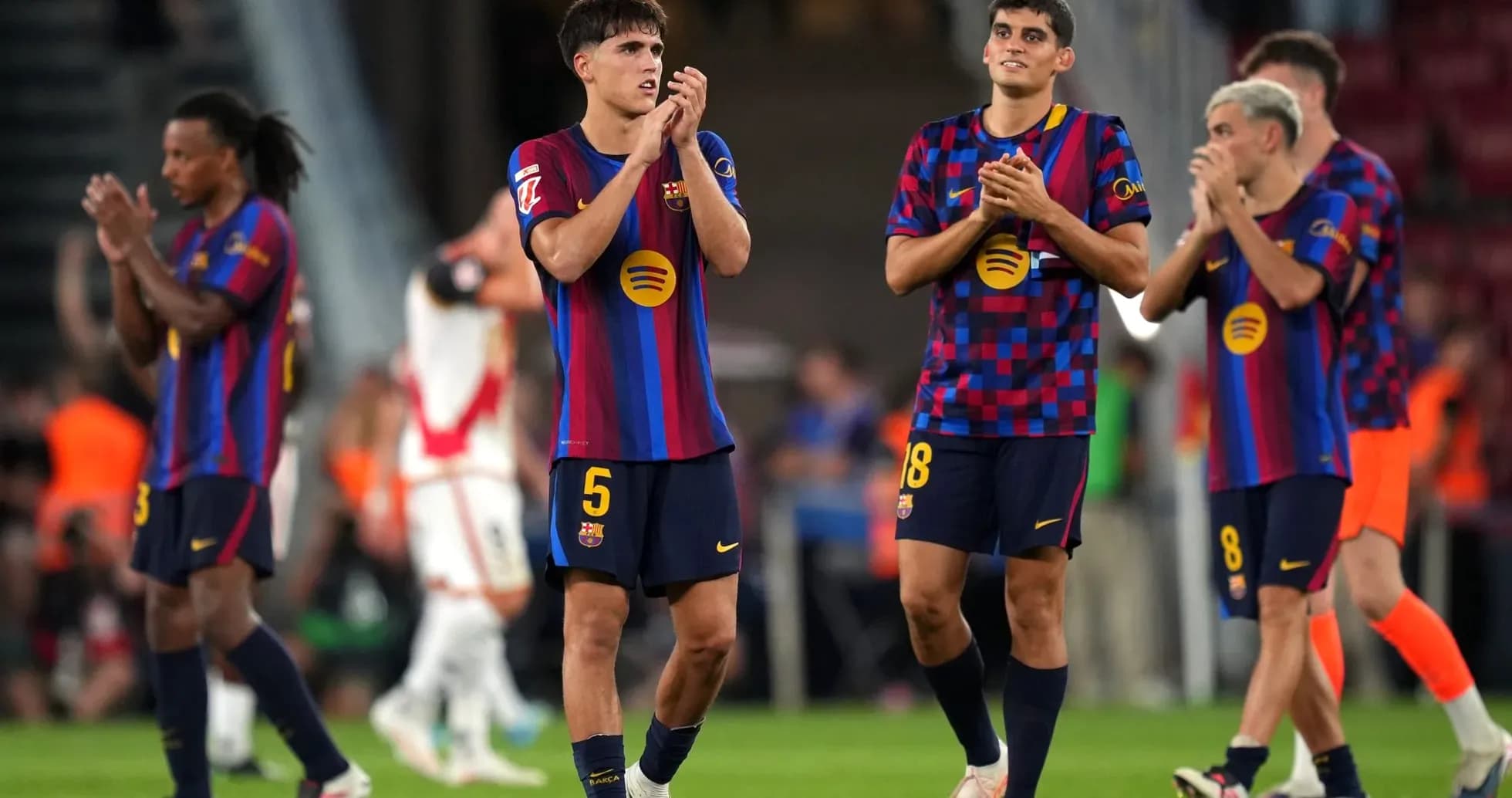
Barcelona Dominates Rayo Vallecano 5–2 in La Liga Showdown
Under the Barcelona night sky, Camp Nou watched a statement rather than a contest. In La Liga’s Regular Season - 3, Barcelona dismantled Rayo Vallecano 5–2, a scoreline that mirrored the gulf between a side surfing early-season momentum and another already staring at a relegation fight.
Following this result, the league table snapshots the contrast. Barcelona sit 1st with 9 points from 3 matches, perfect with three wins from three and a towering overall goal difference of +10 (12 scored, 2 conceded). At home they have taken 6 points from 2 fixtures, scoring 7 and conceding 2, a home goal difference of +5. Rayo Vallecano leave Barcelona 18th with just 1 point from 3 games, their overall goal difference at -4 (4 scored, 8 conceded). On their travels they have lost both away fixtures, scoring 3 and conceding 7 for an away goal difference of -4.
I. The Big Picture – Flick’s fluid 4-2-3-1 vs Rayo’s fragile mirror
Both coaches opened in a 4-2-3-1, but the systems lived very different lives. Hansi Flick’s Barcelona used the shape as a platform for controlled aggression. J. Garcia anchored as goalkeeper behind a back four of J. Kounde, P. Cubarsi, A. Christensen and X. Espart. In front, the double pivot of M. Bernal and Pedri gave structure, freeing a devastating line of three – Lamine Yamal, D. Olmo and A. Gordon – to orbit around the lone forward, Raphinha.
Benat San Jose mirrored the formation but not the control. D. Cardenas started in goal, with I. Balliu, F. Lejeune, P. Ciss and J. Vertrouwd across the back. O. Valentin and G. Bouare formed the midfield screen, while J. de Frutos, U. Lopez and A. Garcia supported S. Camello up front. On paper it was a balanced, compact structure; on the pitch it was repeatedly stretched and torn apart by Barcelona’s rotations.
Barcelona’s season profile underlines how this match fit their emerging identity. Overall they have played 3 league fixtures, winning all 3, with 12 goals for and just 2 against. Their overall scoring average stands at 4.0 goals per game, while they concede only 0.7 on average. At home, they are averaging 3.5 goals scored and 1.0 conceded, numbers that frame this 5–2 as an extension of a dominant home pattern rather than an outlier.
Rayo’s season numbers tell the opposite story. Overall, they have played 3 matches without a win, drawing 1 and losing 2, with 4 goals for and 8 against. Their overall attacking average is 1.3 goals per game, but they are conceding 2.7 on average. On their travels, the picture is harsher: 2 away games, 0 points, 3 goals scored and 7 conceded, an away average of 1.5 scored and 3.5 conceded. The 5–2 defeat in Barcelona fits squarely into that away fragility.
II. Tactical Voids – Missing architects and patched back lines
Barcelona’s dominance came despite a significant list of absentees. R. Bardghji, M. Casado, Gavi and F. de Jong were all ruled out, with Gavi and F. de Jong sidelined by knee injuries and Bardghji also missing through a knee problem. D. Livakovic was unavailable as well. Flick therefore leaned heavily on his fit core: Pedri as the main organiser, M. Bernal as the stabilising pivot, and the wide creativity of Lamine Yamal and A. Gordon.
For Rayo, the absences cut into their spine and leadership. A. Batalla, M. Kumbulla, Luiz Felipe and I. Palazon were all missing, stripping San Jose of defensive depth and attacking personality. Without Luiz Felipe and M. Kumbulla, the defensive line lacked an experienced organiser; without I. Palazon, Rayo’s ability to retain the ball under pressure and break lines suffered. The result was a back four that spent most of the evening reacting rather than dictating.
Disciplinary trends added another layer of risk for the visitors. Across the season, 50.00% of Rayo’s yellow cards have arrived between 61–75 minutes, with another 33.33% between 76–90 and 16.67% in stoppage time. This late-game spikiness under fatigue is exactly when Barcelona tend to keep the ball and probe, inviting fouls in dangerous zones. By contrast, Barcelona’s only recorded yellow card timing so far has come between 16–30 minutes, with no red cards and a generally controlled disciplinary profile.
III. Key Matchups – Hunter vs Shield, Engine Room vs Screen
The headline duel was always going to be Raphinha against Rayo’s defensive shield. The Brazilian arrived as La Liga’s most in-form forward: in total this campaign he has 5 goals and 1 assist from 3 appearances, with 8 shots and 7 on target, and a sparkling rating of 9.03. His penalty record is spotless so far, having scored 1 from 1 without a miss. Against a Rayo side conceding an overall average of 2.7 goals per game – and 3.5 on their travels – the matchup heavily favoured the hunter.
F. Lejeune and P. Ciss, operating as the central defensive pair, were tasked with tracking Raphinha’s diagonal runs from the front and the wide right channel. But they were constantly overloaded. Lamine Yamal, who has 2 goals and 13 key passes in total this season, repeatedly drifted inside from the right, while A. Gordon – La Liga’s top assist provider with 3 in total – attacked the half-spaces on the opposite side. Each time Rayo’s line shifted to deal with one threat, another appeared unmarked.
On the flanks, X. Espart’s role was quietly decisive. The young full-back has delivered 2 assists in total and completed 156 passes with 86% accuracy this season, adding 8 tackles and 5 interceptions. From left-back he pushed high, pinning A. Garcia deeper than he would like and creating a wide overload with Gordon. That trapped I. Balliu and O. Valentin in two-against-three situations, with Pedri or D. Olmo often joining to form a triangle.
In midfield, the engine-room battle pitted Pedri and M. Bernal against O. Valentin and G. Bouare. Rayo’s pair were supposed to shield the back four, but Barcelona’s structure forced them into constant lateral shuffles. With Pedri dropping to help build and Bernal anchoring, Barcelona always had a free man between the lines. U. Lopez, nominally the central attacking midfielder for Rayo, was dragged back so deep to help that S. Camello was often isolated up front.
Yet Camello still showed why he sits among the league’s top scorers. In total this season he has 3 goals from 3 appearances, converting 4 of his 5 shots on target. His movement between P. Cubarsi and A. Christensen caused problems when Rayo could counter, and his ability to draw 6 fouls overall this campaign underlines how he can disrupt defensive rhythm. But Rayo’s lack of sustained possession meant those moments were rare and fleeting.
IV. Statistical Prognosis – A gap that numbers can’t hide
This 5–2 at Camp Nou felt less like a one-off and more like a statistical inevitability. Barcelona’s overall scoring average of 4.0 per match and defensive average of 0.7 conceded, combined with Rayo’s away concession rate of 3.5 and absence of any clean sheet in total, created a tactical and numerical mismatch.
Barcelona’s penalty record remains perfect this season, with 1 converted from 1 taken and none missed, while Rayo have yet to win or take a spot-kick. The Catalans also boast 2 clean sheets in total already, despite conceding twice here, suggesting that when they are not as expansive, they can shut games down entirely.
From a tactical lens, the intersection is stark: a Barcelona side that floods the final third with intelligent movement and high technical quality, against a Rayo team whose defensive line is undermanned by injuries and whose disciplinary spikes arrive just when opponents are most dominant. Even if expected goals data were available, it would likely only confirm what the eye and the season trends already say – Barcelona are built to overwhelm teams like Rayo, and Rayo, as currently structured and depleted, are built to suffer in exactly these fixtures.
Following this result, Barcelona’s early-season arc looks like the blueprint of a title challenge, while Rayo Vallecano’s campaign is already being defined by damage limitation and the urgent need to find defensive stability before the table hardens around them.