.svg&w=384&q=75 "GoalGist logo")
Bafana Bafana and Canada Clash in Historic Knockout Match
Bafana Bafana and Canada step into the unknown on Sunday in Los Angeles, two nations with long World Cup memories but no knockout pedigree, finally breaking through the glass ceiling together.
For both, this is history.
For one, it will become something more.
Bafana wake up at last
South Africa were supposed to be on their way home by now.
They opened the tournament with a flat 2-0 defeat to co-hosts Mexico, then fell behind again to Czechia. It felt like the same old story: bright flashes, brave talk, early flight.
Then the mood changed.
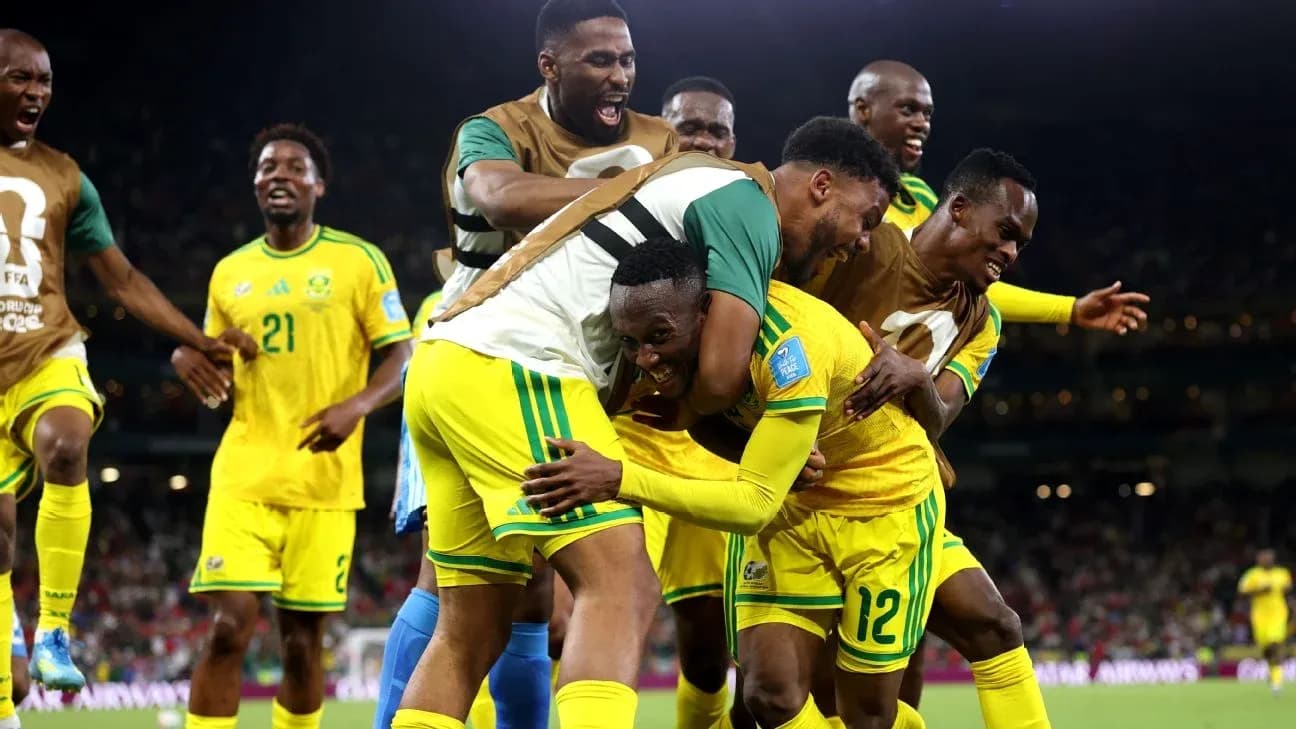
Teboho Mokoena dragged Bafana level in the 83rd minute of that second game, a strike that felt less like an equaliser and more like a turning point. It jolted South Africa into life. From there, the team that had drifted through previous World Cups suddenly looked like it believed.
That belief roared into full view in the 1-0 win over South Korea. Thapelo Maseko’s 63rd-minute winner did more than seal three points; it shoved Bafana into the knockout rounds and rewrote the tone of their entire campaign. A side that had been drifting toward another group-stage exit instead finished second in Group A and booked a ticket to Los Angeles.
Hugo Broos will not have Themba Zwane, whose suspension has been stretched from one game to three after his red card against Mexico. Losing that level of attacking craft at a moment like this is a heavy blow.
But the return of Mokoena from his own one-match ban changes the dynamic in midfield. The “maestro” tag is not misplaced: his range of passing, set-piece threat and sheer authority between the lines give South Africa a focal point in possession that they badly missed.
Around him, the pieces are starting to click.
Relebohile Mofokeng, who led the win over South Korea with four key passes, has emerged as a creative hub in the final third. Maseko brings direct running and a ruthless eye for goal. Evidence Makgopa offers a physical presence up front that defenders cannot ignore.
It has taken South Africa four World Cup appearances – 1998, 2002, 2010 and now – to finally step beyond the group. The sense, inside and outside the camp, is that this is more than a one-off. It feels like a sleeping giant rubbing its eyes.
Canada’s moment on home soil
Canada arrive in the last 16 with their own scars and their own momentum.
They started Group B with a 1-1 draw against Bosnia & Herzegovina, then exploded into life with a 6-0 demolition of Qatar. That result did not just secure their goal difference; it sent a message that Jesse Marsch’s side could be ruthless when the door opened.
A 2-1 defeat to Switzerland in their final group game checked that surge, but not enough to knock them off second place. For a country whose previous World Cup trips in 1986 and 2022 ended at the first hurdle, that alone represents a step into new territory.
They are doing it without their biggest name.
Alphonso Davies, the Bayern Munich left-back and heartbeat of this team, has yet to play a minute at this tournament as he recovers from a hamstring injury. Canada have had to adjust on the fly, reshaping their left flank and attacking patterns without their main outlet in transition.
The injury list runs deeper. Ismaël Koné, the Sassuolo midfielder, suffered a broken leg against Qatar and is out for the remainder of the tournament. Marsch and his staff have been juggling niggles and absences throughout, yet Canada still found a way to qualify.
That resilience underpins their approach.
Maxime Crepeau anchors the side in goal. At the back, Richie Laryea, Derek Cornelius, Luc de Fougerolles and Alistair Johnston provide balance and bite. The midfield four of Ali Ahmed, Mathieu Choiniere, Nathan Saliba and Tajon Buchanan offers legs, width and energy.
Up front, the pairing of Tani Oluwaseyi and Jonathan David brings contrasting threats: one a physical, mobile runner, the other a proven finisher with a sharp penalty-box instinct. If Canada can feed them consistently, South Africa’s back line will have to endure a long afternoon.
This is not just any knockout tie for them. Canada are co-hosting this World Cup with Mexico and the USA. A run on home soil – even if this particular chapter plays out in Los Angeles – carries extra weight.
Tactical edges and thin margins
On paper, the lineups offer a fascinating clash of styles.
South Africa are expected to set up with Ronwen Williams in goal behind a back four of Aubrey Modiba, Mbekezeli Mbokazi, Ime Okon and Khuliso Mudau. In front of them, Sphephelo Sithole and Mokoena should form the double pivot, with Oswin Appollis, Mofokeng and Maseko supporting Makgopa.
Bafana’s threat lies in the spaces between the lines. Mofokeng’s ability to find pockets and slide passes – as he did relentlessly against South Korea – could drag Canada’s midfield out of shape. Maseko’s runs off the right and Modiba’s overlaps on the left will test how well Canada’s full-backs can defend while still offering width.
Canada, likely to mirror their recent setup, will look to stretch the pitch. Buchanan on the right can pin Modiba back, while Ahmed and Saliba will be asked to disrupt Mokoena’s rhythm in the middle. If they manage that, South Africa’s build-up can quickly become predictable.
Set pieces may decide it.
Mokoena’s delivery and long-range shooting give South Africa an obvious route to goal from dead-ball situations. At the other end, Cornelius and de Fougerolles carry aerial presence that could trouble Williams and his defence.
The officiating will be under the microscope as well. Portuguese referee João Pinheiro, a high-profile figure, takes charge. His recent handling of Bayern Munich’s UEFA Champions League semi-final against Paris Saint-Germain drew criticism, and both benches will be watching how he sets the tone early – especially in a match where physical duels in midfield and on the flanks could shape the flow.
History, and a hint of déjà vu
These two nations have met only once before.
In 2007, South Africa beat Canada 2-0 in Durban, with Teko Modise scoring both goals. It is a slender piece of shared history, but it tilts the narrative slightly in Bafana’s favour.
This time, the stakes are immeasurably higher.
Kickoff comes at 12 p.m. local time in Los Angeles on Sunday (9 p.m. CAT, 8 p.m. BST, 7 p.m. GMT) at Los Angeles Stadium in Inglewood. The global audience will be scattered across broadcasters: SuperSport, SABC and SportyTV in South Africa; TSN, RDS, CTV and Crave in Canada; FOX, Telemundo and Peacock in the USA.
For one nation, it will be the night their first knockout game became their last.
For the other, it could be the moment a new football identity hardened into something permanent.
South Africa chasing the awakening of a sleeping giant.
Canada pushing to extend a breakthrough on home soil.
Only one of them walks out of Los Angeles with their World Cup dream growing, not shrinking.