.svg&w=384&q=75 "GoalGist logo")
Arsenal's Ambitious Summer Transfer Plans
Arsenal’s summer was supposed to be about cold, calculated “excellence.” Instead, the clearest sign of their growing power arrived with a jolt from the north: Eddie Howe, gone from Newcastle United amid claims that the club’s transfer plans had pushed him out the door.
At the centre of the storm sits Bruno Guimarães.
Arsenal’s new leverage
Fresh from ending a 20-year wait for the Premier League title and coming within a penalty shootout of winning the Champions League, Arsenal have entered this window from a position they have not enjoyed in a generation. They are not scrambling to catch up. They are shopping from the top shelf.
Names have flown around Europe all summer. Real Madrid’s Vinícius Júnior has dominated the gossip, nudging long-term target Julián Alvarez of Atlético Madrid into the background. The dream is clear: add a genuine superstar to a squad that already looks built to last.
Yet the most realistic signing, the one already twisting the landscape of another club, is Newcastle’s captain.
Reports emerging after Howe’s shock exit from St James’ Park painted a stark picture. According to The Telegraph, the English coach felt driven to step away by the direction of the club’s transfer business, convinced that Guimarães would be sold to Arsenal. In his mind, the Brazilian would follow Anthony Gordon and Sandro Tonali out of the door in a run of departures that cuts to the core of Newcastle’s project.
Only last week, Howe admitted he was not involved in talks over Guimarães’ future and had “no idea” what would happen. For a manager who built his side around the midfielder, that distance told its own story.
Arsenal, whose early offers were swiftly rebuffed, are now believed to be lining up an improved bid in the region of $93.2 million (£70 million). That figure, in this market, signals intent. It also underlines something else: when Arsenal knock now, even ambitious clubs like Newcastle have to listen.
Arteta’s “different dimension”
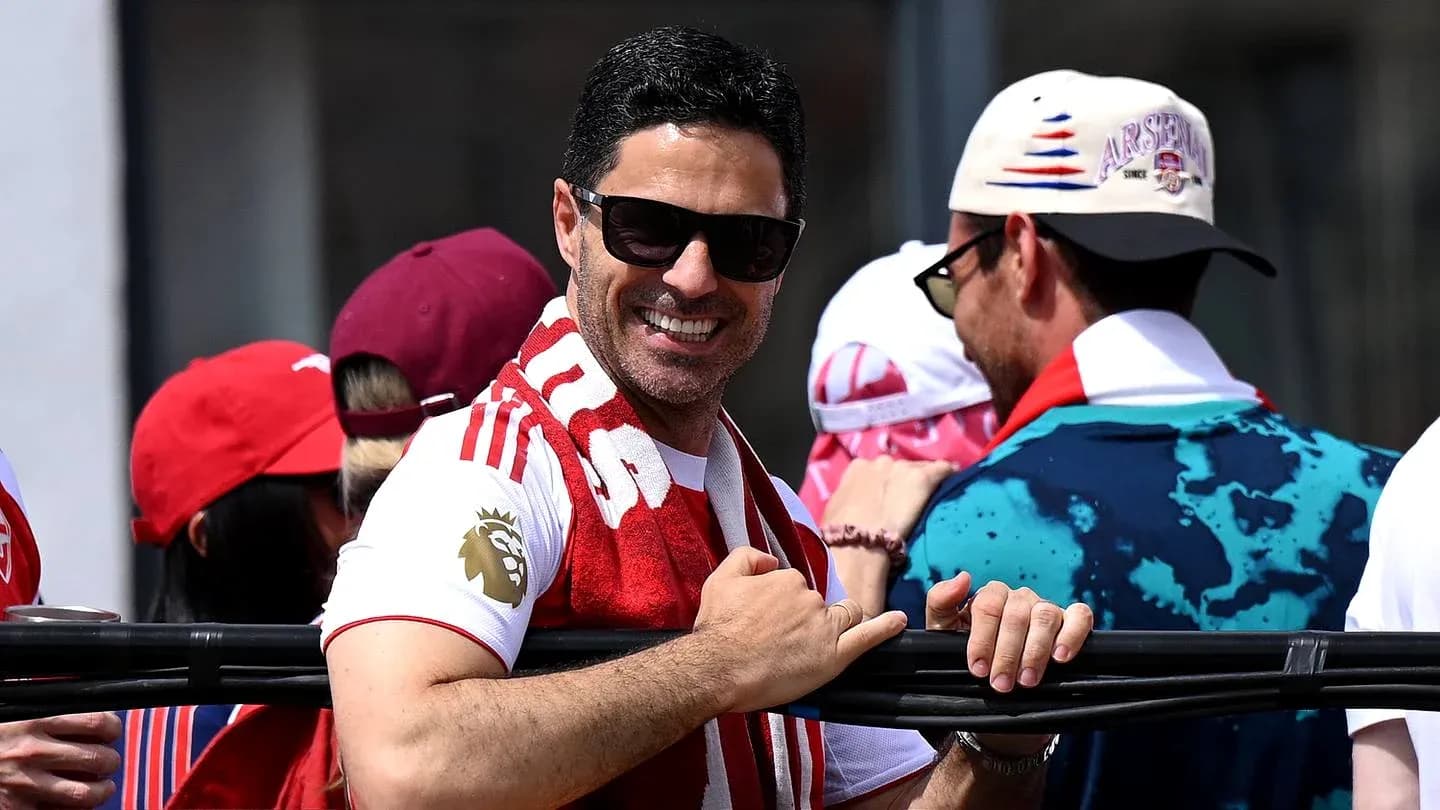
From Arsenal’s preseason base in Spain, Mikel Arteta cut the figure of a man who understands the scale of the opportunity in front of him—and the risks of standing still.
“A lot is happening,” he said, sounding more energised than wary. From ownership down through the board and sporting director, he insisted, there is alignment on one core objective: take Arsenal “to a different level.”
That, in his words, demands “a better squad, better individuals.” The club have already mapped out where they can grow, where the football can evolve, what will be required to stay at the summit rather than just visit it.
The numbers on the board last season were glittering, but the journey was anything but smooth. Arsenal leaned heavily on the technical brilliance of Martin Ødegaard and Kai Havertz, only to see both struggle for consistent minutes amid another wave of injuries. To keep the title charge alive, Arteta’s side increasingly leaned on set pieces, turning dead balls into a weapon as much out of necessity as design.
With stricter rules on the horizon that may blunt some of those routines, Arsenal know they cannot rely on the same tricks. They need more control in open play, more invention between the lines, more help for their creators.
This is where Guimarães fits the picture. He is viewed as the midfielder who can stitch together the phases, feed Ødegaard and Havertz, and still offer his own craft in the final third. He is not a luxury piece. He is a connector.
Up front, the wish list remains bolder. One of Vinícius Jr or Alvarez would be the ideal prize to ignite a frontline that can, at times, run out of ideas. Arsenal scored freely last season, but when the rhythm broke, they often looked short of a player who can tear up a script on his own.
“Hopefully very soon we can start to put things in a very concrete way,” Arteta said, hinting that talks are more advanced than he was prepared to reveal. “Excellence has to be our standard and this has to drive to attack the future.”
His demand is not just about marquee names. It is about daily habits, about “more and more determination and ambition” to prove that last season was not a one-off surge. “We’ve shown that we’ve got it,” he said. Now, he wants his squad to prove they belong at this level—and then push beyond it.
“Take this football club to a different dimension.” It is a bold line, the kind that echoes.
Power, pressure and the cost of ambition
The great Sir Matt Busby once warned managers against talking too loudly about their plans. “It’s very dangerous to shout,” he said, “because in my profession every 24 hours can make you a fool.”
Arteta’s words would normally fall into that category of risk. This time, the context is different. His ambition is being underwritten not just by Arsenal’s owners, but by the tremors it sends through rival dugouts.
If Howe has indeed walked away from Newcastle in part because he believed his best midfielder was being sold to the champions, it underlines where the power now lies. Arsenal are no longer the hunters. They are the club whose interest can shake another manager’s faith in his own project.
The question now is simple and unforgiving: can they turn that power into the kind of squad that not only defends a title, but makes such dominance feel routine rather than remarkable?