.svg&w=384&q=75 "GoalGist logo")
Andy Robertson on Trent Alexander-Arnold's Defensive Challenges at Liverpool
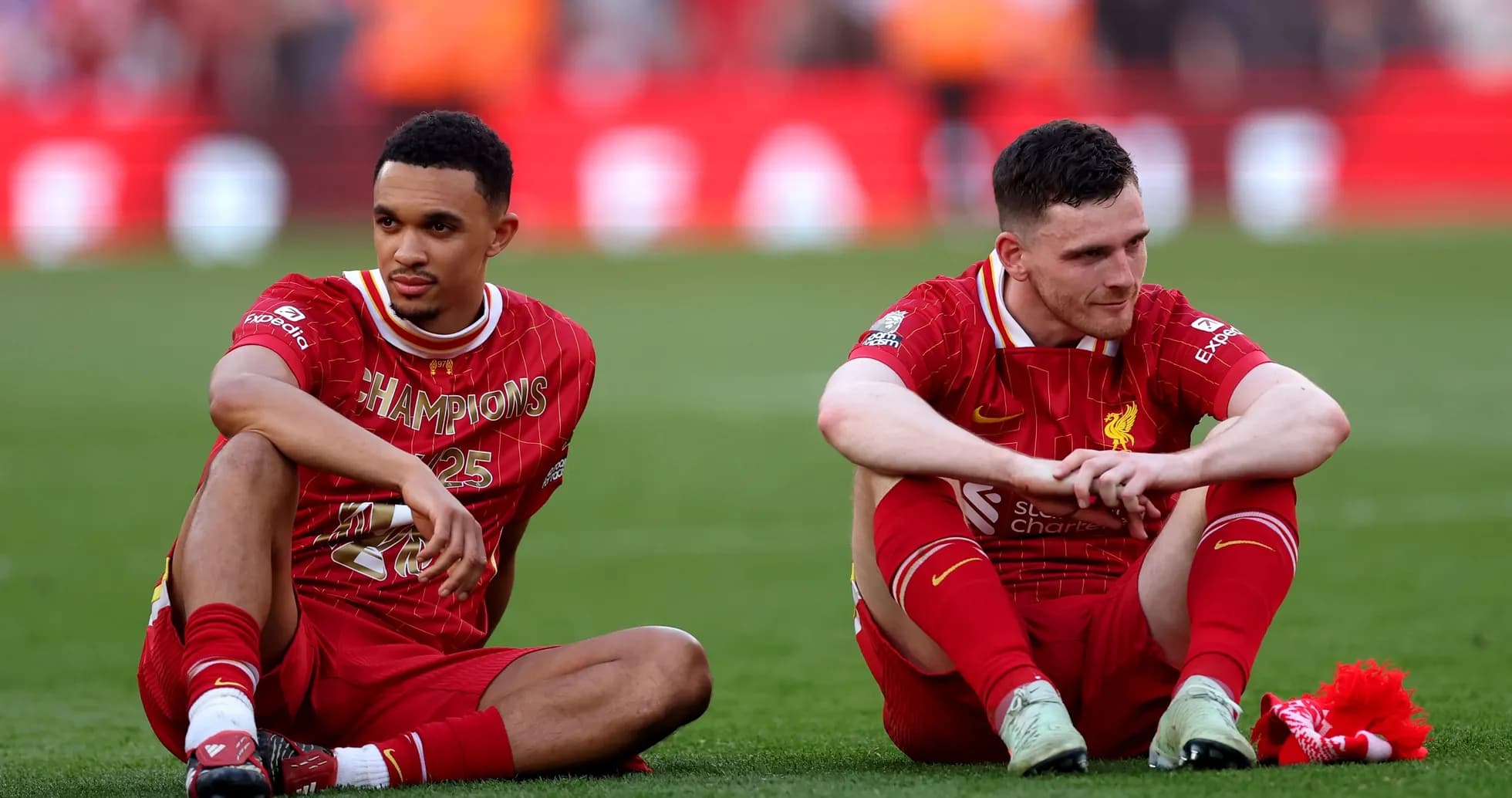
Andy Robertson has lifted the lid on what it was really like defending alongside Trent Alexander-Arnold at Liverpool – and why he always felt his full-back partner took the heavier hits when things went wrong.
Under Jurgen Klopp, the pair formed one of the most devastating full-back duos in modern football. They racked up assists, drove Liverpool to the Champions League in 2019 and the Premier League title a year later, and rewrote what was expected from wide defenders in an elite side.
But behind the numbers, Robertson says the job descriptions on each flank were very different.
‘I started to feel sorry for him’
Speaking on The Overlap, the current Tottenham defender spelled out the tactical imbalance that, in his view, left Alexander-Arnold exposed and fed the long-running criticism of his defending.
On the left, Robertson had Sadio Mane. Relentless, aggressive, always ready to sprint back and double up.
"The way I defended at Liverpool compared to Trent was very different. I had Sadio helping me out and he was a bit more aggressive so if I missed [a tackle], he'd usually be there," Robertson explained.
On the right, Mohamed Salah’s brief was the opposite. His starting positions were higher, his licence to stay forward greater. Liverpool did not want their main goal threat dragged back towards his own penalty area.
"With Mo [Salah], we didn't want him coming back towards our box," Robertson said. "A lot of times, Trent was waiting on someone like [Jordan Henderson] to come over, so, sometimes, I started to feel sorry for him."
So when Liverpool’s press was broken and teams switched play quickly, it was often Alexander-Arnold left one-against-one, with space behind and little immediate cover. The same risk that made Liverpool so dangerous going forward left one man carrying the defensive blame.
Praise, pressure and the ‘English’ spotlight
Robertson also pointed to what he sees as a harsher glare on Alexander-Arnold as an England international compared with his own experience as a Scot.
"It's very different when you are English, compared to another nationality," he said. "I always said to Trent, 'I will never get as much high praise as you, but I'll never get as much criticism as you.'
That scrutiny has followed Alexander-Arnold from Anfield to Spain. He left Liverpool for Real Madrid in 2025, yet the same old talking points about his defending continue to trail him, no matter the opposition or the stage.
Robertson believes that stigma was stamped on his teammate early and has proved stubborn.
"Now, at times, he maybe makes mistakes. But we all do," he admitted. "But it's if [Trent] had this stigma around him, that he can't defend. And he's had that from a very early age. It's as if he can't shift it."
‘He locked out Mbappe’
For Robertson, that narrative simply doesn’t tally with what he saw at close quarters during Liverpool’s peak years under Klopp.
Despite the noise, Alexander-Arnold produced big defensive displays when it mattered most, particularly during Liverpool’s run to the 2018 Champions League final. Against top European forwards, he did far more than just spray passes and whip in crosses.
"I've seen him lock out [Kylian] Mbappe at PSG. In the Champions League finals, he was unbelievable," Robertson said. "Trent is a very, very good defender… [in his] best games, he was an unbelievable one-v-one defender."
Those nights, Robertson argues, should define the conversation far more than the isolated clips that circulate whenever Liverpool’s right side is breached.
A career at a crossroads
Alexander-Arnold, now 27, finds himself at a delicate moment for both club and country.
He has been named in Thomas Tuchel’s latest England squad, another chance to convince a national-team manager that he can be trusted as a starter in a system that has rarely been built around his unique strengths. His international career has often felt like a battle for a consistent role, rather than a celebration of his talent.
At Real Madrid, the challenge is just as stark. Since his move to the Spanish capital in 2025, his La Liga spell has stuttered, with form and rhythm hard to pin down. His future at the Bernabeu hangs in the balance as he searches for the level that once made him the most influential right-back in Europe.
The stigma Robertson talks about still lingers. The next few months will decide whether Alexander-Arnold finally shakes it off – or has to carry that label into the next phase of his career.