.svg&w=384&q=75 "GoalGist logo")
Andoni Iraola's Transition Challenges at Liverpool
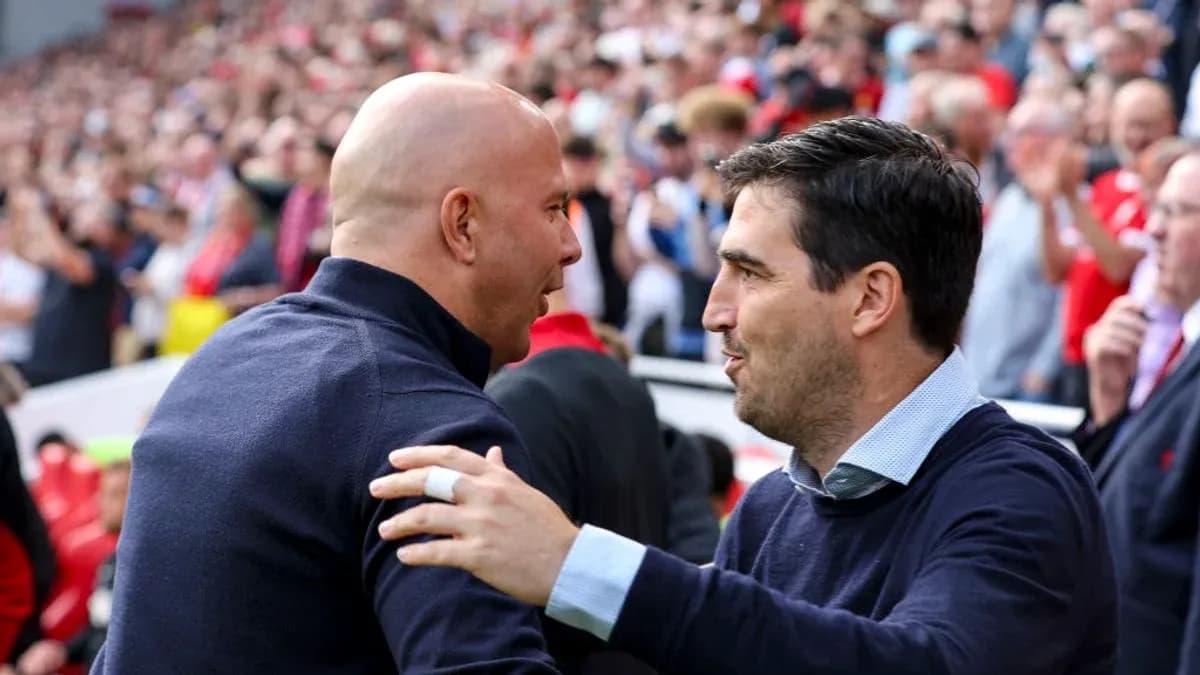
Andoni Iraola has never been afraid of a slow start. At Bournemouth, it took him 10 games to taste a Premier League win. At Liverpool, he will have to wait at least one more week.
A 2-2 draw with Newcastle on opening day was not a disaster. But it was messy. Disjointed. And it underlined, in Iraola’s own words, just how much work lies ahead.
Caught Between Two Identities
Liverpool were outrun by Newcastle and, at times, pulled apart. The structure looked fragile, the distances wrong, the reactions slow. None of that surprised Iraola, who had already used the club’s American preseason tour to question the team’s “energy” levels — a remark that felt like a thinly veiled critique of the Arne Slot era.
Then came an interview with Steven Gerrard for TNT Sports that cut even deeper into Liverpool’s current identity crisis.
Asked if he felt closer in style to Jurgen Klopp or Slot, Iraola did not hesitate.
“Probably closer to Jurgen, probably, I would say. But I loved a lot of the things that the team had with Arne also,” he replied.
That tension sits at the heart of Liverpool’s early-season confusion. Under Slot, the team had been drilled to dominate the ball, recycle possession, and patiently chip away at low blocks. Under Klopp, Liverpool were built to explode in transition, to attack quickly and vertically, to suffocate opponents with intensity.
Iraola clearly leans toward the Klopp model. But he has inherited a squad whose instincts were reshaped by Slot.
“There has to be a balance. Things are going to evolve differently because the first game we had 60, 61 percent of possession straight away,” Iraola said of the Newcastle draw.
“Naturally, because the natural tendency of the players is towards that side, and I need to adapt also towards that side. ... But we also need to keep being vertical, keep attacking, keep taking sometimes some risks.”
That phrase — “natural tendency” — is the red flag.
Possession Without Protection
Against Newcastle, too many Liverpool players drifted into the same zones and stayed there. Dominik Szoboszlai, Ryan Gravenberch, Jeremie Frimpong, Milos Kerkez — all were happy to operate high up the pitch when Liverpool had the ball, hovering around the attacking third, ready to combine.
Under Slot, that was the plan. Pack the final third, probe, recycle, move the block around. You accept some risk behind you in exchange for control in front.
Iraola wants something sharper. Faster. More direct. But if you keep that many players ahead of the ball and then lose it, you expose what Liverpool currently cannot protect: space.
At 35, Virgil van Dijk still reads the game superbly, but asking him to defend repeated counters in big open channels is asking for trouble. Alongside him, Jeremy Jacquet is learning the Premier League in real time. That pairing, left to cover vast areas on the break, was punished twice by Newcastle.
Both goals Liverpool conceded stemmed from exactly that imbalance: a team pushed high and wide to sustain possession, without the compactness or legs to recover when the move broke down.
Iraola is effectively coaching against muscle memory. The squad’s habits lean towards Slot’s control-based blueprint. The manager wants Klopp-like verticality and aggression layered on top. For now, the result is an awkward hybrid that leaves Liverpool vulnerable in transition and not yet ruthless enough with the ball.
Fitness, Intensity, and Time
None of this is happening in isolation. Iraola has already warned that the physical base is not where it needs to be.
After a preseason match against Leeds in early August, he did not sugarcoat it.
"I think we played really good [in the] first half, especially the first 30 minutes, but right now probably we don't have much more in terms of the level required to play like this," he said. "Then they were much better in the second half.
"The problem is right now probably they don't have the energy for 90 minutes and they start to get tired. It will take time with them, we need more training with them."
Those comments, paired with his “natural tendency” remark, paint a clear picture. The squad is not yet conditioned to sustain the intensity Iraola demands, and its default with the ball still belongs to a different coach.
So he faces two Slot-era issues at once: a possession-first mindset that drags the team higher than their defensive security allows, and a fitness level that cannot yet support the relentless, vertical game he prefers.
The draw with Newcastle was a reminder that stylistic transitions at elite clubs rarely happen cleanly. Liverpool hired a coach whose ideas echo Klopp more than Slot, but the squad’s habits, positioning, and conditioning still lean the other way.
Iraola knows this will take time. The question is not whether Liverpool will improve. It is how long a club of this size, and a fanbase raised on immediate impact, is willing to wait while he tears out old wiring and installs his own.