.svg&w=384&q=75 "GoalGist logo")
Andoni Iraola's Liverpool: Addressing Rest Defence Issues
Andoni Iraola walked into Liverpool with one big question hanging over him: could his football scale?
It worked at Rayo Vallecano. It worked at Bournemouth. High intensity, aggressive pressing, a team that lives off collective effort without the ball. That’s one thing when you’re scrapping in mid-table. It’s something else when the brief is to chase a Premier League title and dominate games.
At St James’ Park, on the opening weekend, that question took on a new, more specific shape. Not about pressing. Not about build-up. About something most supporters don’t talk about on the way to the ground.
Rest defence
Liverpool drew 2-2 with Newcastle United. They escaped, really. And they did so with a glaring flaw laid bare in front of everyone.
The idea behind the chaos
Strip football down and it’s simple. You’ve either got the ball or you haven’t.
With it, you attack. Without it, you defend. Those are the two basic phases. But the sport lives in the split-second between them — the moment you lose it, or win it back. That’s where modern coaches obsess.
Rest defence lives exactly there.
The term comes from the German Restverteidigung: the “rest” of your defence, the players left behind when everyone else is piling forward. Not resting as in relaxing, but the remainder — the ones who aren’t directly involved in the attack.
In possession, you might commit six, seven, even eight outfield players to threaten the opposition goal. Rest defence asks a blunt question of the other two or three:
How are you positioned if this move breaks down right now?
Can you slow the counter? Can you kill it at source? Or do you leave your centre-backs staring at a sprint race they don’t want to run?
Against Newcastle, Liverpool’s answer was brutally exposed. Twice.
The first punch: Elanga strikes early
The opening goal starts with Liverpool in what should be a promising position.
Ryan Gravenberch is on the ball, turning neatly into space. He’s the deepest of the midfielders, but his first instinct is to carry. Ahead of him, Dominik Szoboszlai has already joined the front line, threatening the run in behind. Florian Wirtz is to the left, also looking to drive at goal.
Three midfielders. All thinking forward.
Behind them, a problem is forming. Space yawns in front of the Liverpool defence. If Newcastle turn the ball over and find a player in that pocket, Liverpool are exposed.
Will Osula is that player. He’s free between the lines, with no red shirt close enough to engage him if the ball comes his way.
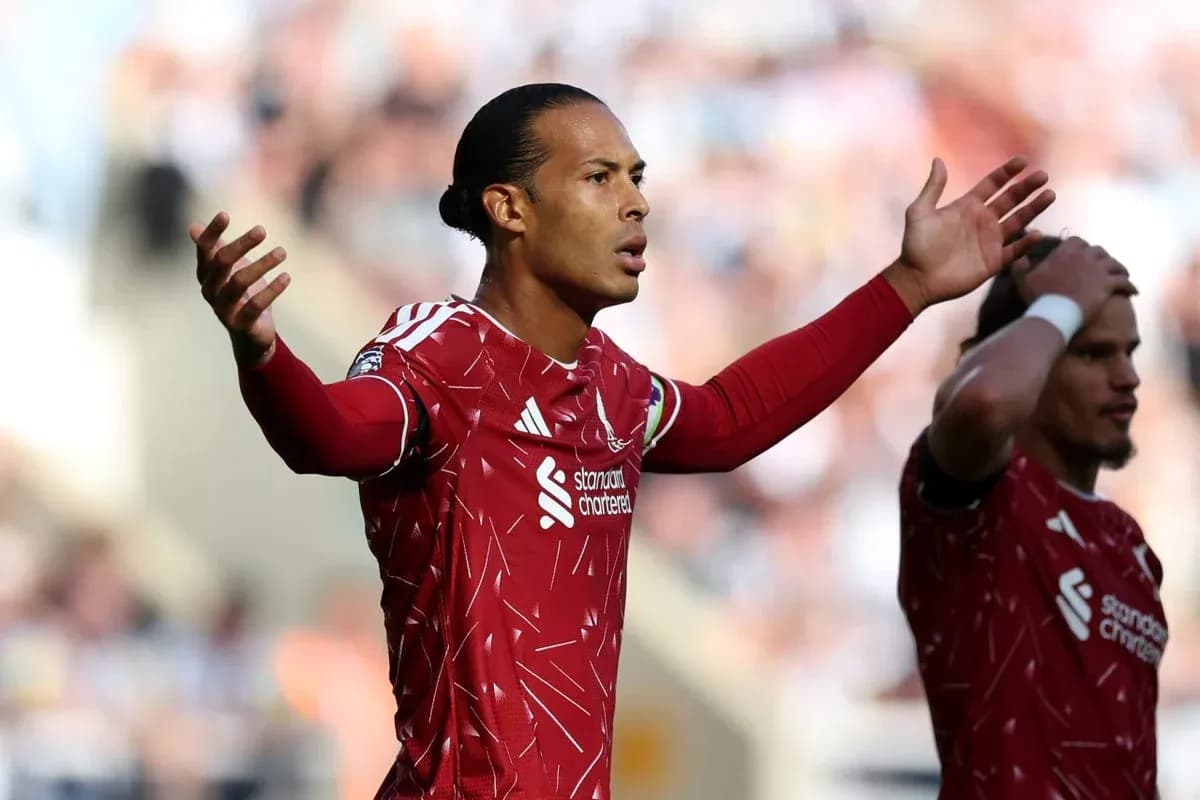
Virgil van Dijk sits a touch too deep — something he later admitted. Wirtz, drawn into the attack, has gone too high given Szoboszlai’s advanced position. Nobody is close enough to Osula. The “rest” of Liverpool’s defence is scattered.
Gravenberch reaches the edge of the box and has choices. He can shoot. He can try to slide Szoboszlai in on his right, a tricky angle on his weaker side or via an awkward technique. Either option likely ends the move in a way that doesn’t punish Liverpool’s poor spacing behind the ball.
Instead, he goes for a risky pass towards Alexander Isak. It doesn’t come off. The ball squirms loose at the edge of the area.
Amar Dedic reacts quickest, stabbing it out towards Osula.
Now the counter is on.
There’s another structural flaw. Milos Kerkez isn’t tight enough to Anthony Elanga. If he had held better proximity, he might have cut out Dedic’s pass and killed the danger. Instead, Elanga is alive to the break and ready to run.
Osula collects under no pressure, builds speed, and forces Liverpool’s centre-backs backwards. Van Dijk can’t show him decisively to the left. The pass finds Elanga. Kerkez, starting from behind, never really gets close enough to disrupt him.
One of the quickest players in the division is suddenly driving at goal with a head start.
Elanga finishes cleanly. Newcastle lead 1-0 inside five minutes. The conversation about Iraola’s Liverpool doesn’t start with pressing triggers or rotations. It starts with what happens when they lose the ball.
Same story, second time: Willock punishes again
Newcastle’s second goal tells a similar tale, even if Liverpool’s shape is marginally tidier.
This time, there is at least some coverage. As Gravenberch steps forward again and Wirtz drops a little deeper, Szoboszlai has better access to Yoane Wissa, who lurks in the central space that could open up on transition.
Even so, the back line sits a fraction too deep. One centre-back could have stepped into midfield to compress the space, leaving the other to sweep behind. Instead, there’s a gap to play into.
Then comes the decision that flips the move.
Gravenberch tries an ambitious backheel. High risk, high reward — but in this area, with Liverpool already stretched behind the ball, the trade-off is brutal. The ball goes the other way, and Newcastle spring.
To their credit, both Wirtz and Szoboszlai react quickly and recover into the zone in front of the defence. They get back around the ball. They’re there, numerically at least.
Wissa, though, still bursts past both. Neither chooses the cynical option: take the foul, take the yellow, stop the attack. Maybe they trust the cover behind. Maybe they think the numbers are enough.
They aren’t.
Liverpool have an overload in terms of shirts around the ball, but they don’t turn that into control. Newcastle ride the pressure, keep the move alive, and Joe Willock arrives at the edge of the box to finish sharply.
Again, the final actions can be picked apart defensively — slow into duels, not aggressive enough in contact, not quite nasty enough in transition. But the root cause sits earlier.
Risky decision on the ball. Imperfect spacing behind it. Rest defence, again.
What it says about Iraola’s Liverpool
This wasn’t the Iraola problem people expected.
At Bournemouth, nobody spent much time dissecting his rest defence. For a start, the context was different. His side had far less of the ball, far fewer prolonged attacking phases where counters could really hurt them. The scrutiny level was lower too.
Liverpool is another universe.
Here, Iraola’s team will dominate possession in most games. That means more time attacking, more bodies committed forward, more moments where one bad touch or one risky pass can flip the pitch.
It also means rest defence becomes a central pillar of the project, not a footnote.
The encouraging part? These are fixable issues, and they don’t demand a philosophical U-turn.
Tactically, the adjustments are straightforward on paper. Midfielders can be drilled to check their team-mates’ positions before driving forward. One centre-back can be instructed to step into midfield in certain patterns, tightening access to opposition forwards like Osula or Wissa. The riskier passes in central areas can be dialled down when the structure behind the ball isn’t set.
None of that cuts against Iraola’s core ideas. It sharpens them.
Personnel offers another lever. Gravenberch’s instinct is to carry, to surge into space and open the pitch up. That has value, but it also stretches the area in front of his back line and increases the burden on his partners to balance him out.
Use a different profile there and the picture changes.
Within the current squad, there are options. Trey Nyoni has looked a natural fit as the deeper of the two midfielders in pre-season, more inclined to hold and screen. Alexis Mac Allister has also impressed in that role when his legs allow him to cover the ground. None of this needs a transfer window to solve; it needs clarity and repetition.
A different kind of opening-day verdict
The narrative many expected this season was of a Liverpool side wild in the press, ragged in possession, trying to bolt Iraola’s intensity onto a squad still adjusting.
At St James’ Park, that wasn’t the story.
Liverpool dominated the ball. They created enough to take something from the game and did, even if the 2-2 felt generous. The problem wasn’t their ability to attack. It was what happened in the heartbeat after those attacks broke down.
Twice, Newcastle punched through the gaps in that heartbeat.
For a manager stepping into the elite bracket, this is the exam paper. Not just whether his ideas work, but whether he can tighten the bolts quickly enough at a club where every transition, every turnover, feels like a referendum.
Liverpool have their point. They have their warning, too.
How fast they solve the rest-defence riddle will go a long way to deciding whether this season is a title challenge or just another lesson.