.svg&w=384&q=75 "GoalGist logo")
World Cup 2026: Farewell Tours for Football Legends
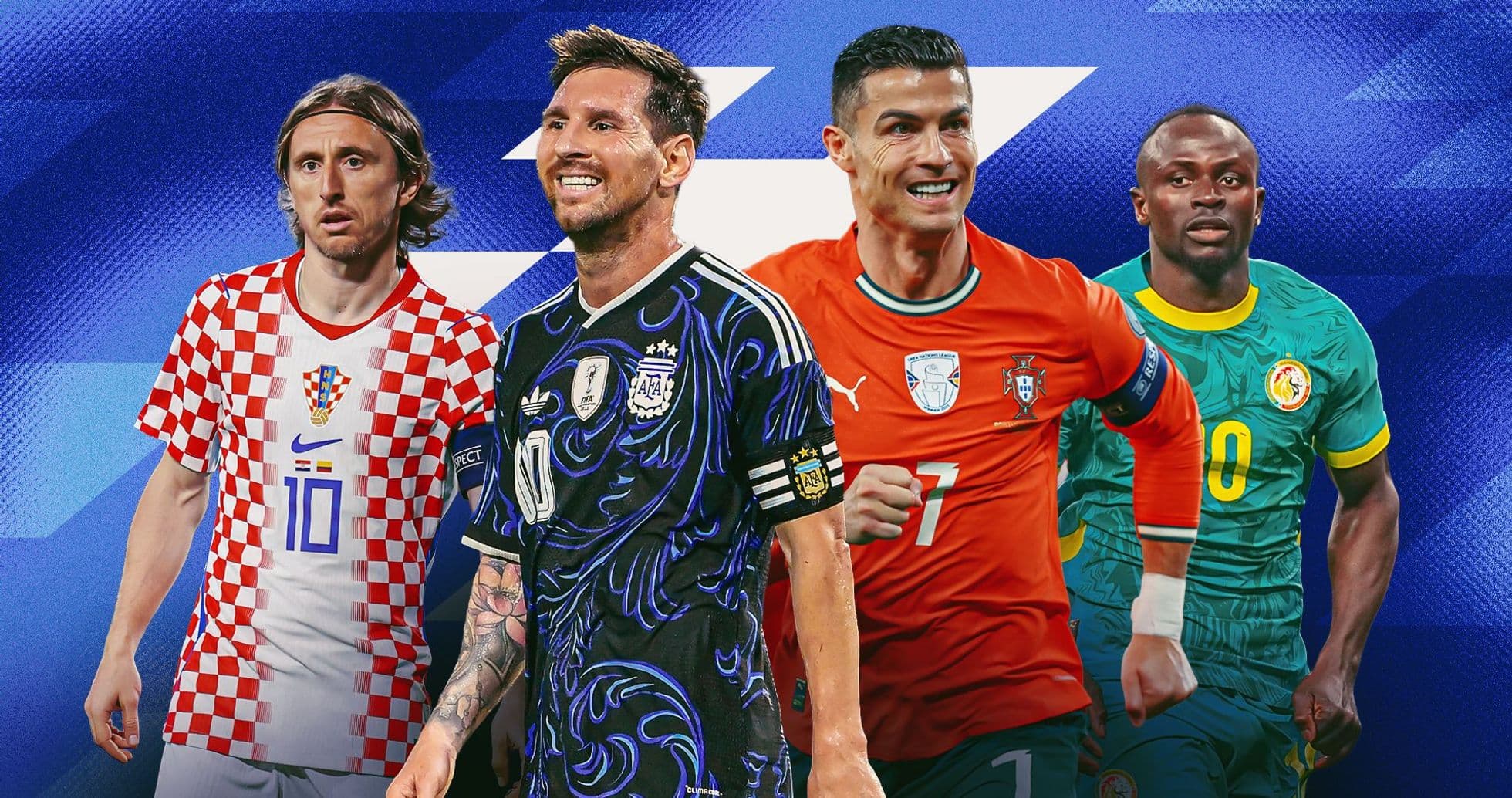
The World Cup has always loved a farewell tour. In 2026, it might stage the biggest one yet.
Across North America, a generation that defined modern football will walk into the heat, the expanded format and the glare of a final global reckoning. Some arrive as champions, others as nearly men, a few as cult heroes. All of them know the clock is no longer their friend.
Messi and Ronaldo: One last shared chapter
Lionel Messi will turn 39 during the tournament and still he comes, chasing a record-breaking sixth World Cup. He has nothing left to prove. He won the trophy in 2022, in that wild, dizzying final against France that settled the greatest- ever debate for many.
Since then, he has swapped European intensity for Miami sunsets and MLS travel, managing his body and minutes with the care of a veteran who understands every muscle and tendon. Yet for Argentina, the magic remains. He still picks passes no one else sees, still finishes moves that younger legs can’t even start.
There are doubts. The expanded World Cup means more games, more miles, more strain. The North American summer will be brutal. But Messi has never been a player who exits quietly. If this is the end, he will try to write it in bold ink.
Cristiano Ronaldo, 41, comes with a different burden. Should Portugal win, he would become the oldest player ever to lift the World Cup. He has never scored in the knockout rounds, never owned this tournament the way he has dominated every other stage. For a five-time Ballon d’Or winner, his World Cup record has always felt oddly incomplete.
He keeps refusing to fade. In Saudi Arabia with Al-Nassr, he still scores relentlessly and still talks like retirement is a distant rumour. Portugal have a stacked squad, full of running and invention, with Rafael Leao, Pedro Neto and Goncalo Ramos waiting to inherit the shirt. Yet Roberto Martinez continues to build around Ronaldo, trusting his presence, his gravity, his obsession.
Like Messi, he will step into a sixth World Cup. Unlike Messi, this is the last throw of the dice for a man who has spent two decades chasing a trophy that never quite came into focus.
Ochoa and Neuer: Goalkeepers who outlived eras
If Messi and Ronaldo were inevitable, Guillermo Ochoa was anything but. The Mexico legend, now 40, had drifted away from the national team, playing just once for El Tri after the CONCACAF Nations League finals in March 2024. His World Cup story looked finished.
Then Angel Malagon ruptured his Achilles in March. A door that seemed bolted shut swung open again.
Ochoa, with more than 150 caps and a career that has taken him through Spain, Italy, France, Portugal, Belgium and most recently Cyprus with AEL Limassol, is back for a sixth World Cup. He has hinted this will be his last act. For two decades, he has been a recurring character in the tournament’s drama; now he gets to write his own ending on home soil.
Germany have their own blast from the past. With Marc-Andre ter Stegen struggling for fitness and doubts swirling around Oliver Baumann, Julian Nagelsmann reached for a familiar name: Manuel Neuer.
Neuer, 40, had already walked away from international football after Euro 2024 on home turf. Nagelsmann persuaded him back. Another strong season with Bayern Munich proved he still reads the game faster than most and still commands a penalty area like few others in history.
The coach has already confirmed him as his No.1 in North America. Germany, scarred by two straight group-stage exits, turn again to the man who once redefined what a goalkeeper could be.
Modric and Dzeko: Final acts for the old conductors
Luka Modric will also be 40 when he leads Croatia out, second only to Ronaldo among the oldest outfield players at this World Cup. His résumé is already heavy: a World Cup final in 2018, a third-place finish in 2022, a Ballon d’Or, and a decade as the heartbeat of his country’s greatest ever side.
He left Real Madrid for AC Milan last summer, a move designed to keep his legs sharp and his minutes manageable. This will be his fifth World Cup, and he stands on the brink of another milestone: one of just four players ever to reach 200 international caps. Messi, on 198, is likely to get there first. Modric, on 197, won’t be far behind.
Edin Dzeko’s path has been rougher. Bosnia and Herzegovina have not been regulars on the major-tournament circuit; their only previous World Cup came in 2014. It would have been easy to assume that was Dzeko’s one shot.
He refused to accept that. Now 40, he dragged his country through the UEFA play-offs, toppling Italy to book a place in North America. About to pass 150 caps, with more than 70 goals for Bosnia, he remains a penalty-box menace. His January move to Schalke reignited his club career, helping fire them back to the Bundesliga.
For a striker of his quality, one World Cup never felt enough. This second chance offers him a proper farewell on the grandest stage.
Asia and Africa’s icons at the crossroads
Son Heung-min turns 34 in July. On paper, he has time. In reality, the weight he carries for South Korea is enormous. He is captain, talisman, symbol and safety net for a nation that lives every kick.
He has already stepped away from European football to join LAFC in MLS, trading the Premier League grind for a different rhythm. By the end of 2026, after another qualifying cycle and another World Cup, he may decide he has given all he can to the national cause.
Mohamed Salah stands in a similar place, just a few days older than Son and just as central to his country’s hopes. For years, he has dragged Egypt forward almost alone. This time, he at least has a stronger supporting cast, with Manchester City’s Omar Marmoush among those easing the creative burden.
But the expectation remains the same: Egypt will look to Salah. His Liverpool form has dipped dramatically over the past 12 months, yet his hunger should be fierce. His only previous World Cup, in 2018, was scarred by the shoulder injury he suffered in that season’s Champions League final. For a player of his stature, the global stage still feels underused.
With a move to Saudi Arabia looming after his departure from Anfield, Salah is entering the winding-down phase of his career. Banking on him to go again in 2030 feels optimistic. This summer may be his last realistic shot at a defining World Cup.
Sadio Mane knows that feeling. The 34-year-old has been the face of Senegal’s rise, scoring the penalty that delivered their first Africa Cup of Nations in 2021 and hauling them to consecutive World Cup appearances. Injury then robbed him of his place at the 2022 tournament.
His move to Al-Nassr has taken him out of the weekly European spotlight, but his commitment to Senegal has never wavered. He still wears the armband, still sets the standard. Around him, Ismaila Sarr and Illiman Ndiaye are blossoming into serious threats. Mane’s experience and calm in big moments could be the difference between another respectable showing and a deep, era-defining run.
Riyad Mahrez completes a formidable African trio. At 35, the former Manchester City winger remains one of the most technically gifted players of his generation. His first touch still kills the ball dead, his dribbling still leaves defenders twisting.
Yet he has only ever played in one World Cup, back in 2014. Algeria have missed every edition since. Now, with his career winding down at Al-Ahli in Saudi Arabia, he finally gets another crack at the biggest stage. For a player of his artistry, this tournament owes him a proper goodbye.
Europe’s brains and backbone feel the strain
Kevin De Bruyne arrives in North America as a question mark as much as a maestro. His first season at Napoli has been punctured by injuries, and there is a growing fear that his body is starting to betray him as he nears 35.
When he is fit, no midfielder stitches a game together quite like him. He can split a defence with a single pass, change a match with a shot from distance, or simply dictate the tempo until opponents crack. Belgium’s much-hyped ‘Golden Generation’ is fading, but De Bruyne remains the reference point, the man everything orbits.
Rudi Garcia’s squad is in transition. That might suit De Bruyne. Less ego, more responsibility, one last chance to drag his country into contention as a dark horse rather than a heavily backed favourite.
Virgil van Dijk, meanwhile, will turn 35 during the World Cup and still stands as the anchor of the Netherlands. For years at Liverpool he has been the defender forwards tried to avoid, the one-on-one they did not want.
The past season has not been his best. On Merseyside, there are whispers that he has lost a fraction of pace, that his anticipation is not quite as razor sharp. That only heightens the stakes. Dutch fans will hope the orange shirt restores his dominance, because this is almost certainly his second and final World Cup.
James, Neymar and the artists chasing one last spark
Some players belong to the World Cup more than to any club. James Rodriguez is one of them.
He will turn 35 in July, and for Colombia supporters, his presence in North America is non-negotiable. His 2014 tournament, with those outrageous goals and effortless swagger, catapulted him to Real Madrid and etched his name into World Cup folklore.
Injuries have stalked him ever since. He has bounced between clubs, including a recent stint with Minnesota United in MLS, using short contracts to stay fit enough for the moments that matter most: international duty. His career was made by this tournament. A final appearance feels like football closing its own circle.
Neymar’s relationship with the World Cup has been complicated, painful, and endlessly dramatic. Now, at 34, he gets one last chance.
Brazil’s all-time leading scorer has not played for his country since tearing his ACL in October 2023. Carlo Ancelotti, after taking over the national team in September, initially looked ready to move on without him. Injuries to other forwards forced a rethink.
At the last moment, Ancelotti called him into the 26-man squad, a decision that sent Brazilian fans into raptures. Neymar, now back at Santos, has to prove his fitness again after suffering yet another injury just days after that call-up. His body is clearly rebelling.
No one seriously expects him to make it to 2030. This is his final shot at the trophy that has always seemed just out of reach, the one that would finally give Brazil their sixth star and give Neymar’s career the closure it craves.
Kane and England’s looming handover
Amid all the goodbyes, Harry Kane stands at a different point in his story. At 32, he may be at his absolute peak. More than 60 goals for Bayern Munich this past season underline that he remains one of Europe’s deadliest finishers, and he already sits alone as England’s record scorer.
Could he go on to 2030? Absolutely. The gap between him and the next generation of English strikers is wide, and fans of the Three Lions will cling to the hope that his body and motivation hold.
Yet the calendar offers a natural break. England will co-host Euro 2028. For Kane, that tournament on home soil could be the perfect moment to sign off from international duty, especially if it ends with a long-awaited trophy.
If that happens, this World Cup becomes his last on the global stage. The same might be true for Jordan Pickford, John Stones and perhaps even Marcus Rashford. The lure of a final lap in front of their own fans in 2028 will be strong.
Across continents, the pattern repeats: icons at the edge, legends stretching their careers into one last summer, bodies creaking but minds still burning. The World Cup has always been about the future, about the next star and the next story.
In 2026, it might belong, just for a moment, to the players who refuse to let go.