.svg&w=384&q=75 "GoalGist logo")
Vinicius Jr's Impact on Premier League Dynamics
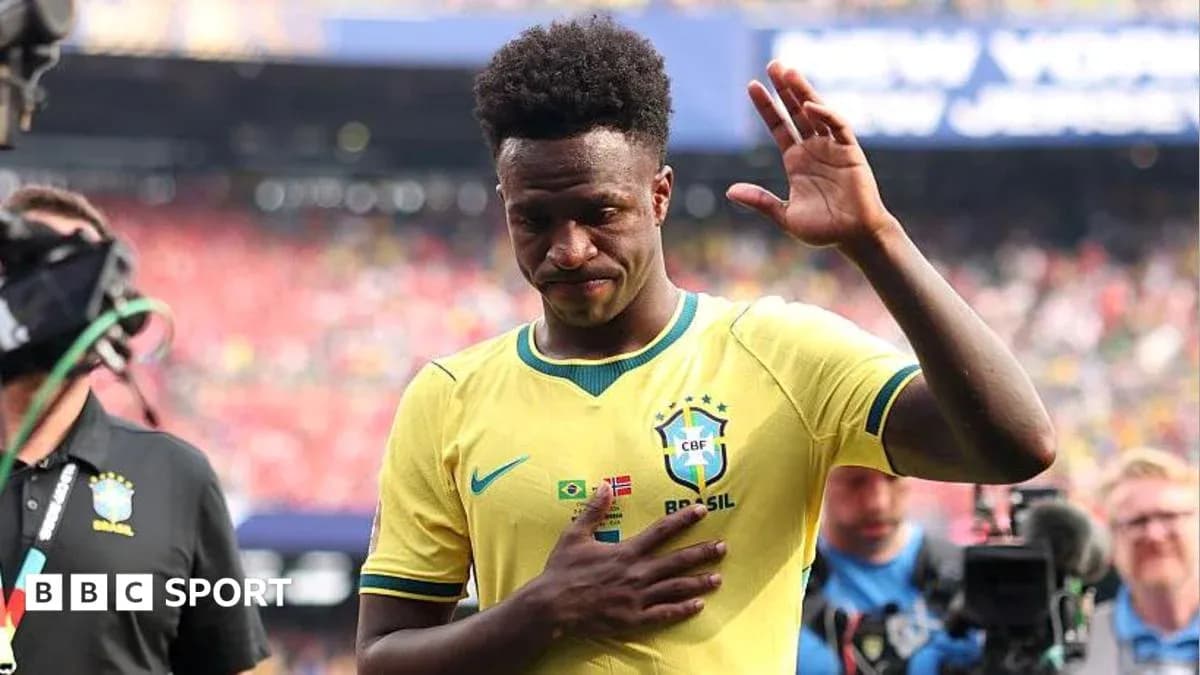
If Vinicius Jr had walked into Arsenal’s dressing room this summer, it would have felt like a rupture in the modern order of European football.
A genuine, fully formed global superstar. In his prime. Choosing the Premier League not as a launchpad, but as a destination.
Arsenal were ready for that scenario. The Brazil forward was lined up as their primary target if he ever decided his time at Real Madrid was over, and at 26 he was at least open to listening. For a moment, the door stood ajar.
Then came the signature. A new contract at the Bernabeu, running to 2032, and with it another reminder of a stubborn truth about English football’s superpower.
The Premier League is rich. It is relentless. It is widely seen as the strongest domestic competition in the game. Yet when it comes to attracting fully established Ballon d’Or contenders, players already seated at the top table, it still loses too many arguments.
The league of makers, not takers
Premier League clubs can buy almost anything. Almost.
They hoard elite centre-backs and goalkeepers with ease. They stockpile internationals, build squads two-deep with £50m footballers, and drive up prices within their own borders. But at the sharp end of the pitch, where the game’s true icons tend to live, the picture changes.
Since the league’s launch in 1992, only three men have won the Ballon d’Or while playing for an English club: Michael Owen with Liverpool in 2001, Cristiano Ronaldo at Manchester United in 2008, and Rodri at Manchester City in 2024. Three in more than three decades of unprecedented financial might.
What England does better than anyone is something else entirely: it turns potential into superstardom.
Dennis Bergkamp arrived at Arsenal with doubts hanging over him after a difficult spell at Inter Milan. In north London he became one of the most influential players the Premier League has seen. Eric Cantona showed flashes in France and at Leeds, but it was at United that he became the defining symbol of their first great Premier League side.
Thierry Henry came to Arsenal from Juventus as a winger still trying to work himself out. In England he grew into one of the outstanding forwards of his generation. Ronaldo joined United at 18 from Sporting, a raw, thrilling winger. Five years later he had a Ballon d’Or in his hands and a ticket to Real Madrid.
Erling Haaland fits the pattern too. When Manchester City signed him from Borussia Dortmund in 2022, he was already one of Europe’s most coveted young strikers. He was not yet what he has since become in England: a devastating, almost mechanical goalscorer, one of the most feared number nines in world football.
That is a different proposition from signing someone like Vinicius after multiple Champions League titles, after he has already become one of the sport’s most recognisable faces.
The rare arrivals at the summit
There have been exceptions, but they are thin on the ground and often tinged with “what if?”.
The clearest comparison to Vinicius remains Andriy Shevchenko. Chelsea took him from AC Milan in 2006 when he was 29, just two years removed from winning the Ballon d’Or and having finished fifth in the voting in 2005. He arrived as a fully formed global superstar, still close enough to his peak to feel like a coup.
Ruud Gullit and George Weah also came to Chelsea as Ballon d’Or winners, but those moves came late in their careers. Ronaldo’s emotional return to Manchester United came at 36. Zlatan Ibrahimovic joined United at 34. Jurgen Klinsmann signed for Tottenham at 30.
These were marquee names, no doubt. They were also, in different ways, after the crest of the wave.
Contrast that with the era when Serie A sat at the centre of the football universe. In the 1980s and 1990s, Italy was both rich and irresistible, the natural habitat for the game’s biggest stars.
Diego Maradona left Barcelona for Napoli at his explosive best. Brazil’s Ronaldo moved from Barcelona to Inter in his pomp. Michel Platini, Marco van Basten, Lothar Matthaus, Zinedine Zidane – all spent some of their finest years in Italy. Serie A did not simply polish rough diamonds; it bought the crown jewels.
A different kind of dominance
The Premier League’s financial muscle has created something else: depth rather than singular glamour.
English clubs spend enormous sums, but those fees often spread across entire squads or circulate within the league itself. Alexander Isak, Morgan Rogers, Elliot Anderson, Moises Caicedo, Declan Rice and Jack Grealish have all moved between Premier League sides for more than £100m.
Those are not global icons in the traditional sense. They are elite pieces in a collective machine, bought as much for tactical fit and long-term value as for shirt sales.
From abroad, the pattern is similar. Players such as Liverpool’s Florian Wirtz arrive with big reputations and serious hype, but with the sense that their best years still lie ahead of them. They come to grow, not to crown a career.
The model is clear: less about importing a single “Galactico”, more about assembling 18 to 22 top-level players capable of surviving a 60-game season at a ferocious tempo. The star is often the system.
Haaland stands as the counterargument, the one who came young and is now brushing the ceiling of the sport. City took him at 21 and he has since become the terrifying spearhead of their era of dominance.
Yet even his story underlines the pull of Madrid.
During the 2026 World Cup, his father Alfie spoke to DAZN about the possibility of his son one day moving to the Bernabeu. “He’s happy at City, he’s got a long contract… but any player wants to play for Real Madrid,” he said.
No transfer request. No countdown clock. But the sentiment cut through.
England can build the stage. It can mint new idols, inflate markets, and shape careers. The harder part is persuading those who already rule the sport to choose the Premier League at their peak – and, when they get there, convincing them that the summit they dream of is in Manchester or London, not still shimmering on the hill in Madrid.