.svg&w=384&q=75 "GoalGist logo")
Universitatea Craiova vs Ararat-Armenia Tactical Analysis
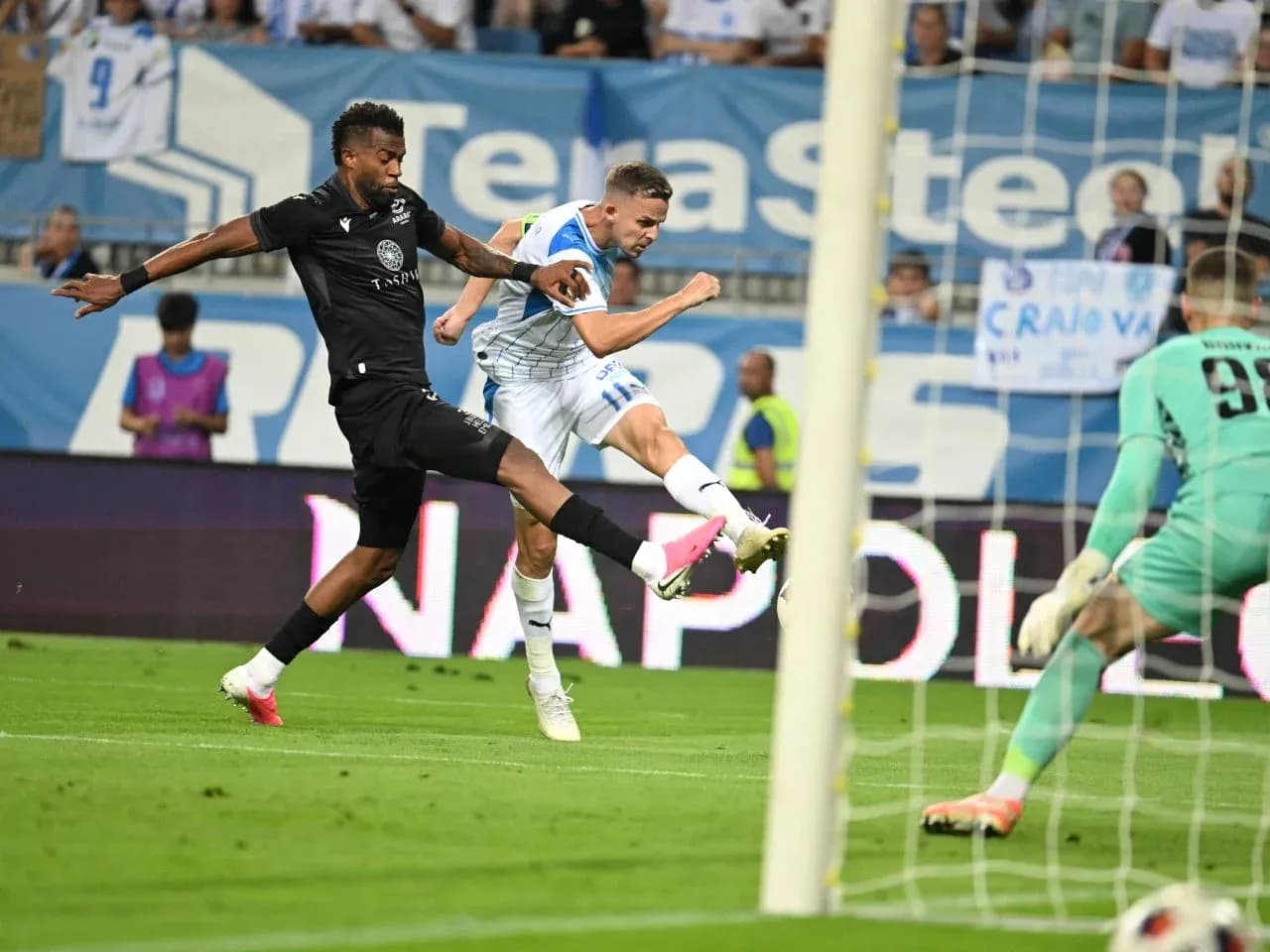
Universitatea Craiova’s 3-4-3 against Ararat-Armenia’s 4-3-3 produced a territorially assertive but ultimately blunt home performance at Stadionul Ion Oblemenco, ending 1-1. The statistical profile is clear: Craiova generated more shots on goal (7 to 2), more corners (8 to 4) and committed three times as many fouls (15 to 5), yet could not convert structural dominance into a decisive second goal.
Filipe Coelho’s 3-4-3 was built around a back three of V. Screciu, A. Rus and O. Romanchuk, with N. Bancu and C. Mora as wide midfielders and A. Mekvabishvili and A. Cicaldau inside. Ahead of them, D. Matei operated as the advanced midfielder behind the front pair of A. Al Hamlawi and S. Baiaram. This layout aimed to pin Ararat-Armenia’s full-backs and create overloads in the half-spaces, particularly through Bancu on the left.
Ararat-Armenia’s 4-3-3, guided by Tulipa, was more conservative and line-oriented. A back four of E. Grigoryan, A. Malis, B. R. Wilson Valdez and Junior Julio sat behind a compact midfield triangle of K. Muradyan, Benny and H. Oliveira, with A. Serobyan and Z. Banjaqui supporting central forward Sandro Lima. In practice, this functioned as a 4-1-4-1 out of possession, with one midfielder screening in front of the centre-backs and the wide players dropping to form a second line of four.
The pattern of the match revolved around Craiova’s attempts to progress through wide channels. With three centre-backs, Coelho could commit both wing-oriented midfielders high. Bancu, nominally a midfielder on the left, acted as a hybrid wing-back and playmaker, timing his surges beyond the first line and combining with Cicaldau and Matei. The 7 shots on goal underline that the home side were able to arrive in finishing zones regularly, but the lack of recorded total shots and xG makes it impossible to quantify the quality of these chances.
Craiova’s defensive behaviour was aggressive and front-footed. The 15 fouls, compared to Ararat-Armenia’s 5, reflect a strategy of disrupting transitions early, especially once the ball was lost in the attacking third. The yellow cards to David Matei (39'), Oleksandr Romanchuk (47'), Adrian Rus (69') and Monday Etim (78') show that this intensity spilled into repeated infringements across the defensive line and midfield. Each caution came without a specified reason in the data, but their spread across positions suggests systemic, not purely individual, over-commitment.
Tulipa’s side, by contrast, accepted long spells without the ball and focused on compactness. With only 2 shots on goal and 4 shots off goal, Ararat-Armenia’s attacking presence was sporadic, but they were efficient early on, capitalising through A. Malis from a set or second-phase situation assisted by H. Oliveira. Their 5 fouls and absence of yellow cards point to a controlled defensive approach, favouring positional discipline over duels.
Substitutions in the second half underline the tactical intentions of both coaches. At 62', Coelho made a double change: S. Nsimba (IN) came on for A. Al Hamlawi (OUT), and M. Etim (IN) came on for D. Matei (OUT). These moves refreshed the front line and the advanced midfield role, seeking more vertical threat and energy between the lines. Later, at 69', Teles (IN) replaced A. Cicaldau (OUT), subtly rebalancing the midfield, and at 85' T. Baluta (IN) came on for A. Mekvabishvili (OUT) while L. Basceanu (IN) replaced S. Baiaram (OUT). By the closing stages, Craiova had effectively rotated much of their attacking and central midfield unit, chasing higher tempo and fresh pressing legs rather than altering the 3-4-3 structure itself.
Ararat-Armenia’s changes were more about preserving shape and legs than changing system. At 69', Franca Carlos (IN) replaced Benny (OUT), refreshing central midfield. At 75', J. A. Balanta (IN) came on for H. Oliveira (OUT), another like-for-like adjustment in the middle third. The triple substitution on 80' – Z. Shaghoyan (IN) for Z. Banjaqui (OUT), M. Carlier (IN) for K. Muradyan (OUT), and A. Tera (IN) for A. Serobyan (OUT) – re-energised both flanks and the midfield screen simultaneously, ensuring the 4-3-3/4-1-4-1 block could maintain intensity against Craiova’s late pressure.
Set-play dynamics and wide pressure are reflected in the corner count: Craiova’s 8 corners to Ararat-Armenia’s 4 suggest the home side forced more last-ditch defending and blocks around the box, consistent with their 7 shots on goal and 1 blocked shot. Ararat-Armenia’s 2 blocked shots hint that, when they did venture forward, Craiova’s back three stepped out aggressively to close shooting lanes.
Possession is recorded as "0%" for both sides, which is clearly unusable and must be treated as an absent metric rather than a genuine indicator. Without valid possession or passing data, we cannot quantify circulation or build-up control, but the foul profile, shot distribution and corner imbalance collectively support the reading of Craiova as the territorial protagonist and Ararat-Armenia as a compact, counter-punching unit.
Goalkeeper-specific statistics are not provided in the data, so no precise evaluation of L. Popescu’s (Universitatea Craiova) or Joao Bravim’s (Ararat-Armenia) shot-stopping or goals prevented is possible. What can be inferred from team-level shooting is that Bravim faced the heavier workload in terms of shots on goal, while Popescu had to remain concentrated despite longer periods of relative inactivity.
Overall, the tactical story is of a home side using a back three and advanced wide midfielders to create pressure and volume, but lacking the extra layer of creativity or penalty-box efficiency to turn that into a win. Ararat-Armenia, in a disciplined 4-3-3, accepted territorial inferiority, relied on an early breakthrough and then defended it with structure, minimal fouling and carefully timed, like-for-like substitutions to keep their block intact to the final whistle.