.svg&w=384&q=75 "GoalGist logo")
Twenty-Nine Years Since Henrik Larsson Transformed Celtic
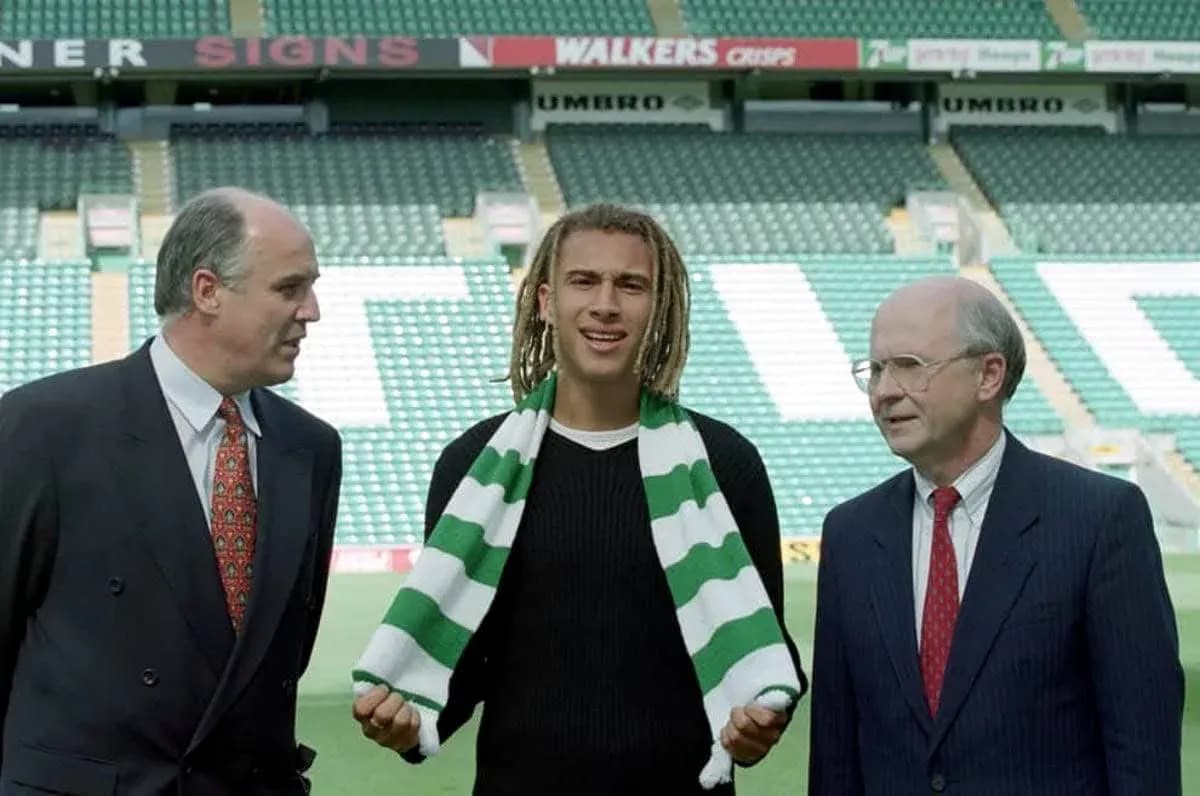
He walked out in a Hoops top and denims, dreadlocks bouncing, onto the Celtic Park turf. A 25-year-old Swede, signed from Feyenoord for £650,000, announced as Celtic’s latest gamble.
On 25 July 1997, Henrik Larsson arrived. Nothing at the club would ever quite be the same again.
Wim Jansen knew what he was doing. He had already signed Larsson once for Feyenoord and understood the contract situation that allowed Celtic to prise him away for what would become one of the great bargains of the modern game. At the time, it was a shrewd bit of business. In hindsight, it was daylight robbery.
From early slip to instant heartbeat
The start was anything but regal. Larsson’s Celtic debut is remembered for the wrong reason: a misplaced pass at Easter Road that helped Hibs to an opening-day win. It was the sort of moment that can bury a new signing in Glasgow.
He didn’t flinch.
Game by game, he stitched himself into the fabric of the team. Goals, assists, relentless running, a quiet steel behind the easy smile. The dreadlocked forward went from curiosity to cult favourite to undisputed talisman in the space of a season.
That first year brought a League Cup win and, far more importantly, the league title that “stopped the ten”. Celtic’s first championship in a decade, wrestled back from Rangers, with Larsson at the centre of it all. He wasn’t just a good signing. He was the difference.
Becoming the complete striker
If his debut season made him vital, the next one turned him into a phenomenon.
Under Dr Jozef Vengloš, Larsson exploded. Thirty-eight goals. Left foot, right foot, headers, tap-ins, volleys from distance. He evolved into the complete striker: penalty-box predator, creative link man, relentless presser. Whatever Celtic needed in the final third, he provided it.
By then, it wasn’t just about his goals. It was the inevitability of them. When Larsson was on the pitch, Celtic always felt like they had an answer.
Breaking, then bending the odds
Then came Lyon. A horrific leg break in European competition that silenced a stadium and threatened to halt one of the great Celtic careers in full flow.
For many, that kind of injury is a turning point in the wrong direction. Larsson used it as a springboard. He rebuilt himself and returned sharper, more ruthless, mentally stronger. The period around that injury also coincided with the unraveling of John Barnes’ brief spell in charge, a reminder of just how much Celtic leaned on their No.7.
The club wobbled. Larsson didn’t.
O’Neill, Sutton and a 53-goal monster
When Martin O’Neill walked through the door, the stage was set for Larsson to reach a different stratosphere.
Paired with Chris Sutton, he found his perfect foil. Sutton’s physical presence and intelligence created space; Larsson filled it with cold, clinical brilliance. In O’Neill’s first season, Celtic swept to a domestic treble – their first clean sweep in 32 years – and Larsson plundered 53 goals.
Fifty-three.
It was a number that sounded almost cartoonish, but it reflected what he produced: towering headers, deft chips, ruthless one-on-ones. He wasn’t just Celtic’s finisher. He was their leader, their symbol, the man who turned big games into his own stage.
Europe and a night in Seville
The years that followed kept the silverware flowing at home, but Larsson’s legend stretched far beyond Scotland’s borders.
His goals powered Celtic deep into Europe, culminating in the run to the UEFA Cup Final in 2003. On a sweltering night in Seville, against a cynical and streetwise Porto side, Larsson delivered two world-class finishes in a losing cause, dragging Celtic into extra time almost by force of will.
They lost the final. His reputation soared anyway. On one of the biggest nights in the club’s modern history, he was the standout figure on the pitch.
Leaving as a legend
By the time he left Celtic in 2004, the numbers told their own story: 242 goals in 313 appearances. Third on the club’s all-time scoring list in its long, unbroken history.
The statistics are stark. The feeling he left behind is harder to measure.
For one generation, Jimmy Johnstone and the Lisbon Lions will always be the standard. For another, the 1970s will forever belong to Kenny Dalglish, another king who crossed the border and became Liverpool’s greatest.
But ask most Celtic supporters who grew up watching the club from the late 1990s onwards, and the answer comes back the same. Henrik Larsson is the greatest they have seen in the Hoops. The King of Kings.
Twenty-nine years on from that summer day at Celtic Park, the image remains vivid: the denim, the dreadlocks, the shy smile. A modest entrance for a man who would come to define an era and set a benchmark that every Celtic forward since has been measured against.
The question now is not whether he was a legend. It’s whether anyone will ever quite touch what he became.