.svg&w=384&q=75 "GoalGist logo")
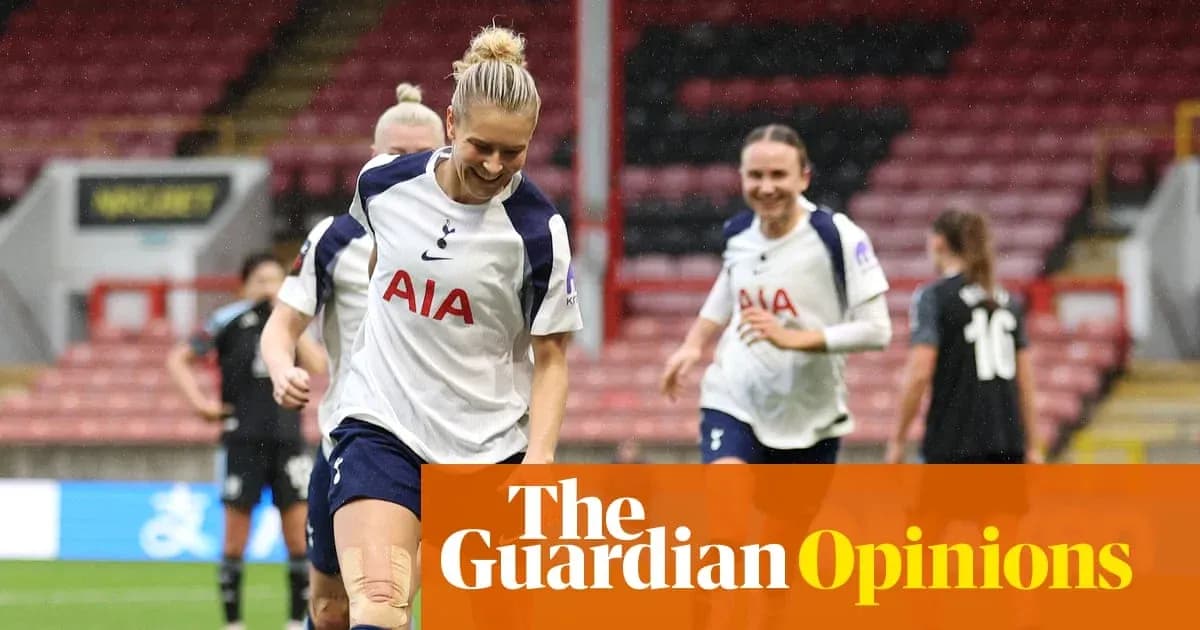
Tottenham Women: A Season of Progress and Ambition
Tottenham’s women did more than play good football last season. They offered a lifeline.
While the men’s side spent months eyeing up relegation like a long-term commitment, the women quietly stitched together the most accomplished campaign in their WSL history. As the men’s season lurched from anxiety to apathy, the women delivered 90 minutes of clarity every week: attacking, organised, and unapologetically ambitious.
A season that actually deserved a lap of honour
Tottenham’s Premier League survival felt like relief, not triumph. By contrast, the women’s team produced moments that genuinely merited celebration.
There was the 7-2 demolition of Aston Villa, a scoreline more reminiscent of training-ground mismatches than top-flight contests. There was that surreal FA Cup penalty shootout against London City Lionesses, where the first 17 penalties found the net before someone finally blinked. And there were the goals. Cathinka Tandberg’s 40-yard strike wasn’t just a highlight; it was the sort of outrageous hit that rewires how a fanbase talks about a player.
While the men’s WhatsApp groups dissolved into tactical despair – why the endless passing around the box, where were the emergency signings? – there was an alternative. Three years ago, one family took it. They became Tottenham Women season-ticket holders, a decision sparked not by Spurs but by England’s Lionesses.
In Brisbane during the 2023 World Cup, England’s 2-1 quarter-final win over Colombia turned into something unexpected. Outnumbered roughly 100 to 1 in the fan zone, a small cluster of England supporters found themselves being congratulated by Colombian fans. Handshakes, smiles, respect. That, you think, is the kind of football culture you want your child to grow up with.
Tottenham Women have carried that feeling forward.
Martin Ho’s imprint
The turning point came with a coaching change. Martin Ho arrived last year with a solid, if understated, résumé: assistant at Manchester United, head coach at Brann in Norway. The whispers from inside the camp were simple and consistent – the players liked him, and more importantly, they respected him.
He didn’t just stay in the dugout. At Leyton Orient, where Spurs Women play most of their home games, Ho has been known to wander through the Legends Lounge before kick-off, chatting with supporters. It’s a small gesture, but it underlines a connection that feels genuine.
On the pitch, his impact has been unmistakable. Spurs played on the front foot, but with structure. Roles looked defined, responsibilities clear. The team moved as if everyone knew exactly where the help would come from.
That clarity marked a sharp break from what came before. In 2024-25, Tottenham had badly underperformed, finishing just one place above relegation and prompting the departure of Robert Vilahamn. Last season, under Ho, they roared out of the blocks, winning five of their first six games. Nobody outside the dressing room knows exactly what he told the squad, but it clearly wasn’t an Igor Tudor-style demolition job about what they couldn’t do.
They attacked. They defended. They ran. And they did all three well.
Eveliina Summanen anchored and harried. Amanda Nildén offered balance and intelligence. Lize Kop brought security in goal. Drew Spence and Clare Hunt added steel, craft and presence. This was a side that didn’t just avoid collapse; it imposed itself.
Chasing the WSL heavyweights
There were bruising days. Manchester City handed out a couple of thumpings, powered by Khadija “Bunny” Shaw, whose goals-per-game ratio outstrips even Erling Haaland’s. But City went on to win the league, finishing ahead of Arsenal, Chelsea and Manchester United – the four clubs that have long set the pace in the WSL.
Tottenham finished fifth, leading the chasing pack behind those giants. That position wasn’t a fluke. It was a statement: this is a club edging towards the top tier, not clinging to its coat-tails. Cracking the top four no longer feels fanciful; it feels like a live target for the next season or two.
Recruitment has matched that ambition. Midfielder Olivia Holdt finished as the club’s top scorer last season, a testament to her timing and technique from deeper areas. At the back, Toko Koga emerged as a rock in central defence. January brought another dimension with Signe Gaupset, a midfielder who doesn’t just carry the ball – she drives through lines with it, turning defence into attack in a few purposeful strides.
The work didn’t stop when the season did. Within days of the final whistle, Spurs moved to strengthen again. Caitlin Dijkstra, a highly rated Netherlands international, arrived from Wolfsburg to reinforce the back line. Up front, Shekiera Martinez joined after showing sharp, clinical finishing at a struggling West Ham. Kirsty Hanson came in from Aston Villa, and Alice Sombath from OL Lyonnais, adding proven quality and depth across the pitch.
This is what a plan looks like.
Farewells that still sting
Progress, though, has its cost. Spurs have already had to say goodbye to two figures who helped define this era.
Ashleigh Neville’s departure to Leicester makes sense on a human level – a move closer to home – but it still leaves a gap in personality and presence. Bethany England’s exit is harder to rationalise. As the club’s record goalscorer, she had earned at least the conversation about a one-year extension. It never came. For many, that will remain a nagging frustration.
By the time the new season kicks off, the team on the pitch will look markedly different from the one that early adopters fell for three years ago. Yet something crucial has endured: the bond in the stands.
A different kind of Spurs experience
The regulars at Spurs Women games are not casual observers. Many have followed both the men’s and women’s teams for years. They write blogs, host podcasts, and make the thankless midweek trips to places like West Ham, standing in the rain and wind for a sliver of joy. Some remember the days when only a handful watched Broxbourne Ladies, as the club was then known, grind their way up the divisions.
Their knowledge is deep. Their investment is real. And the atmosphere they create is distinct.
Frustration still crackles around the ground when decisions go against Spurs. Referees are asked, with pointed politeness, whether they have recently visited a well-known high street optician. But the rage and relentless swearing that so often poison men’s fixtures are largely absent. The temperature is lower, yet the passion is not.
Before kick-off, banners appear across the stands: Spurs players framed by the Progress Pride flag. It’s more than decoration. It’s a clear message that LGBTQIA+ identities are not just tolerated here, but celebrated. For some supporters, it has been an awakening, a reminder of how powerful football can be as a force for inclusion and change when a club chooses to lean into that role.
On the pitch, the product holds up. Women’s football might be a shade slower than the men’s game in pure physical terms, but the matches themselves are brisk, open and uninterrupted by VAR. There are still the occasional officiating blunders, of course, but they come with a trade-off: no five-minute waits, no heads craning towards a screen, no hollow celebrations cut short by a distant review.
You see the ball hit the net. You celebrate. You live with the decision.
Where this is heading
All of this – the football, the signings, the culture – points in one direction. Tottenham Women are no longer just a pleasant distraction from the men’s turbulence. They are a serious WSL outfit with a credible shot at breaking the established order.
The hope now is simple: bigger crowds, more families, more first-timers discovering that this version of Spurs offers something the men’s side often can’t – joy without exhaustion.
It’s hard to recommend a matchday at Tottenham Women more strongly. Other teams are out there, other stories unfolding across the women’s game. But in north London, there’s a club quietly asking a pointed question of its own supporters:
If you want to see what Spurs could be at their best, are you looking in the right place?

