.svg&w=384&q=75 "GoalGist logo")
Tottenham's Transformative Stadium: A Financial Blueprint for English Football
Tottenham supporters will gladly erase last season from memory.
Another manager gone. Key players breaking down. A final day spent staring over the cliff edge as the ninth-richest club in world football flirted with relegation before scrambling to safety. Seventeenth place, for the second year in a row, is not a blip. It’s a warning siren.
Yet while the football stuttered, the balance sheet boomed.
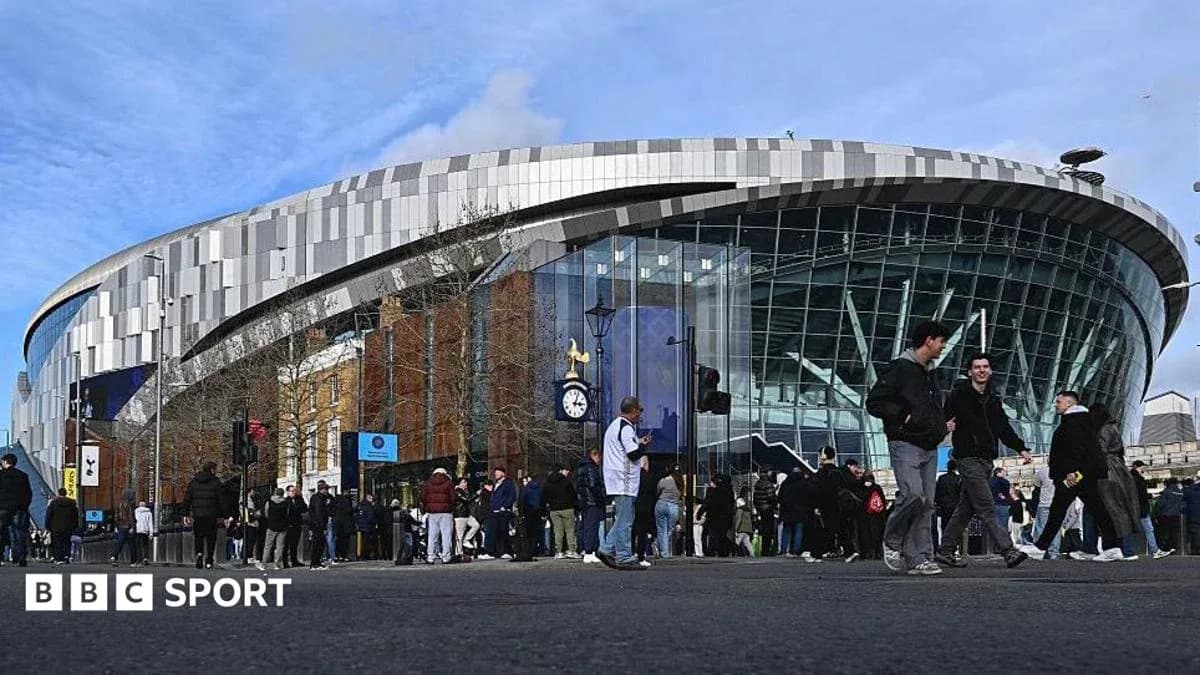
Inside the gleaming bowl of the Tottenham Hotspur Stadium, the numbers tell a very different story. The club that staggered on the pitch has quietly become the financial benchmark off it. And that, more than any tactical tweak or transfer rumour, is what the rest of the Premier League is studying.
The Stadium That Prints Money
To understand the scale of Tottenham’s transformation, start with the turnstiles.
“Spurs' matchday income has increased from £45m in 2016-17, the season they left White Hart Lane, to £126m in 2024-25,” says football finance expert Kieran Maguire.
Less than double the capacity. Two and a half times the revenue. That is not an accident. That is design.
They have built a place people want to linger in. Fans are arriving earlier, staying later. They are not just watching football; they are eating, drinking, browsing, spending. Maguire puts it bluntly: “If people are spending an extra 40 to 50 minutes in the stadium itself they're not just spending time - more importantly they're spending money.”
And this isn’t just about 19 Premier League home games and a few cup ties.
Tottenham can stage up to 30 non-football events a year at full capacity. The pitch has already hosted NFL games, Anthony Joshua’s heavyweight showdown with Oleksandr Usyk in 2021, and regular rugby union blockbusters such as Saracens v Harlequins in the London derby since 2023. Layer on major concerts and the stadium stops being a ground and becomes a year-round venue.
The impact is brutal and clear. Commercial revenue has rocketed from £73m in 2016-17 to £277m in 2024-25. That is the sort of leap that changes transfer windows.
It is why Tottenham can go into the market and land a player like Sandro Tonali for a club-record fee that could reach £100m, even after back-to-back seasons skirting the drop. The football has stalled. The financial machine has not.
New Rules, Old Loophole
This summer, the Premier League rips up its Profitability and Sustainability Rules and replaces them with a new framework built around Squad-Cost Ratio (SCR) and Sustainability and Systemic Resilience (SSR).
Strip away the jargon and SCR is simple enough: it caps what a club can spend on its playing squad as a percentage of its total revenue. Wages, transfer amortisation, agent fees – they all get counted.
But one category sits outside the calculation. Stadium infrastructure.
“In the case of Spurs, their infrastructure costs are around £70m a year - but those are excluded,” Maguire explains. “Any money that you invest in stadiums is completely ring-fenced and excluded from your ability to invest in players.”
That quirk turns bricks and steel into a strategic weapon. Clubs can pour money into a new ground or a major redevelopment without it biting into their squad budget under SCR.
Of course, stadiums are expensive. Tottenham’s came with a huge price tag. Yet Maguire points out they borrowed at “spectacularly cheap” interest rates. The result? The long-term upside dwarfs the pain of the repayments.
“In order to be competitive, you need to have a significant increase in matchday income,” Maguire says. The options are stark: hike prices – and risk a revolt – or build bigger and smarter, targeting a greater share of tickets at non-season-ticket supporters and corporate clients.
Tottenham chose the second path. Others are now weighing the same choice.
The Rest of the League Looks Up
Everton and West Ham have already moved into new homes. The financial logic is persuasive, the emotional cost less so. Not every fanbase has embraced the change.
Across the division, boards are wrestling with the same question: stay and renovate, or leave and rebuild?
Renovation looks cheaper on paper. Then reality intervenes. Where does the team play if the old ground becomes a building site? How much revenue disappears during the construction years? And what happens to the identity of a club that has grown up around a particular postcode?
The emotional pull of a historic home is powerful. The balance sheet pulls the other way.
At Manchester United, Sir Jim Ratcliffe has made his intention clear. He wants a new stadium to stand as the defining symbol of his era at the club. The vision is bold: a 100,000-capacity arena with extensive corporate areas that would dwarf United’s current matchday take and inject fresh money into the senior squad.
The early plans, unveiled in March 2025, featured a vast canopy. It looks spectacular on the drawings. It will also be expensive. And crucially, anything beneath that overhang sits within United’s footprint. Maintenance, security, long-term upkeep – the bill lands at Old Trafford.
Is the spectacle worth the spend? That is the trade-off Ratcliffe must judge.
Club officials suggest that parts of the build could be constructed off-site and then assembled on location, a modular approach that should cut costs compared to tearing down and rebuilding Old Trafford piece by piece. By putting the new stadium just down the road, United also dodge the awkward question of where to play during construction.
Borrowing a rival’s ground sounds simple until you factor in security, capacity and cost. Manchester City, Liverpool and Everton all fall short of Old Trafford’s size and would be expensive to hire even if the politics could be managed. United’s current plan – finish the new ground, then move across – neatly sidesteps that storm.
Newcastle’s Dilemma
If Tottenham represent the upside of going big on a stadium, Newcastle show the cost of standing still.
This summer, Newcastle have effectively had to sell some of their best players to stay on the right side of the financial rules. On Tyneside, the argument for a new, purpose-built ground grows louder with every set of accounts.
The numbers are unforgiving. For 2024-25, Newcastle’s matchday income stood at £52m. Manchester United’s reached £160m. Arsenal’s hit £154m. Spurs, with their new arena, posted £126m.
A gap of around £100m to your direct rivals is not a gap you close with marginal gains. You either become spectacularly clever in recruitment and coaching, or you charge significantly more for the same product.
“How can Newcastle increase the yield per fan and still be loyal to the Gallowgate hardcore?” Maguire asks. His verdict is blunt: “You need to be able to offer a different product and St James' Park wasn't built for a corporate audience.”
The financial case for moving is obvious. The emotional case against it is just as strong.
Newcastle fan Charlotte Robson captures that conflict. “I think we can host gigs at St James' Park but probably not on the scale of Spurs or West Ham's London Stadium,” she says. “I don't think it would be stupid to move from the ground but I think there is so much identity for Newcastle fans who are attached to St James' Park that it would break a lot of hearts to move the ground in any significant way.”
That is the tension running through boardrooms across the country: the heart versus the spreadsheet.
London Advantage, National Question
Every club eyeing Tottenham’s model has to ask a blunt question: does it translate?
“Spurs have got the advantage that they're in London - a huge tourist trap. They are also a club with a global fanbase, so it works there,” Maguire says.
The capital brings tourists, business travellers, and a vast corporate market willing to pay premium prices for hospitality. That cocktail is hard to replicate in more localised markets where ticket hikes trigger immediate resistance and the corporate base is smaller.
“Is that going to work elsewhere in the country where you've got a more localised fanbase and where there is resistance to putting up prices for tickets? Then it becomes more challenging,” Maguire warns.
On top of that, the cost of building has surged. Materials, labour, regulation – everything is more expensive. Yet despite the rising bills, the appetite for new stadium projects has not disappeared. If anything, the looming SCR era makes them more attractive. Infrastructure spending is ring-fenced. Squad spending is not.
So clubs stare at Tottenham’s numbers, then look at their own. They see a team that finished 17th, twice, yet still generated £126m on matchdays and £277m in commercial income. They see a club able to sign a £100m midfielder while others sell to survive.
The lesson is stark. In the age of financial controls, the real arms race is not just on the pitch. It is in concrete, steel, and hospitality lounges.
Who blinks first – the fans clinging to their spiritual homes, or the owners chasing the kind of stadium that might decide who actually competes at the top in the next decade?

