.svg&w=384&q=75 "GoalGist logo")
Tottenham's Transformation: From Relegation Battle to Title Contenders
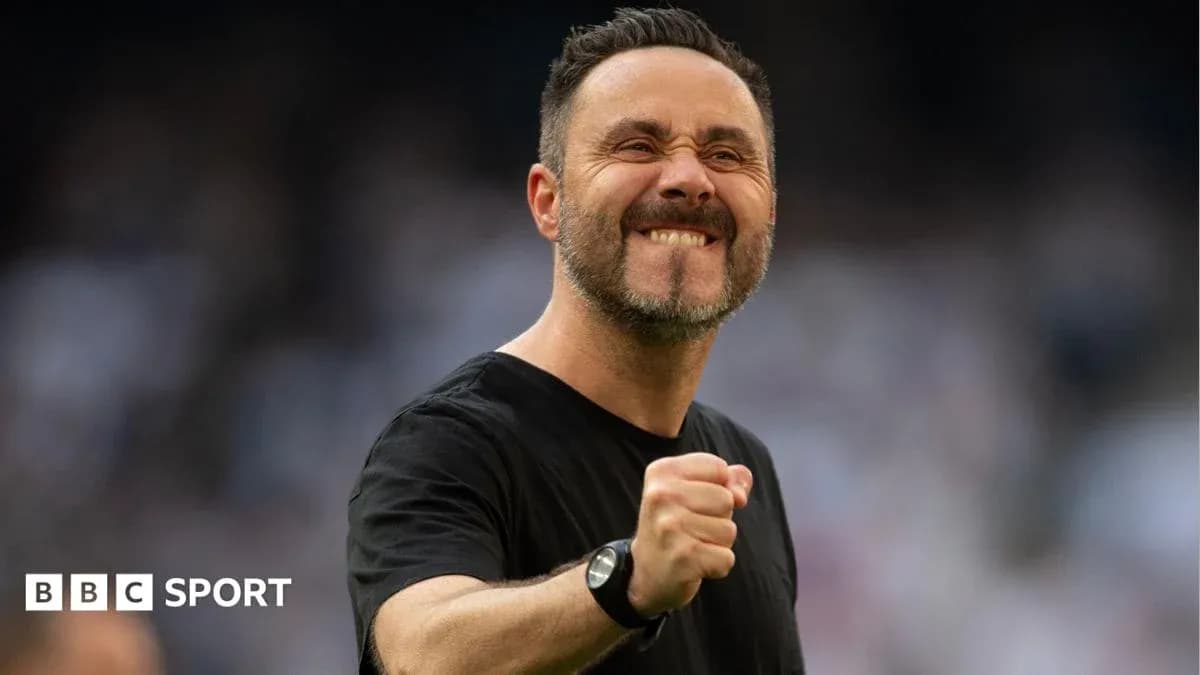
There was a point last spring when Roberto de Zerbi looked around the Tottenham dressing room and wondered aloud: “Did we pass away?”
Players were on their backs. Some were in tears. A 1-0 defeat at Sunderland in his first game had left Spurs staring into the abyss, six matches from relegation and seemingly devoid of life.
Four months on, the picture could not be more different.
From Stadium of Light to Sydney sunshine
The broken dressing room at the Stadium of Light has been replaced by a private floor in a Sydney hotel, a few strides from the Harbour Bridge and Opera House. Laughter carries down the corridor. Coffee cups clink. A club-appointed barista keeps the espresso flowing.
On one side, competitive table tennis matches rage. On the other, a club-record £237m worth of new signings drift in and out of conversations, slowly folding into a squad that suddenly dares to talk about trophies again.
- Sandro Tonali, the £100m centrepiece from Newcastle.
- Mateus Fernandes, prised from West Ham for £85m.
- Jan Paul van Hecke, Andrew Robertson, Martin Dubravka – all already on the pitch in Australia and New Zealand.
- Marcos Senesi, fresh from a World Cup final with Argentina, has finally joined training at Hotspur Way after extended leave.
The mood is unrecognisable from the team that clung to survival on the final day of last season.
“I deserve to want the top players, because now Tottenham deserves to build up a top team,” De Zerbi says, no hint of apology in his voice.
Two plans, one escape
Tottenham went into the summer with two transfer blueprints: one for relegation, one for survival. It was that bleak.
De Zerbi insists he would have stayed even in the Championship. Instead, he operates from Plan A – and that means trying to keep, or at least manage the exits of, key figures such as captain Cristian Romero and goalkeeper Guglielmo Vicario.
“At the beginning of my time in April I had one million individual meetings,” he jokes. Players were asked, bluntly, if they wanted to be there.
His message was even blunter.
“Yes, help me to stay up, and then I help you to leave,” he told those eyeing the exit. “If you don’t help me to stay up, you stay underwater with me.”
They stayed up. Just.
New regime, same shark in the market
The club above him has changed almost as dramatically as the squad. Vinai Venkatesham now runs Tottenham on behalf of the Lewis Family Trust. Johan Lange, the only senior survivor of the previous regime, continues as technical director, fronting negotiations alongside Venkatesham.
Rafi Moersen has arrived as director of football operations. Dan Lewindon, recruited from City Football Group, has been handed a clear brief: fix Spurs’ chronic injury record.
De Zerbi, though, is the constant presence in every conversation. He describes his transfer-market persona in the most De Zerbi way possible.
“In the transfer market, when I want one player, I become like a shark. No chance to say no.”
That “shark” has already delivered the most expensive midfield pairing in the club’s history. Fernandes from West Ham. Tonali from Newcastle. Two deals that required Tottenham to be fast, aggressive and, at times, willing to stretch on fees and wages.
“I love working in the transfer market. It’s not a pressure, it’s one of the nicest parts in my work, in my job,” he says.
Why?
“I don’t know, maybe because when you take the decision, you take the responsibility. If the coach calls the player, you can build a special connection at the beginning.”
With Fernandes, that connection started at home. Literally.
De Zerbi spoke with the midfielder’s parents and told Fernandes’ father he would be his son’s “second dad” in England. It is the kind of personal pitch that has become central to Tottenham’s recruitment drive.
Beating the giants, texting the enemy
Spurs have not just spent. They have competed.
They beat Manchester United and Manchester City to their two record-breaking midfielders. They landed Van Hecke despite interest from Chelsea. Each move underlined a clear approach: move early, move hard, and send De Zerbi in to close the deal.
The Italian is not shy about using history to his advantage either. After a 2-2 draw with Brighton in April, when Georginio Rutter’s 95th-minute equaliser dented Spurs’ survival hopes, De Zerbi messaged Van Hecke – the defender who had provided the assist.
“You wanted to push down Tottenham for Brighton when you made the assist to Rutter, now you have to come to me, you have no choice,” he told him.
Tonali’s pursuit carried the same intensity. The day after survival was confirmed with a final-day win at Everton, De Zerbi texted the midfielder. Soon after, he was in Tonali’s home in Brescia for a face-to-face meeting that proved decisive. Club staff then hammered out the details.
Now he hints at one more flourish – what he calls a final attacking “bomba”. Two forwards are expected, one of them Manchester City’s Savinho.
Spending big, thinking long
The numbers are eye-catching. So is the timing. The Lewis family injected £100m into the club in June, giving Spurs the financial oxygen they needed after a turbulent 2025-26.
De Zerbi rejects the idea that Tottenham are throwing money around recklessly. He points to Chelsea, Arsenal and Liverpool as recent examples of clubs that have needed similar injections to reset their squads.
There is also money coming in. Luka Vuskovic has joined Brighton for £45m. Questions still hang over Lucas Bergvall and Djed Spence, but the principle is clear.
“We assessed the request of Vuskovic [to join Brighton], with Vinai, with Johan together, because I consider Tottenham’s money my money,” De Zerbi says. “It’s like the owner is my father, I think you don’t want to ask your father to lose money.
“Like all the big clubs, we have to sell a player at as big of a price as possible and we have to bring a player with a small price, we are starting for a plan of five seasons because we are building.”
That logic also underpinned a high-profile non-transfer. Tottenham chose not to sign Joao Palhinha permanently from Bayern Munich – not because De Zerbi doubted his ability, but because the overall financial package did not fit the long-term plan.
Killing the negativity
If the squad and structure have changed, so too has the atmosphere around the training ground.
After that bleak night in Sunderland, the gloom was not confined to the dressing room. Staff arrived at Hotspur Way carrying the same sense of dread.
“The day after I organised a meeting without players and I said, ‘The first one I see say something negative, I send you home immediately’,” De Zerbi recalls.
He has spent the months since trying to reset “behaviour, attitude and spirit” at a club scarred by consecutive seasons of struggle – 17th the year before, even if that campaign ended with a Europa League triumph under Ange Postecoglou and without the same suffocating fear of the drop.
There have been lighter touches too. He took the players for “one big dinner in Mayfair, with alcohol” at the end of the season, a deliberate attempt to loosen the tension and remind them they were more than a group defined by a relegation battle.
He remains adamant Spurs were unlucky in their final fixtures and could have secured safety earlier. The players, he felt, had started to see themselves as worse than the rest of the league believed.
“I think they considered themselves in that moment worse than the people thought,” he admits. The healing, he knows, is still in progress. “I hope next time they organise [dinner and drinks] for themselves.”
That, for De Zerbi, is the endgame. A squad that no longer needs the manager to drag them out for bonding sessions. A club that no longer flirts with the trapdoor.
“With love, friendship and care,” he says, “you become top, top, top.”
The question now is whether this rebuilt, re-energised Tottenham can turn that belief – and that money – into something more than survival.