.svg&w=384&q=75 "GoalGist logo")
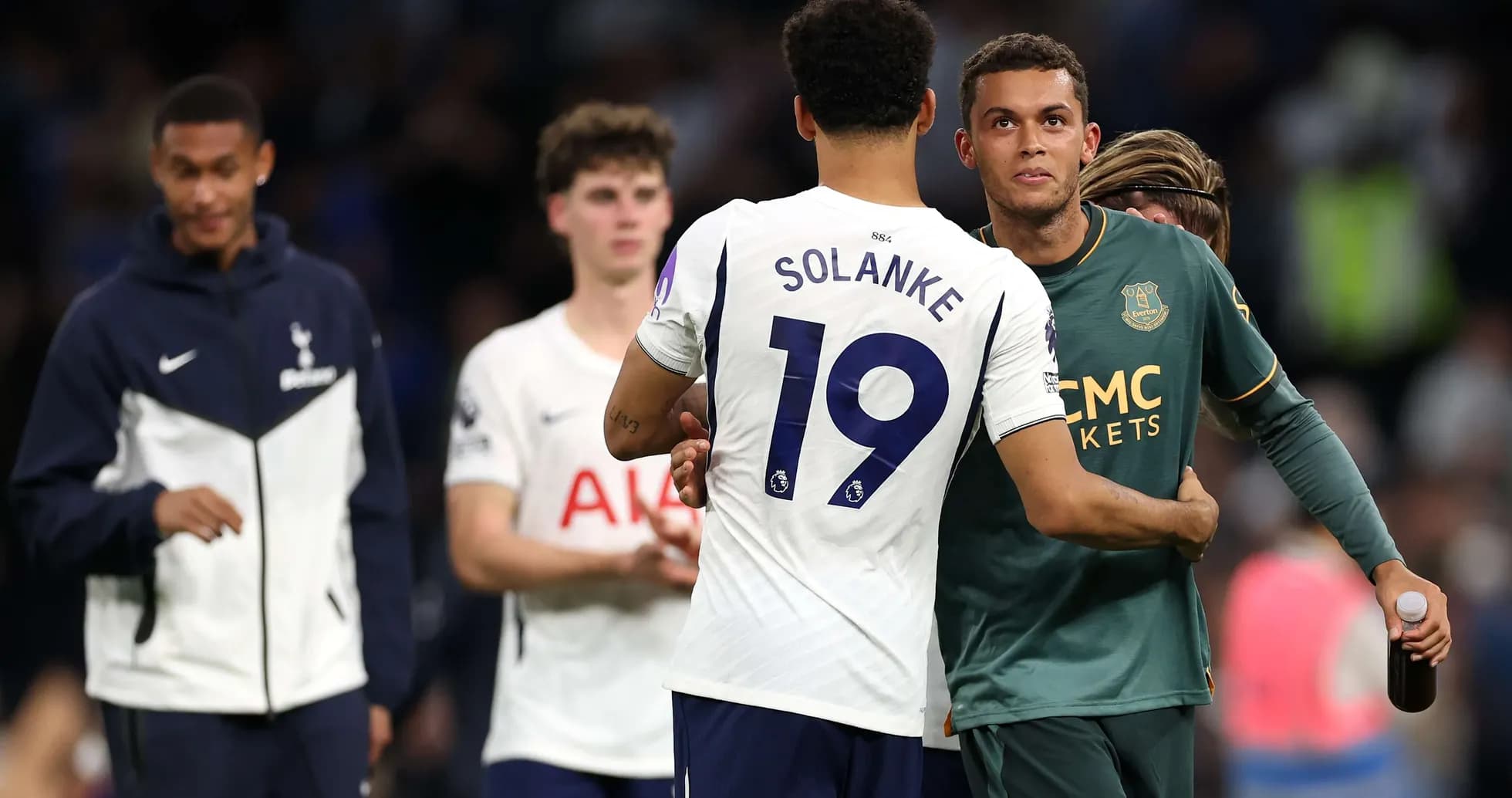
Tottenham and Everton Battle to a Stalemate at the Tottenham Hotspur Stadium
Under a grey north London sky, the Tottenham Hotspur Stadium staged a meeting of two sides heading in opposite emotional directions, yet bound by the same 4-2-3-1 shape. Tottenham and Everton cancelled each other out in a 0-0 that said as much about their evolving identities as it did about the scoreline.
I. The Big Picture – contrasting trajectories in the same structure
Following this result, Tottenham remain winless after four Premier League games, 17th in the table with 2 points. Their overall goal difference sits at -5, the product of 0 goals scored and 5 conceded. At home, they have now played 2, drawn 2 and lost 1 across the campaign’s early stretch if we include the standings snapshot: 0 goals for and 2 against on their own turf, an average of 1.0 goal conceded per home match and 0.0 scored.
Everton, by contrast, leave London with their unbeaten run intact. They stand 8th with 6 points from 4 matches, having won 1 and drawn 3 overall. Their overall goal difference is +2, with 5 scored and 3 conceded; away from home they have drawn both of their matches, scoring 1 and conceding 1 on their travels, an away average of 0.5 goals scored and 0.5 conceded.
Both coaches trusted the same base shape. Roberto De Zerbi’s Tottenham lined up in a 4-2-3-1 that leaned heavily on technical security and rotations between the lines, while David Moyes mirrored it with Everton, using the structure as a defensive exoskeleton to protect a positive early-season record.
II. Tactical Voids – absences that bent the game’s geometry
For Tottenham, the list of absentees reads like a blueprint torn in half. D. Kulusevski (knee injury), M. Mudryk (ankle injury), W. Odobert (knee injury) and X. Simons (knee injury) were all unavailable, while Richarlison missed out due to transfer negotiations. That is an entire band of potential wide and creative threats removed from De Zerbi’s toolbox.
In their absence, the starting three behind D. Solanke were Sávio, Mateus Fernandes and Omar Marmoush. Talented, yes, but still a makeshift trio when you consider how much of De Zerbi’s football relies on repetition, automatisms and chemistry in tight spaces. The lack of goals this season is no coincidence: heading into this game, Tottenham had failed to score in all 4 of their league fixtures, both at home and away, despite keeping 2 clean sheets overall. The forward patterns are still being written.
Everton’s own key absentee was C. Norgaard, ruled out through injury. In a Moyes side, a player of his profile would likely have been central to screening the back four and knitting transitions. Without him, the double pivot of H. Armstrong and J. Garner had to carry both the destructive and constructive load.
Disciplinary trends shaped the tone. Tottenham’s yellow-card distribution this season shows a pronounced late-game spike: 40.00% of their bookings come between 76-90 minutes, with 20.00% in each of the 0-15, 31-45 and 46-60 minute windows. It speaks to a team that often ends up firefighting as matches stretch. Everton’s bookings are more evenly spread, but with a noticeable rise between 61-75 minutes at 28.57%, hinting at a side that increases its aggression as the second half matures.
III. Key Matchups – Hunter vs Shield, Engine Room vs Enforcer
The “Hunter vs Shield” duel was embodied less in a single individual and more in Tottenham’s collective attacking unit against Everton’s defensive spine. With Tottenham yet to score a single league goal overall, the burden fell on Solanke as the lone forward, supported by the drifting creativity of Sávio and Marmoush. Behind them, R. Bentancur and S. Tonali formed a double pivot designed to control rhythm and feed the three between the lines.
Yet Everton’s shield was impressively structured. The central pairing of J. Tarkowski and J. Branthwaite, flanked by A. Maitland-Niles and V. Mykolenko, sat in front of J. Pickford and rarely lost their positional discipline. The numbers back the broader trend: heading into this game, Everton had conceded only 3 goals overall in 4 matches, an average of 0.8 per game, with just 1 goal conceded away at an average of 0.5. This is a defence that travels well.
In the “Engine Room” duel, S. Tonali and Bentancur faced off against H. Armstrong and J. Garner. Garner, in particular, arrived as one of Everton’s most quietly influential figures this season. Over 4 league appearances and 240 minutes, he has completed 128 passes with 3 key passes and a 90% accuracy rate, while winning 16 of his 27 duels and making 11 tackles. He has drawn 5 fouls and committed 4, collecting 2 yellow cards but no reds, a blend of bite and intelligence that perfectly suits Moyes’s midfield demands.
Against Tottenham’s more possession-oriented double pivot, Garner’s role was to disrupt and to launch. Armstrong, alongside him, offered legs and coverage, allowing Everton’s line of three – B. Johnson, K. Dewsbury-Hall and Tyrique George – to push higher in moments, supporting T. Barry as the nominal striker.
IV. Statistical Prognosis – two stories in one stalemate
Strip away the emotion and the narrative, and the numbers sketch a clear picture of where each squad stands.
Tottenham’s overall attacking output remains the glaring concern. Four matches, 0 goals, 4 failures to score both home and away, and a goals-for average of 0.0 across every dimension. Their defensive record is not disastrous – 5 conceded overall at an average of 1.3 per game, split into 1.0 at home and 1.5 away – but when the attack is this blunt, even a modest defensive leak feels fatal.
Everton, by contrast, look like a side with a solid defensive floor and a flexible ceiling. They have scored 5 overall at an average of 1.3 per match, with a particularly strong home output of 2.0 goals per game, and have conceded only 3, keeping 2 clean sheets and failing to score just once. Their away record – 2 draws, 1 goal scored, 1 conceded – suggests a pragmatic approach on their travels: control the game state, avoid chaos, and trust that their structure will deliver enough.
In xG terms, this match would likely have reflected that balance: Tottenham probing, circulating and trying to manufacture high-quality chances through their technical midfield, Everton content to absorb, compress central spaces and threaten in carefully chosen moments. The 0-0 feels less like a fluke and more like a natural intersection of Tottenham’s attacking crisis and Everton’s defensive assurance.
For De Zerbi, the challenge is clear: reintegrate or replace the missing creative profiles and find a way to convert sterile control into incision. For Moyes, the task is more about evolution than revolution – adding layers of risk and invention to a side that already knows how to survive.
At the Tottenham Hotspur Stadium, the scoreline stayed still, but the underlying trajectories of these squads moved a little further apart.