.svg&w=384&q=75 "GoalGist logo")
Slovan Bratislava's Tactical Mastery in 2-0 Victory Over Mjallby AIF
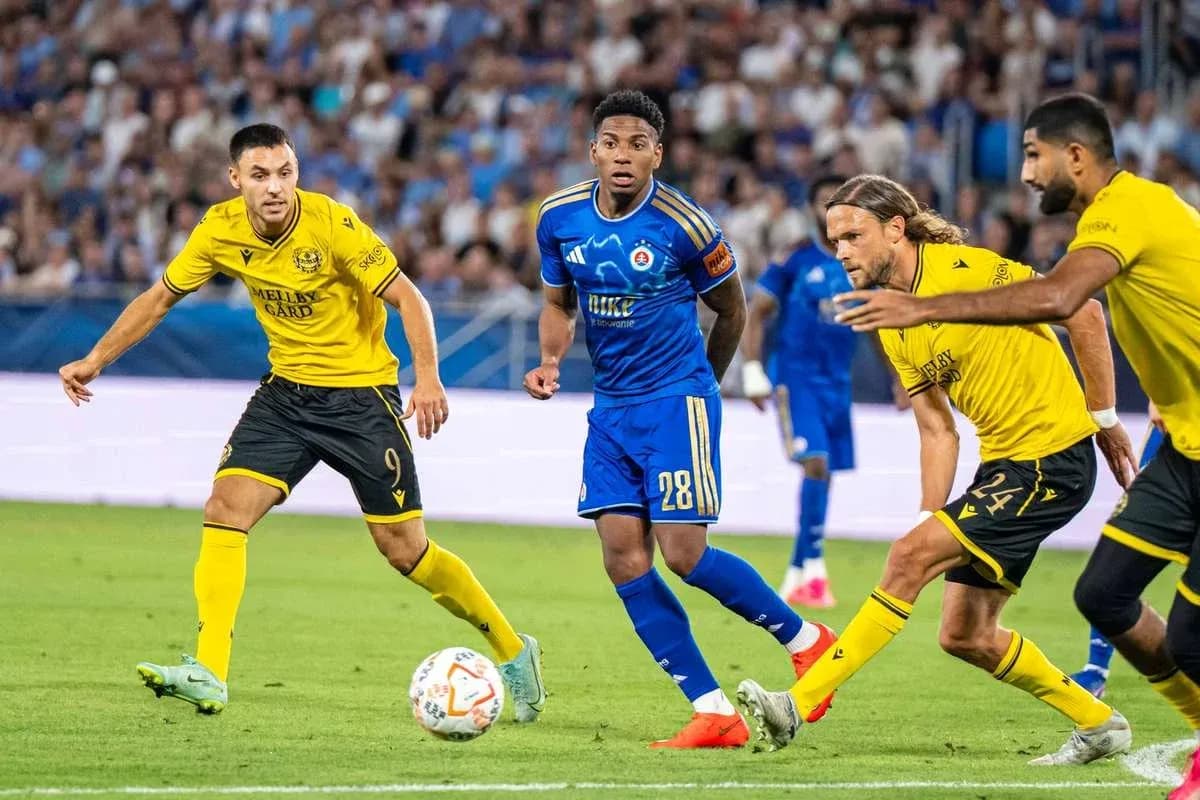
Slovan Bratislava’s 2-0 win over Mjallby AIF at Tehelne Pole Stadion was built on clear structural superiority rather than overwhelming volume. With possession split exactly 50–50 and both sides failing to register any blocked shots, the difference came from how Slovan used their 4-1-4-1 to control central zones, create cleaner final-third connections, and then protect the lead with disciplined game management in the second half of this UEFA Champions League 3rd Qualifying Round tie.
Yaya Toure set Slovan up in a classic 4-1-4-1, with P. Pokorny anchoring in front of a back four of S. Cruz, S. Markovic, K. Bajric and C. Blackman. Ahead of the pivot, the line of four—M. Kianga, A. Mustafic, R. Ibrahim and S. Camara—worked off the lone striker M. Kukharevych. The structure gave Slovan a clear rest-defence: full-backs could step into wide lanes knowing Pokorny would slide across, while the two centre-backs held a conservative line against Mjallby’s front three.
Mjallby’s 3-4-3 under Karl Aksum, with R. Wallinder in goal behind a back three of T. Pettersson, L. Svanberg and A. Iqbal, tried to stretch Slovan horizontally through the wing-backs V. Granath and I. Hoffmann. In practice, though, the 3-4-3 often flattened into a 5-4-1 without the ball, leaving J. Kjaer, J. Bergstrom and A. Samuelsen isolated from midfield support when possession was regained.
First Half
The first half reflected this tactical arm-wrestle. Mjallby managed to keep the shot count competitive overall (2 shots on goal, 4 off target), but they rarely accessed the central pocket between Pokorny and the centre-backs. Slovan’s 15 fouls versus Mjallby’s 9 underline how aggressively the hosts defended transitions, breaking up counters early even at the cost of bookings. The yellow cards for Rahim Ibrahim and later Alen Mustafić were the by-product of this approach: Slovan were willing to foul to prevent Mjallby’s front three from running at an exposed back line.
The key tactical shift came immediately after half-time. At 46', T. Barseghyan (IN) came on for M. Kianga (OUT), adding a more direct, one-v-one threat on the flank. Within a minute, the rebalanced attacking line paid off. At 47', S. Camara finished a move created by S. Cruz’s overlapping involvement, giving Slovan the 1-0 lead and validating the 4-1-4-1’s emphasis on wide overloads. Cruz’s role was pivotal: as a full-back in a back four, he had license to push high once Pokorny slid over, pinning Mjallby’s wing-back and opening the half-space for Camara to attack.
Second Half
Mjallby’s response was to adjust their wing-back profile. At 56', A. Youssef (IN) came on for I. Hoffmann (OUT), and T. Miettinen (IN) replaced L. Svanberg (OUT), signalling an attempt to add more energy and ball progression from wide and from the back three. However, because Slovan continued to defend in a compact 4-1-4-1 block, Mjallby’s extra width did not translate into central penetration; their 4 corner kicks to Slovan’s 2 show they reached advanced wide areas, but the lack of blocked shots and only 2 efforts on goal indicate that Slovan’s box defending remained untroubled.
The hosts then doubled down on controlling the rhythm through midfield substitutions. At 59', A. Yirajang (IN) came on for M. Kukharevych (OUT), and C. Martinez (IN) replaced R. Ibrahim (OUT), effectively refreshing the advanced line and adding legs between the lines rather than maintaining a classic target striker. This tilted Slovan towards more fluid interchanges in the final third, with runners attacking spaces rather than playing into a fixed reference point.
The decisive second goal at 78' encapsulated that shift: A. Yirajang, introduced as a fresh forward, scored from another S. Cruz assist to make it 2-0. Again, the pattern was consistent—Slovan’s full-back pushing high from the 4-1-4-1 base, linking with a mobile forward rather than a static No.9, and exploiting Mjallby’s difficulties in tracking runners from deep out of their back five.
On Mjallby’s side, the later changes—L. Tidstrand (IN) for V. Granath (OUT) and O. Lindberg (IN) for J. Kjaer (OUT) at 72', then M. Agnarsson (IN) for V. Gustafson (OUT) at 87'—were attempts to inject fresh legs and a different profile in midfield and attack. But by then, Slovan’s game-state management had taken over. The 2-0 scoreline allowed them to sit a little deeper, preserve their central compactness and accept a lower foul count in the final phase, trusting their shape rather than constant pressing.
Discipline also had a tactical dimension. Mjallby finished with 2 yellow cards (Tom Pettersson and Villiam Granath, both for Foul), while Slovan took 3 bookings—Rahim Ibrahim (Foul), Suleiman Camara (Simulation) and Alen Mustafić (Foul). The Simulation booking for Camara at 58' came just after Slovan’s opener and highlighted the home side’s willingness to keep forcing the issue in the box, even at the risk of individual sanctions. Meanwhile, Mjallby’s lower foul count and card total reflected a more passive defensive posture, sitting in their structure rather than aggressively contesting second balls.
Statistically, the match was finely balanced in possession—50% each—and even in unblocked shooting volume (4 shots on goal for Slovan, 2 for Mjallby, with both sides recording 0 blocked shots and 7 vs 4 shots off target respectively). The separation came in the quality of final-third execution and how each system translated structure into chances. Slovan’s 4-1-4-1 produced two goals and repeated high-value incursions via S. Cruz, while Mjallby’s 3-4-3 too often morphed into a reactive 5-4-1, leaving their forwards disconnected.
In the context of a Champions League 3rd Qualifying Round tie, this was a textbook example of how a well-drilled back four plus single pivot can neutralise a front three, and how targeted, early second-half substitutions can tilt a balanced contest decisively without any need for radical formation changes. Slovan Bratislava controlled the key zones, used their full-backs as primary playmakers, and turned a 50–50 statistical profile into a clear 2-0 tactical victory.