.svg&w=384&q=75 "GoalGist logo")
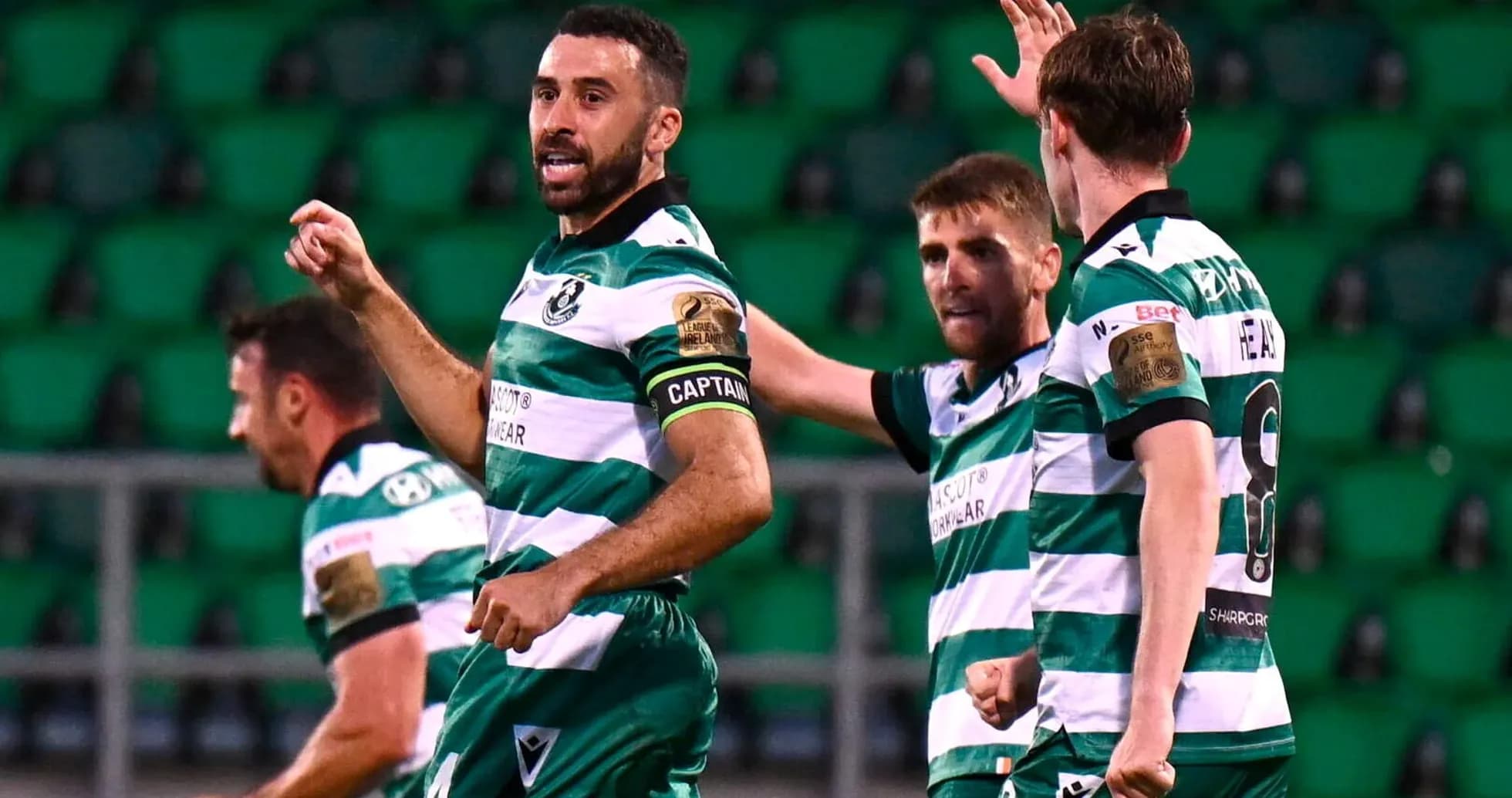
Shamrock Rovers Triumph Over Egnatia Rrogozhinë in UEFA Europa League
Shamrock Rovers’ 3-1 win over Egnatia Rrogozhinë at Tallaght Stadium in the UEFA Europa League 3rd Qualifying Round was built on structural clarity in a mirrored 3-5-2 battle. With both sides lining up in the same base system, the match became a test of execution in wide areas, penalty-box composure, and in-game management rather than surprise tactical schemes.
Stephen Bradley’s 3-5-2 for Shamrock Rovers was front‑foot and possession-oriented in its intent, even if the raw possession figures are not available. The back three of E. Stevens, R. Lopes and T. Sobowale offered a stable rest-defense platform, with Stevens and Sobowale stepping wide to cover the channels behind the wing-backs. In midfield, the trio of M. Healy, J. Byrne and D. Watts provided the structural spine: Healy as the balance point, Byrne as the primary connector and passer, and Watts as the shuttling presence able to press forward and support the forwards.
The wing-backs, W. Fitzgerald on the right and A. Brennan on the left, were crucial to Rovers’ ability to stretch Egnatia’s 3-5-2. Their advanced starting positions effectively turned the home side into a 3-3-4 in possession, pinning Egnatia’s own wing-backs and forcing their wide centre-backs into uncomfortable lateral defending. This width was a key factor in generating the pressure that led to the 29th-minute penalty converted by G. Burke, with Rovers repeatedly accessing the half-spaces and forcing Egnatia’s back line to defend facing their own goal.
Up front, the pairing of Burke and A. Greene worked as a classic split strike partnership. Burke often dropped into the left half-space to link with Brennan and Byrne, while Greene threatened depth and attacked the channels between centre-back and wing-back. This complementary movement helped drag Egnatia’s central trio out of shape and created the kind of disorganisation that underpinned the later second-half surge.
Egnatia Rrogozhinë, under Nevil Dede, mirrored the 3-5-2 but with a more transitional, vertical orientation. The back three of Z. Aliyev, E. Bitri and E. Sota sat a touch deeper, with G. Jaime nominally starting as a wide defender but frequently stepping into advanced positions, which became decisive. The central midfield of Fernando Medeiros, A. Kryeziu and I. Diabate was tasked with screening and then springing quick counters, using the mobility of D. Adjessa and the drifting movements of I. Gruda to attack the spaces behind Rovers’ wing-backs.
The 41st-minute sequence encapsulated Egnatia’s approach: Guillem Jaime first missed a penalty, then, moments later, G. Jaime scored a normal goal, capitalising on Rovers’ brief defensive disarray after the spot-kick. It highlighted how Egnatia looked to punish transitional moments rather than construct long positional attacks. However, this reliance on moments rather than sustained control left them vulnerable once Shamrock Rovers increased their tempo after the break.
Bradley’s in-game management was decisive. At 46', A. Brennan (OUT) made way for J. Mulraney (IN), a like-for-like change that nonetheless shifted the dynamic on the left flank, with Mulraney offering more direct dribbling threat. On the Egnatia side, the triple change at the same time — I. Diabate (OUT) for A. Albanese (IN), I. Gruda (OUT) for K. Loukili (IN), and D. Adjessa (OUT) for J. Montenegro (IN) — significantly altered their attacking structure. Removing Gruda and Adjessa reduced their ability to stretch Rovers vertically and attack the spaces behind the wing-backs, and Egnatia lost some of their early fluidity.
Rovers exploited that loss of cohesion. In the 55th minute, R. Lopes scored from a situation that showcased the value of their structured build-up and set-piece or second-phase organisation, with Byrne providing the assist. Just two minutes later, an own goal by A. Yago, credited to Shamrock Rovers, pushed the score to 3-1 and effectively broke Egnatia’s resistance. That own goal was the direct product of sustained pressure and forced defending inside the box; Rovers’ wing-backs and midfielders had Egnatia repeatedly defending deep, increasing the probability of such errors.
Subsequent changes from Bradley further locked down control. At 58', A. Greene (OUT) was replaced by J. Afolabi (IN), refreshing the forward line with physical presence and hold-up play. On 69', a double change — G. Burke (OUT) for D. Mandroiu (IN) and D. Watts (OUT) for N. Razi (IN) — re-energised midfield and attack, with Mandroiu offering fresh creativity between the lines and Razi adding legs and pressing intensity. Later, at 77', J. Byrne (OUT) made way for J. O’Sullivan (IN), a substitution that signalled a shift toward game management, with Rovers more focused on compactness and ball retention than further expansion.
Egnatia’s later substitutions were more reactive than proactive. At 69', Z. Aliyev (OUT) for N. Ajetovikj (IN) slightly reshaped the back line, and at 81', A. Yago (OUT) for E. Ndreca (IN) altered the left side, but by then the structural damage was done. Their earlier attacking substitutions had already undermined their best counter-attacking outlets, and they struggled to generate sustained pressure.
Discipline also played a subtle tactical role. Egnatia collected two yellow cards — Ildi Gruda (Foul) at 38' and Alessandro Albanese (Foul) at 47' — while Shamrock Rovers had one, Dylan Watts (Foul) at 60'. The early booking for Gruda may have constrained his defensive aggression on Rovers’ right side, and Albanese’s quick caution after coming on further limited Egnatia’s ability to disrupt Rovers’ rhythm in midfield without risk. Watts’ booking came at a point when Rovers were already ahead and structurally in control, so its tactical impact was minimal.
With no reliable data on shots, possession, passing or goalkeeper saves, the tactical verdict rests on structure, substitutions and the event flow. Shamrock Rovers’ 3-5-2 was the more coherent and better-managed version of the mirror system, using wing-back width, a balanced midfield trio and well-timed substitutions to first create, then extend, and finally protect a winning platform. Egnatia’s heavy half-time reshuffle blunted their own counter-attacking edge, and once Rovers turned the screw early in the second half, the tie at Tallaght Stadium tilted decisively in favour of the home side.