.svg&w=384&q=75 "GoalGist logo")
Sabah FA's Tactical Masterclass in 4-0 Victory Over Aarhus
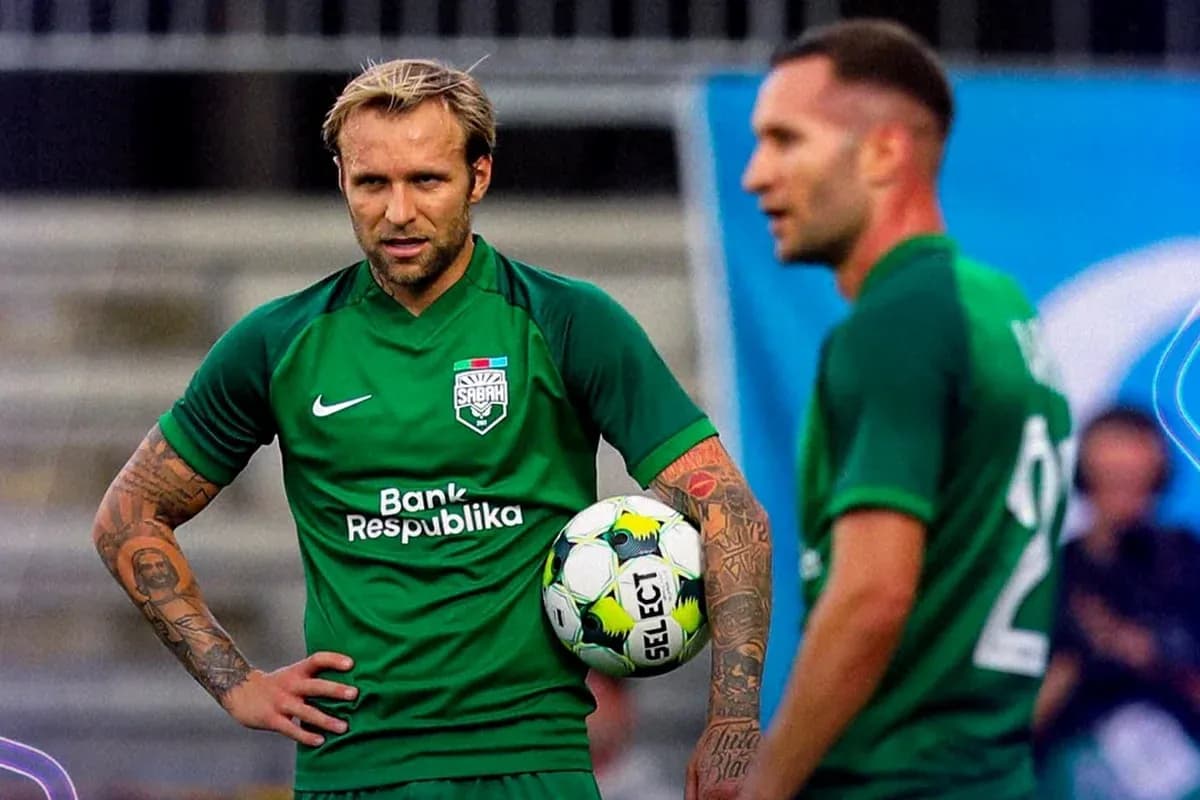
Sabah FA’s 4-0 dismantling of Aarhus at Bank Respublika Arena was built on a clear, coherent game plan rather than a freakish finishing streak. In a UEFA Champions League 3rd Qualifying Round tie that was perfectly balanced on the ball (50% possession each), Valdas Dambrauskas’ side engineered a territorial and chance-creation dominance that the raw possession numbers alone do not reveal. The home team’s 4-2-3-1 repeatedly overwhelmed Aarhus’ 3-1-4-2 structure in the half-spaces, turning equal ball share into a 29–14 shot count and, crucially, 23 efforts from inside the box.
First Half
Structurally, Sabah FA’s 4-2-3-1 was aggressive and front-foot. With S. Pokatilov in goal, a back four of A. Zedadka, S. Solvet, R. Dashdamirov and T. Puchacz pushed high, compressing the pitch and allowing the double pivot of U. Rakhmonaliyev and I. Lepinjica to operate more in Aarhus territory than in their own. Ahead of them, the trio of V. Simic, A. Isayev and J. Mickels constantly rotated around lone forward O. Mbina, later replaced by X. Severina, to overload the channels either side of Aarhus’ single holding midfielder, J. Jonsson.
The statistical pattern underlines how well Sabah FA’s positional play functioned. They produced 29 total shots, 10 on goal and 8 blocked, with a remarkable 23 attempts inside the box. That volume from close range speaks to repeated penetrations into high-value zones rather than speculative shooting. Their passing platform was secure: 366 total passes, 311 accurate at 85%. The back four plus double pivot circulated the ball cleanly enough to keep Aarhus’ first line of pressure moving laterally until gaps opened between centre-back and wing-back.
Aarhus' Struggles
Aarhus, in contrast, never truly solved the spacing problems inherent in their 3-1-4-2. With M. Hedenstad in goal behind a back three of J. Andersen, C. Rosler and Eric Kahl, and Jonsson screening, they tried to maintain compactness centrally. But the outer midfielders, R. Carstensen and G. Links, were repeatedly pinned deep by Sabah FA’s full-backs, especially the advanced positioning of Puchacz on the left and Zedadka on the right. This left the central midfield pair M. Knudsen and K. Arnstad exposed to the rotations of Simic and Mickels between the lines.
The card profile shows how much strain Aarhus were under defensively. All three yellow cards went to the visitors, all for “Foul”: Rasmus Carstensen at 8', Jacob Andersen at 32', and Eric Kahl at 66'. Each booking reflects a late or desperate intervention against Sabah FA’s ball-carriers, especially in wide and half-space channels where the 3-1-4-2 was being stretched. Sabah FA, by contrast, completed the match without a single booking, underlining both their control of duels and their ability to defend without resorting to last-ditch challenges.
Second Half
The turning point was not a single tactical tweak but the cumulative effect of Sabah FA’s pressure after the break. With the score 0-0 at half-time despite clear attacking intent, Dambrauskas acted first, bringing on X. Severina (IN) for O. Mbina (OUT) at 58'. That substitution subtly altered the front line: Severina’s tendency to drift and combine rather than play as a fixed reference point created even more confusion for Aarhus’ back three.
The payoff was immediate. At 59', V. Simic scored for Sabah FA, assisted by J. Mickels, for 1-0. The pattern was emblematic: Sabah FA exploiting the space between Aarhus’ midfield and defence, with the attacking midfield line arriving unmarked around the edge of the box. Aarhus tried to respond with a triple substitution wave between 64' and 72'—F. Emmery (IN) for G. Links (OUT), M. Anderson (IN) for R. Carstensen (OUT), and J. Serra (IN) for M. Knudsen (OUT)—but the structural issues remained.
Sabah FA’s second goal at 67', scored by centre-back S. Solvet and assisted by A. Isayev, highlighted their set-piece and second-phase threat. With 7 corner kicks to Aarhus’ 4, the home side consistently generated danger from dead balls. Solvet’s involvement on the scoresheet also underlines how far the centre-backs were allowed to step into advanced zones when Sabah FA locked Aarhus in.
By 78', the contest was essentially over. J. Mickels, already influential as a creator, added Sabah FA’s third without an assist, reflecting how their attacking midfielders were now finding shooting lanes even without elaborate build-up. Aarhus’ late defensive change, with M. Camara (IN) for C. Rosler (OUT) at 81', could not stem the tide, nor could the introduction of S. Jorgensen (IN) for J. Jonsson (OUT) at 82', which removed their lone holding midfielder and further destabilised the central shield.
Sabah FA’s fourth at 89'—X. Severina scoring, assisted by A. Zedadka—was the logical conclusion of the tactical story: full-back overlapping, substitute forward attacking the box, and Aarhus’ wing-back line unable to track runners after 80 minutes of chasing. It confirmed the 4-0 final score and showcased the depth and clarity of roles in Dambrauskas’ squad. Late substitutions—C. Nwachukwu (IN) for A. Isayev (OUT), R. Fernandes (IN) for J. Mickels (OUT), T. Mutallimov (IN) for A. Zedadka (OUT), and A. Khaybulaev (IN) for I. Lepinjica (OUT)—allowed Sabah FA to maintain intensity and defensive security through the closing stages.
Goalkeeper Performances
From a defensive standpoint, both goalkeepers were busy but in very different contexts. S. Pokatilov (Sabah FA) made 5 saves, matching Aarhus’ 5 shots on goal, and anchored a back line that conceded only 14 total shots and 8 inside the box. His interventions were decisive in preventing any Aarhus momentum swings, especially around the hour when the match was still within reach. At the other end, M. Hedenstad (Aarhus) also recorded 5 saves, but behind a defence that allowed 29 shots and 23 from inside the area, he was exposed far too often to high-quality chances.
Statistical Verdict
The statistical verdict underlines Sabah FA’s tactical superiority. Possession was perfectly split at 50–50, but Sabah FA translated their share into higher tempo, more verticality, and significantly more penalty-area occupation. Their 366 passes at 85% accuracy were slightly fewer but nearly as precise as Aarhus’ 372 passes at 86%, yet the home side’s structure turned those passes into territorial gain and shots, whereas Aarhus’ circulation was often sterile and lateral.
Discipline and duels also favored Sabah FA. With 11 fouls to Aarhus’ 10 but no cards, they managed contact intelligently, stopping counters without overstepping. Aarhus’ three yellows for “Foul” reflected a side repeatedly arriving late into challenges, a symptom of being a step behind the ball for much of the second half.
In sum, this was not just a heavy scoreline; it was a tactical demonstration. Sabah FA’s 4-2-3-1, with aggressive full-backs, a stable double pivot and fluid attacking midfielders, systematically unpicked Aarhus’ 3-1-4-2. The numbers—shots, box entries, corners, and the clean disciplinary record—align perfectly with the eye-test narrative of a home side in complete strategic control.