.svg&w=384&q=75 "GoalGist logo")
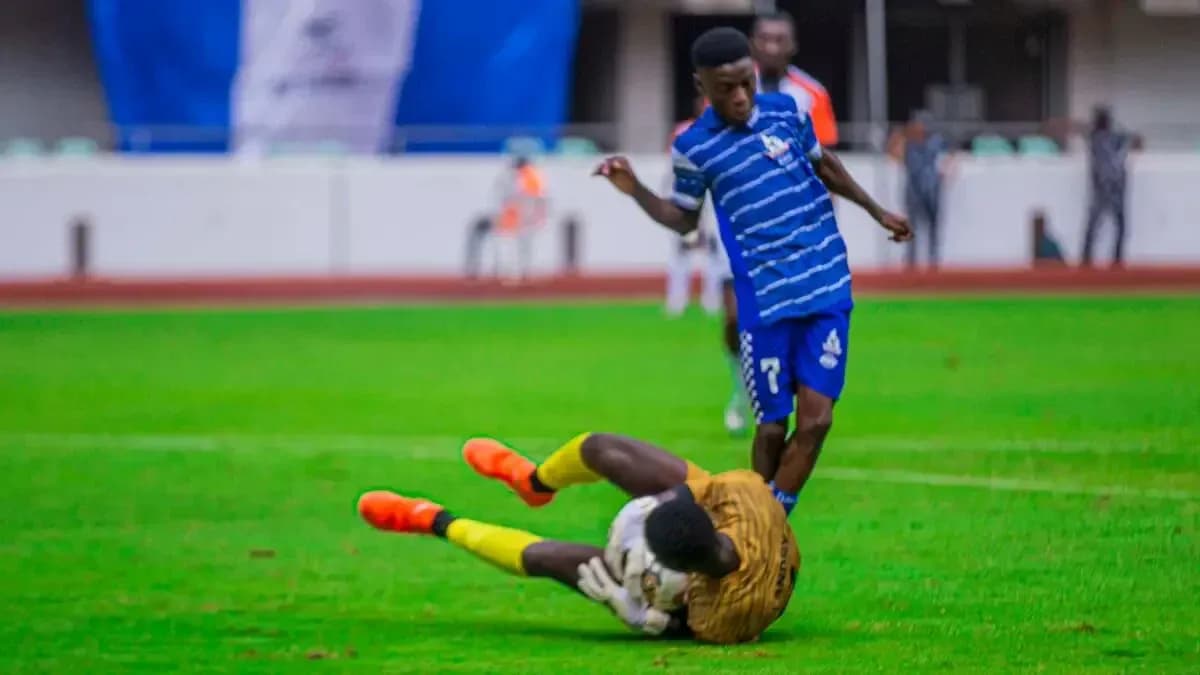
Nasarawa United vs Rivers United: A Tactical Stalemate in NPFL 2027
The late afternoon heat in Lafia had barely begun to soften when Nasarawa United and Rivers United walked out at Lafia Township Stadium, two sides carrying very different early-season identities into this Regular Season - 4 clash of the NPFL 2027 campaign. Ninety minutes later, the scoreboard’s 1–1 verdict felt like a negotiation between those identities: Nasarawa’s stubborn, imperfect rebuild against Rivers’ polished, top-four assurance.
Heading into this game, the table told a clear story. Nasarawa United sat 13th with 4 points from 4 matches, their overall goal difference at -2, the product of 4 goals scored and 6 conceded. At home, though, they had been reliable: unbeaten with 1 win and 1 draw, scoring 2 and conceding just 1. Rivers United arrived as early contenders, 4th in the league with 7 points from 3 matches, and a total goal difference of +4 after scoring 5 and conceding only 1 overall. At home they had been flawless; away, they had drawn their only outing, 1–1. The pattern suggested a classic NPFL tension: fortress versus contender, heat and dust versus polished structure.
I. The Big Picture – Two Identities Colliding
Nasarawa’s season so far has been about balance on a knife-edge. Overall they average 1.0 goals scored per match and 1.5 conceded, but those numbers split into two different teams: at home they score 1.0 and concede just 0.5 on average, while on their travels they still score 1.0 but leak 2.5. Lafia is their shield.
Rivers United, by contrast, travel with the aura of a side built for the long haul. Overall they average 1.7 goals scored and only 0.3 conceded per match. At home, they are dominant, scoring 2.0 and conceding 0.0 on average. Away, the picture is more human: 1.0 scored and 1.0 conceded. This match in Lafia was another test of whether that away version could keep pace with their ruthless home selves.
The 1–1 draw, with both goals arriving after a goalless first half, ultimately confirmed two things: Nasarawa’s home resilience is real, and Rivers’ away ceiling is not yet as high as their reputation suggests.
II. Tactical Voids and Discipline – Edges in the Details
There were no listed absentees, so both coaches had full decks to shuffle. Hakeem Busari, in charge of Rivers United, leaned on a starting XI that looked built for control and vertical thrust: E. Andy in goal, a defensive platform including the likes of E. Akobundu, O. Elias, and A. Salman, and a midfield core with S. Manyo and E. Utaka providing legs and structure. Ahead of them, A. Dabai and A. Oyowah were natural conduits between lines, with M. Chijioke, W. Falolu, and T. Zachariah offering movement and penetration.
Nasarawa United’s selection felt more workmanlike, more about collective effort than star power. C. Olughu and M. Umar both listed among the starters hints at tactical flexibility between the posts and deeper zones, while the defensive line built around C. Nduka, A. Abdullahi, and S. Dapma was tasked with absorbing pressure. In midfield, H. Ebah and A. Odinaka were the spine, with A. Sunday and P. Samuel asked to carry the ball and link to J. Istifanus.
From a disciplinary standpoint, the season trends framed a subtle subplot. Nasarawa’s yellow cards had been evenly split between the 31–45 and 61–75 minute windows, each accounting for 50.00% of their cautions. This suggests a side that becomes reactive in the latter stages of each half, often forced into tactical fouls as shape and legs begin to fray. Rivers United, on the other hand, had taken all of their yellows in the 46–60 minute band, a 100.00% concentration that points to aggressive restarts after half-time, when they often try to impose themselves physically and territorially.
In Lafia, those patterns mattered. The second half, where both teams found the net, was always likely to be the phase where Rivers pushed hardest and Nasarawa dug deepest, with the referee’s pocket a potential factor even if no red cards have shadowed either side this season.
III. Key Matchups – Hunter vs Shield, Engine vs Engine
Without official top-scorer data, the “Hunter vs Shield” duel became more collective than individual. Rivers United’s attack, averaging 2.0 goals at home and 1.0 away, came up against a Nasarawa back line that, at home, had conceded only 0.5 goals per match. That clash of profiles played out almost exactly as the numbers suggested: Rivers created enough to breach once, but not enough to overwhelm.
In midfield, the “Engine Room” duel was decisive. For Rivers, the pairing of S. Manyo and E. Utaka represented industry and distribution, tasked with feeding A. Oyowah between the lines. Oyowah, wearing 10, functioned as the creative pivot, dropping into pockets to turn Nasarawa’s midfield line. On the other side, H. Ebah and A. Odinaka were the enforcers and recyclers, trying to compress space and keep the ball moving quickly into the feet of A. Sunday and P. Samuel.
The Nasarawa front band—Samuel as a notional playmaker, Sunday as a runner, Istifanus as a reference point—relied heavily on transitions rather than prolonged possession. Their season numbers support that: they have yet to fail to score in any match, home or away, despite modest averages. They do not need volume; they need moments.
Rivers’ defensive unit, which had yet to concede away more than 1 goal in a match, again showed why they are considered among the league’s most secure. Even as Nasarawa pushed, especially with the energy of wide players like Sunday, Rivers’ back line, screened by Manyo, limited the game to a narrow margin.
IV. Statistical Prognosis – What This Draw Tells Us
Following this result, the patterns for both sides are reinforced rather than rewritten. Nasarawa United remain a different proposition in Lafia: compact, hard to break, and capable of finding a goal even against superior opposition. Their overall figures—1.0 goals scored and 1.5 conceded per match, with a total goal difference of -2—still speak of a team in transition, but the home split suggests they will mine most of their survival points here.
For Rivers United, the away narrative continues: efficient but not dominant. Overall, their 1.7 goals scored and 0.3 conceded per match remain the profile of a top-four side with continental ambitions, but the away slice—1.0 scored, 1.0 conceded—hints at a ceiling when removed from their own conditions. They control games, but do not yet kill them off.
With neither side awarded nor missing any penalties this season, there is no hidden efficiency or waste from the spot to skew the numbers. What you see is what you get: Rivers as a structured, low-concession machine; Nasarawa as a gritty, home-reliant battler.
In tactical terms, this 1–1 in Lafia feels like a fair equilibrium. Rivers United remain the hunter in the bigger NPFL picture, but in Lafia, Nasarawa’s shield held just firmly enough.