.svg&w=384&q=75 "GoalGist logo")
Martin Odegaard: Arsenal's Captain Changing the Game
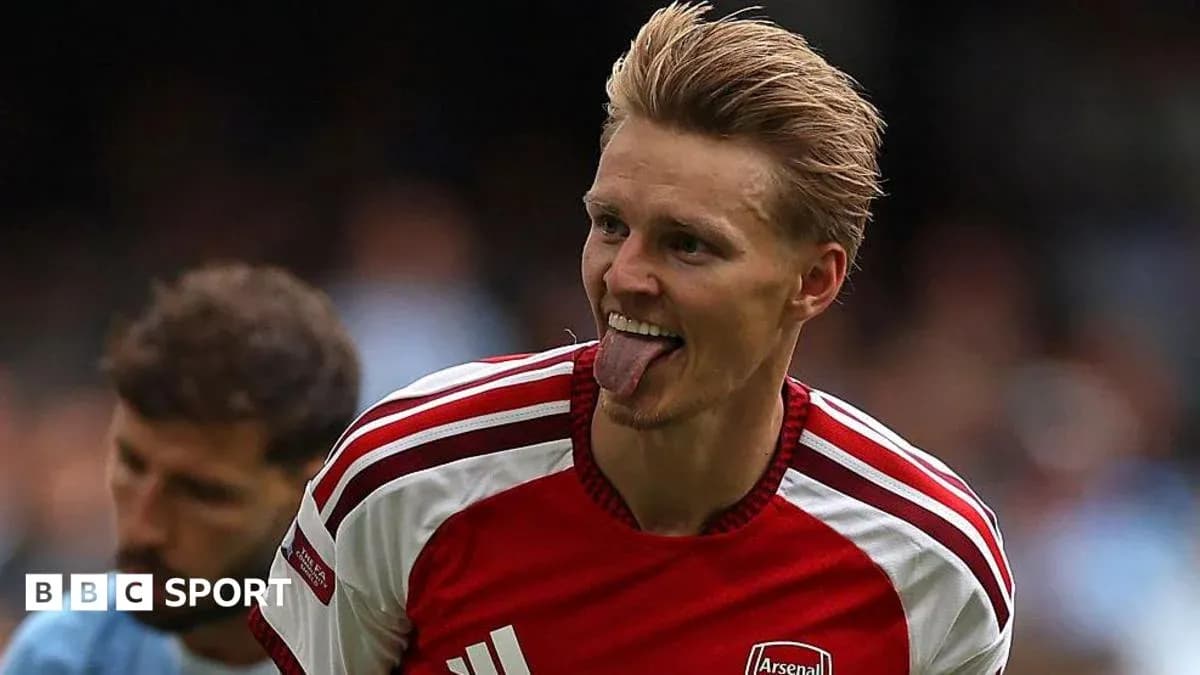
Martin Odegaard did not just lift a trophy in Cardiff. He changed the temperature of Arsenal’s season before it has even begun.
The captain produced a man-of-the-match performance in a 3-0 Community Shield dismantling of Manchester City, the kind of commanding display that has been missing for long stretches of the past year. By the time his dummy sent Gianluigi Donnarumma sprawling and the ball was in the net for Arsenal’s third, it felt like a statement as much as a goal: the old Odegaard, the one who drove Mikel Arteta’s revolution, is back in the room.
From frustration to authority
Last season was supposed to be his coronation. Arsenal won the Premier League for the first time in 22 years, but Odegaard watched too much of it from the sidelines, wrestling with knee and shoulder problems that stripped rhythm from his game and influence from his numbers.
Sixteen league starts. One goal. Seven assists. His leanest return since he made the move from Real Madrid permanent in 2021-22.
The doubts crept in from the outside. Was he still the same creative force? Was he the right captain for a side now expected to win, not just compete? Inside the club, the faith never really wavered, but faith needs evidence. Cardiff supplied plenty.
Odegaard was everywhere. Among Arsenal players, he completed the most passes (55 of 58), the most dribbles (three out of three) and won possession more than anyone else on the pitch in red and white, doing so nine times. He stitched attacks together, pressed City’s midfield into errors and, when the game opened up, he finished it with that cold, ruthless third.
The numbers backed up the eye test. This was the Odegaard who once set the tempo for everything Arsenal tried to do.
A midfield that looks frightening
Arteta has not stood still since that title win. He has doubled down on control and variety in midfield, spending £75m on Bruno Guimaraes and stockpiling technicians and ball-winners in equal measure.
Mikel Merino, one of the many options in that area, has already called Arsenal’s midfield group “probably the best in football”. Looking at the roll call, it is a bold line that does not feel outlandish.
- Odegaard.
- Guimaraes, who impressed in his 45 minutes on Sunday with the calm arrogance of a player who expects to dominate.
- Myles Lewis-Skelly, the academy prodigy with the fearlessness of youth.
- Martin Zubimendi, Declan Rice, Eberechi Eze, Merino himself.
It is depth and variety that most managers can only dream about.
The danger for any incumbent in a squad like that is obvious. Competition can squeeze you. For Odegaard, it might do the opposite. With Guimaraes snapping passes through lines and Rice patrolling behind, the Norwegian suddenly has the freedom to drift, probe and take risks again, knowing he has a platform beneath him.
He and Guimaraes seemed to click almost immediately in their first start together. The passing angles appeared, the rotations came naturally. Odegaard spoke about it as if it were the most simple thing in the world.
“Sometimes you are just in the flow. You need to find that on the pitch,” he said afterwards. “All of us were flowing pretty good out there. I will just try to keep that up and keep going.”
Using the pain
The smoothness of Sunday’s performance comes from a jagged year. Odegaard did not hide from that.
“Last year was really a big struggle with a lot of difficult moments. To miss so many games because of injury was really frustrating,” he admitted. “It is the worst thing for a footballer to not be able to be on the pitch and I had quite a lot of weird injuries, and bad luck.”
He found a way to turn it. He finished the club season fit, then carried that form into the World Cup with Norway, starting five of their six games and recording four assists. Confidence returned. So did the feeling that he could once again dictate games at the highest level.
“It was good for me to end the season with a title, here, and then a good World Cup. Then I had my break and I feel good, ready to go again,” he said. “What I have just worked on is to use that as motivation for this year and to come back stronger. And to use all of those experiences in a positive way.”
Those are not the words of a player content to ride the wave of a title win. They are the words of a captain who knows he owes himself, and his team, a full season at full power.
Arteta’s “different Martin”
Arteta has always been clear: a fully fit Odegaard changes the geometry of his side. The issue last year was simple – he rarely had one.
“Well, he missed five or six months for different things and it was extremely difficult for him to get any momentum,” the Arsenal manager said. “So I’m sure this year if we can maintain him fit, available with the players around him, we’re going to see a very different Martin.”
The key line came next.
“I sense from the first day that he joined [pre-season training] that he has something else on the belly that he wants to prove and show, because the team needs it as well.”
Something else on the belly. A point to prove. A title to defend. A new midfield built to dominate Europe as well as England.
Odegaard was the symbol of Arteta’s early rebuild, the loan gamble from Madrid who grew into the face of a new Arsenal. On this evidence, surrounded by the strongest supporting cast of his time in north London and finally free of those “weird injuries”, he might yet feel like the club’s most important “new signing” of all.
If this is how he looks in August, what does a fully unleashed season of Odegaard do to the balance of power at the very top of English football?