.svg&w=384&q=75 "GoalGist logo")
Marc Cucurella: A Game-Changer for Real Madrid
Real Madrid thought they were signing a left-back. They ended up signing a World Cup winner, a fan-favourite in a global Best XI, and a key piece of their Champions League puzzle.
Cucurella’s arrival this summer has already reshaped the narrative around the club’s summer business. On paper, it looked like a smart, opportunistic deal. In practice, it has become one of the most immediately profitable moves of the window – both on the pitch and in the boardroom.
From Chelsea to Champion
When Real Madrid closed the deal for Marc Cucurella, few imagined how quickly his value would spike. Spain’s squad for the 2026 World Cup did not contain a single Real Madrid player. Not one. That changed the moment Cucurella walked through the doors at Valdebebas.
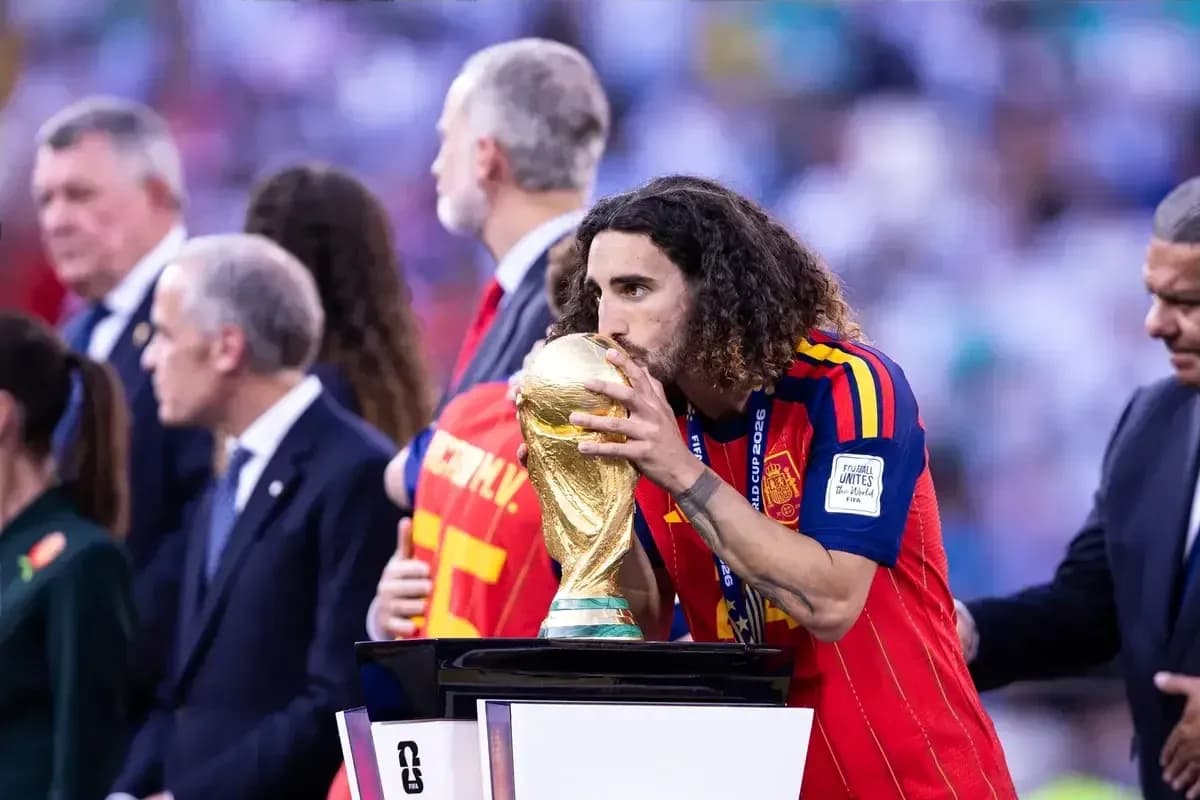
His inclusion in Luis de la Fuente’s list gave Madrid something they had been missing: a direct presence in La Roja at a major tournament. Spain went on to win the World Cup, and with that, a slice of the glory inevitably drifted back to the Bernabéu.
Cucurella was not just a passenger in that story. He impressed enough to be voted by fans into the FIFA World Cup Best XI, one of three Real Madrid players to make that select group. His performances, energy and reliability on the left flank resonated far beyond Spain’s dressing room.
The market reacted just as quickly as the fans. After the tournament, his valuation on Transfermarkt jumped to €60 million, a sharp rise for a player Madrid had only just secured. In pure asset terms, the club watched a new signing appreciate in value within days of his arrival. That is rare, even for an institution as used to winning as Real Madrid.
Tactical Weapon, Regulatory Solution
The sporting benefit is obvious. Madrid have added a high-level, battle-tested fullback to the left side, a player comfortable in elite competition and fresh from the intensity of a World Cup triumph. He strengthens the starting XI and deepens the squad in a position that has often required patchwork solutions.
But Cucurella’s importance runs deeper than his overlapping runs and defensive work.
His arrival also solves a structural problem that every big European club has to manage quietly in the background: UEFA’s homegrown player rules. To register a full 25-man squad for the Champions League and other UEFA competitions, clubs must include at least eight locally trained players.
For Real Madrid, that category covers footballers who spent their formative years, between 15 and 21, at their own academy or at any other academy in Spain. It is not just a bureaucratic box to tick; it shapes transfer strategy and squad planning every summer.
Cucurella fits that profile perfectly. He came through Barcelona’s youth system, continued his development at Eibar and Getafe, and only then crossed to the Premier League with Chelsea. His footballing education is unmistakably Spanish, and that makes him locally trained under UEFA regulations.
With him on board, Madrid hit the required quota. No compromises on quality, no need for late reshuffles or emergency promotions just to satisfy the rulebook. A key regulatory headache disappears with a single signing.
A Move That Echoes Beyond the Left Flank
In the end, Cucurella gives Real Madrid three things at once: a World Cup-winning fullback in his prime, a rapidly appreciating asset, and a crucial homegrown piece that keeps their Champions League squad at full strength.
For a club that measures itself in trophies and details alike, that combination is hard to beat.