.svg&w=384&q=75 "GoalGist logo")
Manchester Derby Insights: United vs City Analysis
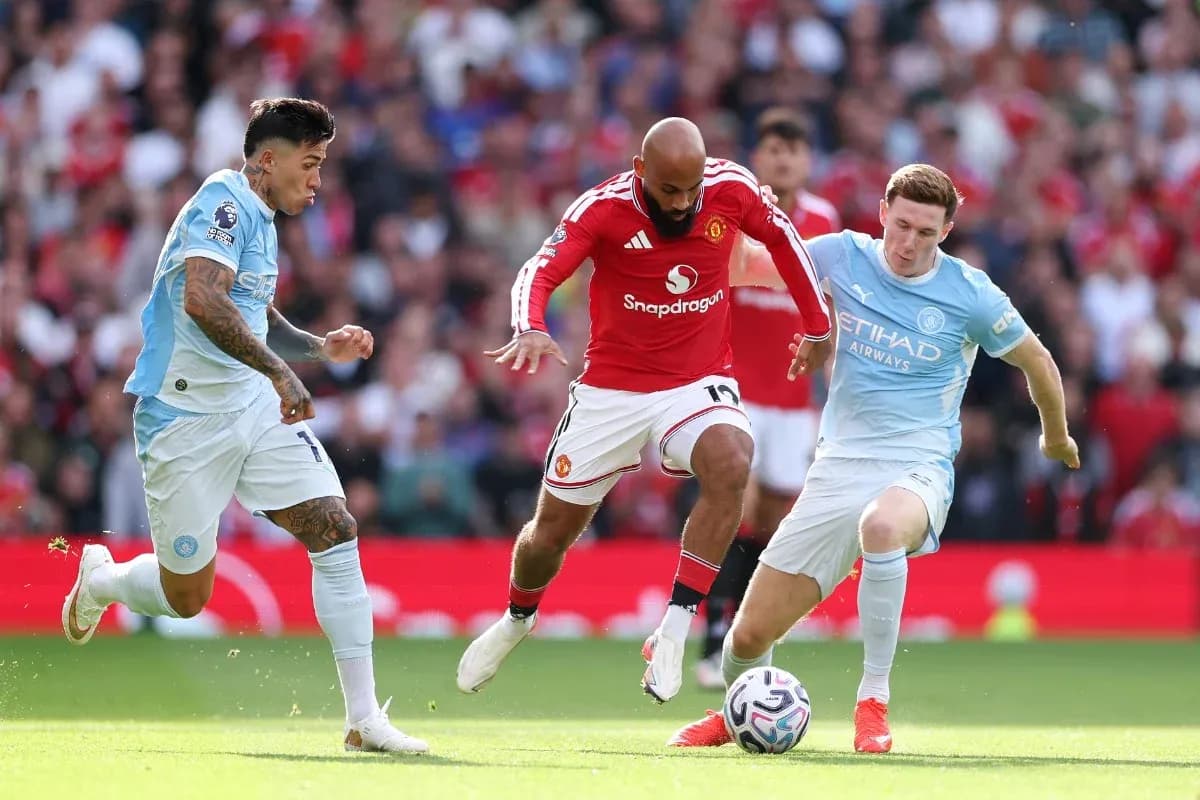
Old Trafford under late-summer light, Michael Oliver in charge, and a Manchester derby that finished with the smallest of margins: Manchester United 0–1 Manchester City in Regular Season - 4 of the 2026 Premier League. Across 90 minutes, the story was less about chaos and more about control, with City’s perfect start extended and United’s uneven campaign laid bare.
I. The Big Picture – Two 4-2-3-1s, two very different realities
Heading into this game, the table already framed the narrative. Manchester United sat 13th with 4 points from 4 matches, their overall goal difference at 0 after scoring 7 and conceding 7. At home they had been more expansive: 5 goals for and 3 against across 2 fixtures, averaging 2.5 goals scored and 1.5 conceded at Old Trafford. But there were no clean sheets in total this campaign and United had already failed to score in 2 of their 4 league outings.
Manchester City arrived as the machine in full rhythm. Second in the table with 12 points from 4 matches, they had an overall goal difference of 6, built on 8 goals for and only 2 against. On their travels, they had been ruthless: 2 away wins from 2, scoring 5 and conceding just 1, with an away scoring average of 2.5 and an away defensive average of 0.5. Two clean sheets overall, zero failures to score – this was a side that had not yet blinked.
Both managers mirrored each other on paper with a 4-2-3-1. Michael Carrick’s United trusted the structure that has defined their early season: S. Lammens behind a back four of Diogo Dalot, H. Maguire, Lisandro Martínez and P. Dorgu. Y. Tielemans and K. Mainoo formed the double pivot, with B. Mbeumo, Bruno Fernandes and M. Rashford supporting Matheus Cunha as the lone forward.
Enzo Maresca’s City also lined up 4-2-3-1, but with a different personality. G. Donnarumma in goal, a back line of Matheus Nunes, M. Guéhi, Rúben Dias and J. Gvardiol. E. Fernández and E. Anderson sat deeper, allowing a creative three of P. Foden, R. Cherki and A. Semenyo to orbit around E. Haaland, the league’s most feared finisher.
II. Tactical Voids – Absences and discipline shaping the contest
United’s bench hinted at both promise and fragility. L. Yoro, N. Mazraoui and A. Heaven offered defensive alternatives; Andrey Santos and M. Mount gave options between the lines; and a forward trio of S. Lacey, B. Šeško and J. Zirkzee suggested firepower that, on the day, remained theoretical.
But the absences were more telling. C. Baleba (ankle injury), A. Diallo, T. Heaton, L. Shaw, M. Ugarte (knee injury) and M. de Ligt (back injury) were all missing. De Ligt’s absence, in particular, forced Maguire into a central role where his aerial dominance is offset by exposure to pace and high pressing. Without Shaw, United lost a natural outlet on the left, leaning instead on P. Dorgu’s energy but sacrificing some of the build-up security and crossing quality Shaw usually provides. The missing Ugarte reduced United’s options for a pure ball-winner in midfield, making Mainoo’s role even more demanding against City’s rotations.
City’s only listed absentee was J. Doku with a calf injury. His absence removed an explosive one‑v‑one threat on the flank, but Maresca compensated with a more combinational front line in Cherki, Foden and Semenyo – less vertical chaos, more positional precision.
Disciplinary trends also cast a shadow over the tactical plan. United’s yellow card distribution this season shows a clear late-game spike: 50.00% of their bookings have come between 76–90 minutes, with additional cards in the 31–45 and 61–75 ranges. City’s profile is similar in its late intensity: 42.86% of their yellows arrive from 76–90 minutes, with another 28.57% between 46–60. They also carry the edge of a side that plays on the limit – their only red card this season belongs to P. Foden, while H. Maguire’s 2 yellows mark him as United’s most card-prone defender.
III. Key Matchups – Hunter vs Shield, Engine Room vs Enforcer
Hunter vs Shield was always going to be E. Haaland against the United back line. Haaland arrived with 4 goals in total from 4 appearances, converting 9 shots on target from 15 attempts and winning 17 of 30 duels. United, who had conceded an overall average of 1.8 goals per match, were facing the league’s most efficient finisher without their first-choice organiser in M. de Ligt.
Maguire, for all the scrutiny, had been quietly productive: 246 passes at 88% accuracy, 5 interceptions, 1 blocked shot and 21 duels won from 34. But his 7 fouls committed and 2 yellow cards underlined the risk profile when dragged into wide or high spaces. Lisandro Martínez’s aggression and anticipation beside him were essential to compress the zones Haaland loves to attack. Diogo Dalot and P. Dorgu, meanwhile, had to be braver in their starting positions to prevent City’s wide midfielders from delivering unopposed.
In the Engine Room, Bruno Fernandes and Y. Tielemans faced E. Fernández and E. Anderson. Bruno entered as United’s creative heartbeat and leading scorer: 3 goals and 1 assist in total, 9 key passes, 262 total passes at 85% accuracy. He is both conductor and finisher, having scored from the spot once this season (United’s only penalty, converted with 100.00% success and no misses). City’s shield against him was collective rather than individual: Fernández’s passing security and Anderson’s work rate designed to block Bruno’s half-space pockets and limit his freedom between the lines.
For City, R. Cherki and P. Foden formed a dual-creator axis. Cherki arrived with 2 goals and 2 assists in total, 10 key passes and 91% passing accuracy – a high-volume, high-precision playmaker who can slip Haaland through or combine with Semenyo. Foden, despite 1 yellow and 1 red this season, remained crucial between the lines with 7 key passes and 2 assists. Their job was to drag Mainoo and Tielemans away from their zones, opening central channels for Haaland and late runs from Fernández.
On the flanks, A. Semenyo’s relentless running and 47 duels contested (15 won) made him a pressing trigger and transitional weapon against United’s full-backs. His 2 assists and 7 key passes this season show a player who can both carry and release, especially when United’s structure stretches.
IV. Statistical Prognosis – Control vs volatility
From a statistical lens, this derby always leaned towards City. They came in with an overall scoring average of 2.0 and conceding only 0.5, compared to United’s more volatile 1.8 scored and 1.8 conceded. City’s ability to keep clean sheets – 2 in total – contrasted sharply with United’s 0, and their record of never failing to score this season was a direct challenge to a defence missing key personnel.
United’s hope lay in Old Trafford’s slightly inflated attacking numbers – 2.5 goals scored at home on average – and the individual brilliance of Bruno Fernandes and M. Rashford in transition. Yet their late-game card surge suggested a side that often ends matches under stress, precisely when City tend to accelerate their tempo and intensity.
The 1–0 full-time scoreline to City ultimately reflected the underlying patterns. Maresca’s side imposed their structure, limited United’s creators, and allowed Haaland, Cherki and company enough moments to tilt the balance. For United, this derby underlined the gap between an evolving project and a fully-formed contender: the structure is there, the talent is there, but the margins – in discipline, defensive cohesion and late-game control – still belong to the blue half of Manchester.