.svg&w=384&q=75 "GoalGist logo")
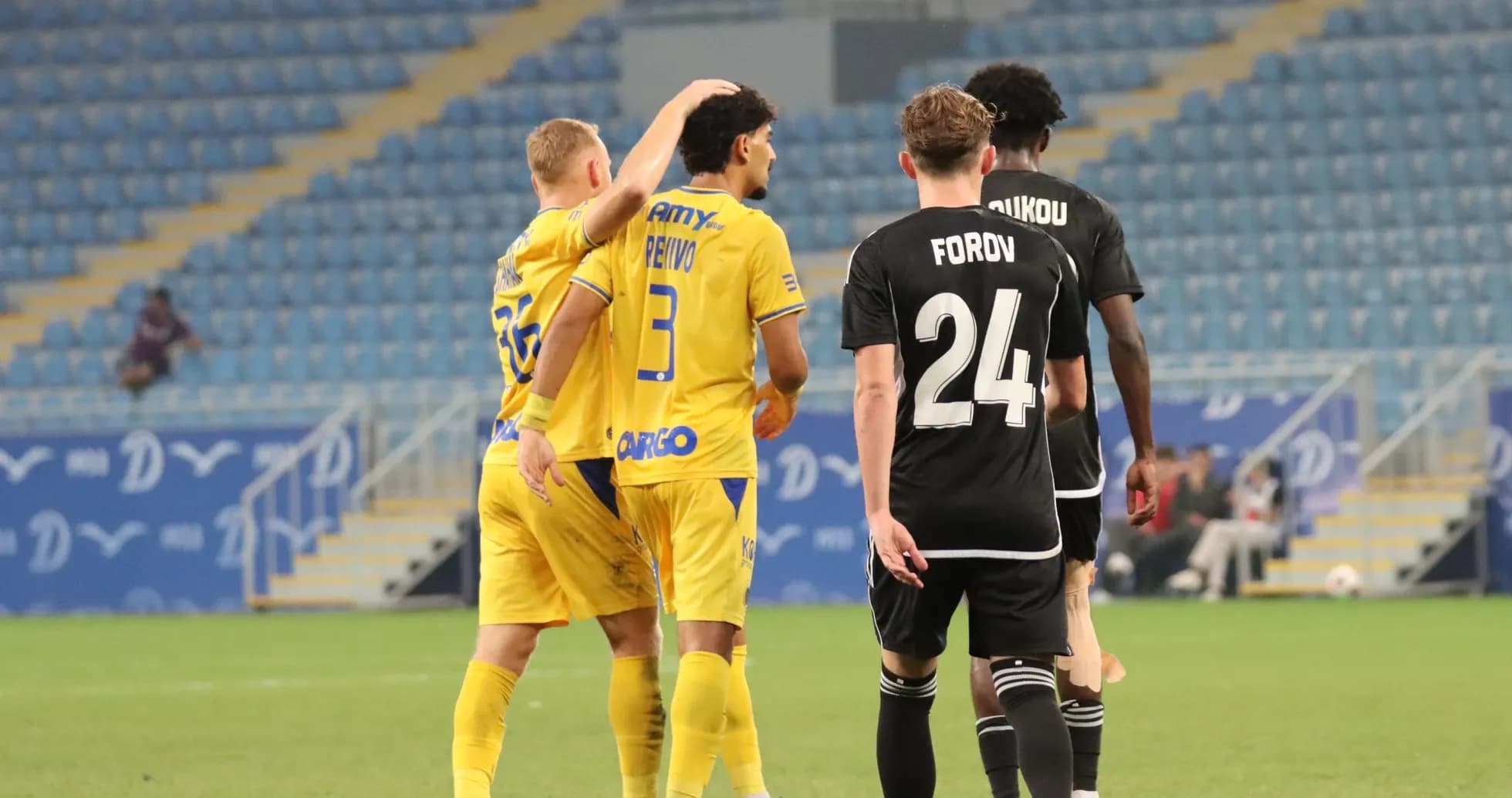
Maccabi Tel Aviv Defeats Sheriff Tiraspol 1-0 in UEFA Europa League
Maccabi Tel Aviv’s 1–0 win over Sheriff Tiraspol at Batumi Arena in the UEFA Europa League 2nd Qualifying Round was a study in territorial control and structural discipline rather than attacking volume. Both sides finished with 50% possession, but the Israeli side translated their share of the ball into more threatening territory, more corners, and the decisive own goal forced under pressure. Sheriff, by contrast, never managed a shot on target and relied on set plays and direct balls to create their limited danger.
Kenny Miller set Maccabi Tel Aviv up in a 4-3-3 that functioned as a clear 2-3-5 in possession. Full-backs N. Ben Harush and R. Revivo pushed high and wide, with D. Peretz anchoring beneath the ball as the single pivot. Ahead of him, I. Sissokho and I. Shahar played as advanced No.8s, frequently stepping into the half-spaces to pin Sheriff’s midfield line. The front three of S. Jehezkel, S. Abu Farkhi and H. Varela stretched Sheriff’s back four horizontally, creating the crossing lanes that underpinned Maccabi’s 12 corner kicks.
The decisive moment on 29 minutes came from that territorial squeeze. With Maccabi established in Sheriff’s third and circulating the ball into wide zones, the Moldovan side were forced deep and narrow. Under this pressure, S. Kone turned the ball into his own net, an own goal that reflected Maccabi’s ability to keep play in Sheriff’s box rather than a single crafted combination. From that point, Maccabi’s task became one of game management: keep the block compact, maintain field position through set pieces, and avoid transitions.
Out of possession, Maccabi’s 4-3-3 became a 4-1-4-1. Peretz screened in front of centre-backs M. Camara and R. Shlomo, cutting off direct passes into Sheriff’s central midfielders. The wingers dropped onto Sheriff’s full-backs, forcing the Moldovan side to build either through their centre-backs or via longer diagonals. The result was that Sheriff’s 4-3-3 rarely developed into sustained positional attacks; they were limited to 4 shots off goal, 2 blocked shots and no shots on target, underlining how effectively Maccabi controlled the central lane and defended their box.
Victor Mihailov mirrored the 4-3-3 on paper, but Sheriff’s structure was more conservative. Rai and M. Ouedraogo were cautious with their forward runs, and the midfield trio of Mota, D. Klas and A. Pergjoni often sat in a flat line rather than staggering between the lines. That left a disconnect to S. Kone, L. Jaures-Ulrich and D. Forov in advanced roles, who frequently received with their backs to goal and little support underneath. Sheriff’s 7 corners show they did find some set-piece platforms, but without a sustained aerial or second-ball threat, those moments never translated into clear chances.
The substitution pattern from both benches confirmed the tactical storyline. Mihailov’s first changes at 57' and 59' were like-for-like: Mota (OUT) for Sapata (IN), then S. Kone (OUT) for V. Nihaev (IN). The structure remained 4-3-3, but the intent was to add fresh legs and more vertical running from midfield rather than change shape. A triple change at 77' — A. Pergjoni (OUT) for N. Swen (IN), L. Jaures-Ulrich (OUT) for V. Cozma (IN), and D. Forov (OUT) for J. Modelo (IN) — again preserved the basic framework, indicating Sheriff were betting on energy and directness rather than systemic risk.
Miller’s adjustments were more about locking the game down. At 63', I. Shahar (OUT) for I. Ben Simon (IN) and S. Jehezkel (OUT) for O. Davida (IN) freshened the wide and central midfield roles, but crucially kept the 4-3-3 intact. Later, at 79', H. Varela (OUT) for I. Noy (IN) and N. Ben Harush (OUT) for I. Ben Hamo (IN) signalled a tilt towards defensive security: new legs in midfield to press and track, and a full-back change to maintain intensity in wide defensive duels. The pattern of play after these changes — Maccabi absorbing more direct balls but conceding no shots on goal — shows the plan worked.
Discipline also shaped the closing stages. Sheriff finished with 11 fouls and 2 yellow cards, both for “Tripping”: at 71' V. Nihaev (Sheriff Tiraspol) — Tripping, then at 90+3' B. Ciss (Sheriff Tiraspol) — Tripping. Chasing the game, their midfielders increasingly stepped late into duels, stopping Maccabi counters at the cost of cards. Maccabi, by contrast, committed 9 fouls and avoided any bookings, a reflection of how often they defended in structure rather than in emergency situations.
Statistically, Maccabi’s attacking edge is clear despite the shared 50% possession. They produced 3 shots on goal, 5 shots off goal and 3 blocked shots, compared with Sheriff’s 0 shots on goal, 4 off target and 2 blocked. The 12–7 corner count in Maccabi’s favour underlines where the game was played: closer to Sheriff’s box than their own. Without data on passes, passing accuracy, xG or goals prevented, the clearest metrics are territorial and defensive: Maccabi repeatedly forced play into advanced areas and then protected their box so well that O. Melika (Maccabi Tel Aviv) was never tested by a shot on target, while E. Timbur (Sheriff Tiraspol) faced the more meaningful pressure.
Within the context of a two-legged European qualifier, this 1–0 scoreline, built on structural control and defensive denial rather than attacking fireworks, gives Maccabi Tel Aviv a platform. They showed they can dictate where the game is played, generate a steady flow of set pieces, and close out a narrow lead without losing shape — all traits that travel well in knockout football.