.svg&w=384&q=75 "GoalGist logo")
Liverpool Players at the World Cup: Munoz, Mac Allister, and More
The World Cup is done. One hundred and four games, a trail of flashpoints, and in the end Spain stood above the noise, picking their way through Argentina’s spoiling and cynicism in a final that summed up a swollen, uneven tournament.
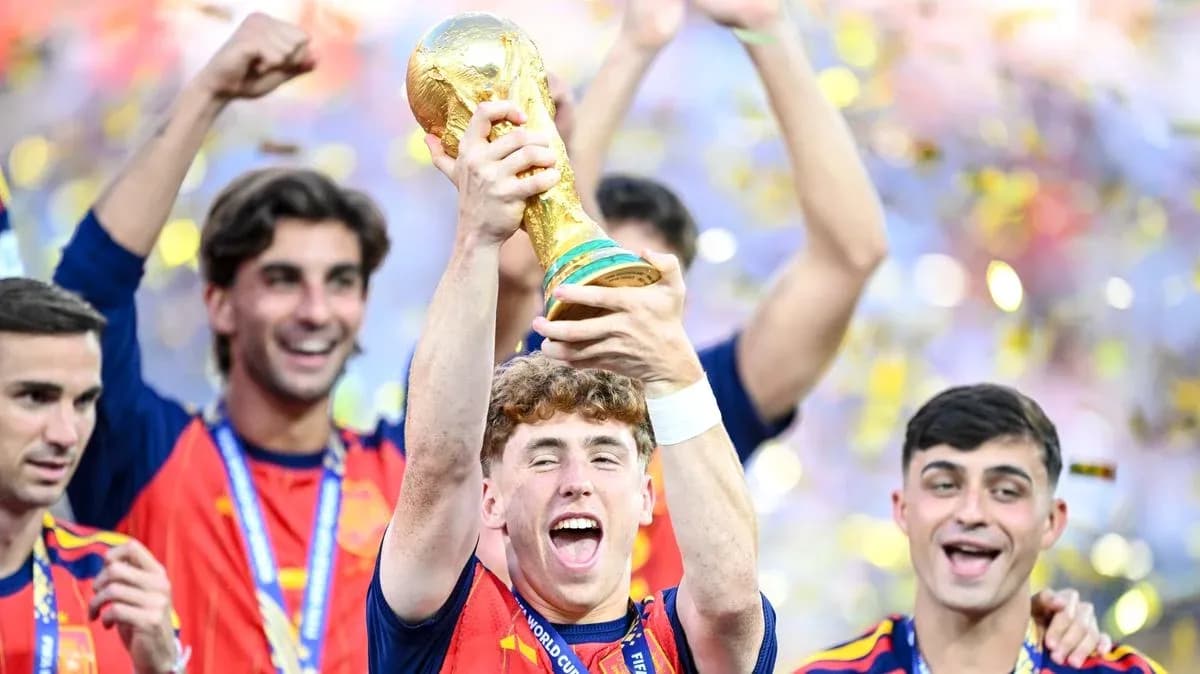
Liverpool’s interest ran deep. Eight players flew out to the United States, Canada and Mexico. Only one of them would definitely come home a world champion, with Alexis Mac Allister’s Argentina colliding with new signing Victor Munoz’s Spain in New York.
Spain won it. Munoz joined a very small Liverpool club. The rest will soon be back under Andoni Iraola, dropping into a pre-season tour that includes Sunderland, Leeds United and Wrexham, carrying with them the scars, form and questions from a long summer.
Here’s how they fared.
Victor Munoz – N/A
Spain were still wondering how they had failed to score against Cape Verde in their opening game when the news broke: Liverpool had triggered Munoz’s £34.5million release clause at Osasuna. The first signing of the Iraola era, announced in the middle of a World Cup campaign.
Supporters settled in, waiting to see what they’d bought.
They never did. An injury took Munoz out of the picture, then Spain’s run gathered speed without him. He didn’t play a single minute as his country marched to the trophy.
Yet his name goes straight into Liverpool’s history. Munoz becomes only the sixth serving Red to win the World Cup, following Roger Hunt, Ian Callaghan, Gerry Byrne, Fernando Torres and Pepe Reina. Not a bad way to arrive before you’ve even kicked a ball.
Alexis Mac Allister – 7
The final will not sit comfortably with Alexis Mac Allister. Like most of his Argentina team-mates not named Lionel Messi, he came up short on the biggest night.
His tournament as a whole tells a different story.
Mac Allister was one of Lionel Scaloni’s untouchables, playing every minute bar the dead rubber against Jordan once qualification was secured. From a more advanced role than he usually occupies at Anfield, he knitted Argentina’s attacks together, threading passes and finding pockets of space.
He created a goal against Cape Verde. He scored the opener in the quarter-final win over Switzerland, a finish that underlined both timing and composure. When Argentina were on the brink against England, he helped drag them back into the tie, showing personality when the pressure rose.
Across eight games he picked up only one booking. For a 27-year-old who relishes the physical side of midfield work, that level of control stands out.
Liverpool will want that sharper, more assertive version of Mac Allister to walk straight into Iraola’s system.
Alisson Becker – 7
Back from injury, back in goal, back to looking like Alisson Becker.
Brazil were a shadow of their great sides, a team with a famous shirt and little of the old authority. Through it all, Alisson remained one of the few pillars you could trust.
He handled cleanly, commanded his box and radiated calm behind a defence that never convinced. There was little he could do about Erling Haaland’s two ruthless finishes in the defeat to Norway that sent Brazil home. The margins for goalkeepers at this level are brutal: one misstep and the narrative turns, yet his never did.
What he showed, again, is why he still belongs in any conversation about the world’s best goalkeepers. The next step is simple, and crucial for Liverpool: stay fit, stay available.
Alexander Isak – 6
The irony will not be lost on anyone at Anfield. Alexander Isak, who never managed a full 90 minutes for Liverpool last season, suddenly became Sweden’s marathon man.
Three complete games out of four. A central role. And at the start, he looked electric.
He tore through a poor Tunisia side, scoring once and laying on two more. His movement dragged defenders all over the pitch, his touch and awareness opening lanes for runners. When Sweden thrashed Holland, he added another assist, again showing the blend of finesse and physical presence that persuaded Liverpool to bring him in.
Then the returns started to fade. The sharpness of that first outing dulled, the impact waned, and Sweden’s campaign drifted with it. By the end, his tournament felt like a snapshot of his club season: flashes of class, questions about consistency, and a lingering sense that there is more to come.
Cody Gakpo – 8
Cody Gakpo needed this World Cup.
Last season at Liverpool, criticism followed him. Some of it harsh, some of it impatient, all of it wearing. With Holland, the weight came off his shoulders and his football loosened.
Playing from the left flank, he looked like a different player. He ran at defenders, demanded the ball, took risks. Against Sweden he produced his standout display: two goals and an assist, a performance full of direct running and clinical finishing.
Then came the most emotional moment of his tournament. In the round of 32 defeat to Morocco, Gakpo scored shortly after the deeply personal news of the loss of his unborn son emerged. It was a goal wrapped in grief, defiance and pride, a reminder that behind the numbers and ratings are lives being lived in real time.
For Liverpool, the Gakpo who lit up Holland’s left side is the one they have been waiting to see more often.
Virgil van Dijk – 7
Virgil van Dijk captained Holland through a campaign that never quite settled.
He chipped in at the other end, scoring in the lively group draw with Japan and providing an assist against Tunisia. In both boxes he remained a presence, winning duels, stepping out with the ball, trying to set a tone.
Back home, though, the familiar grumbles continued. Certain voices in the Dutch media and fanbase have never truly warmed to him, and every misstep fed the narrative. The criticism grew even as Ronald Koeman’s side clearly leaned towards attack, often leaving the back line exposed.
Holland conceded in all four games. That statistic will stick, fair or not. Van Dijk was not flawless, but he was far from the main problem in a team built to outscore rather than outlast.
He returns to Liverpool with another heavy workload behind him and another reminder that scrutiny will follow him wherever he goes.
Ryan Gravenberch – 7
Ryan Gravenberch’s World Cup was a tactical tug-of-war.
Koeman pushed him higher up the pitch than he usually operates at Liverpool, and the early signs were promising. Against Japan he delivered two clever assists, picking passes that sliced through the defence and highlighted his vision in the final third.
The experiment did not last. When Holland faced Morocco, Gravenberch dropped back into a more defensive role, tasked with shoring up the middle of the pitch. He was substituted before Holland conceded the late equaliser that dragged the tie to penalties, but the shift in his responsibilities blunted his attacking threat.
For Iraola, that versatility is both a gift and a puzzle. Gravenberch proved he can hurt teams between the lines. The challenge now is to find a settled role that lets him do it more often.
Florian Wirtz – 6
On paper, Florian Wirtz had a productive World Cup. Three assists in four games from a position predominantly off the left. Neat numbers in a disjointed Germany side.
Yet the feeling lingered that he had left something on the table.
His touch and intelligence were obvious. He drifted into spaces, linked play, and at times seemed the only German attacker capable of threading a pass through traffic. Still, too many of his contributions felt like half-moments, promising moves that never quite turned into match-defining actions.
When Germany’s campaign ended in controversy against Paraguay, Wirtz was already off the pitch before the penalty shootout drama. It was a fitting image for his tournament: involved, influential in flashes, but not on the grass when it truly exploded.
Liverpool know his ceiling is high. The question now is whether this World Cup becomes a springboard or a missed opportunity that nags at him into the new season.

