.svg&w=384&q=75 "GoalGist logo")
Levski Sofia vs AEK Athens: Tactical Stalemate in Champions League Play-offs
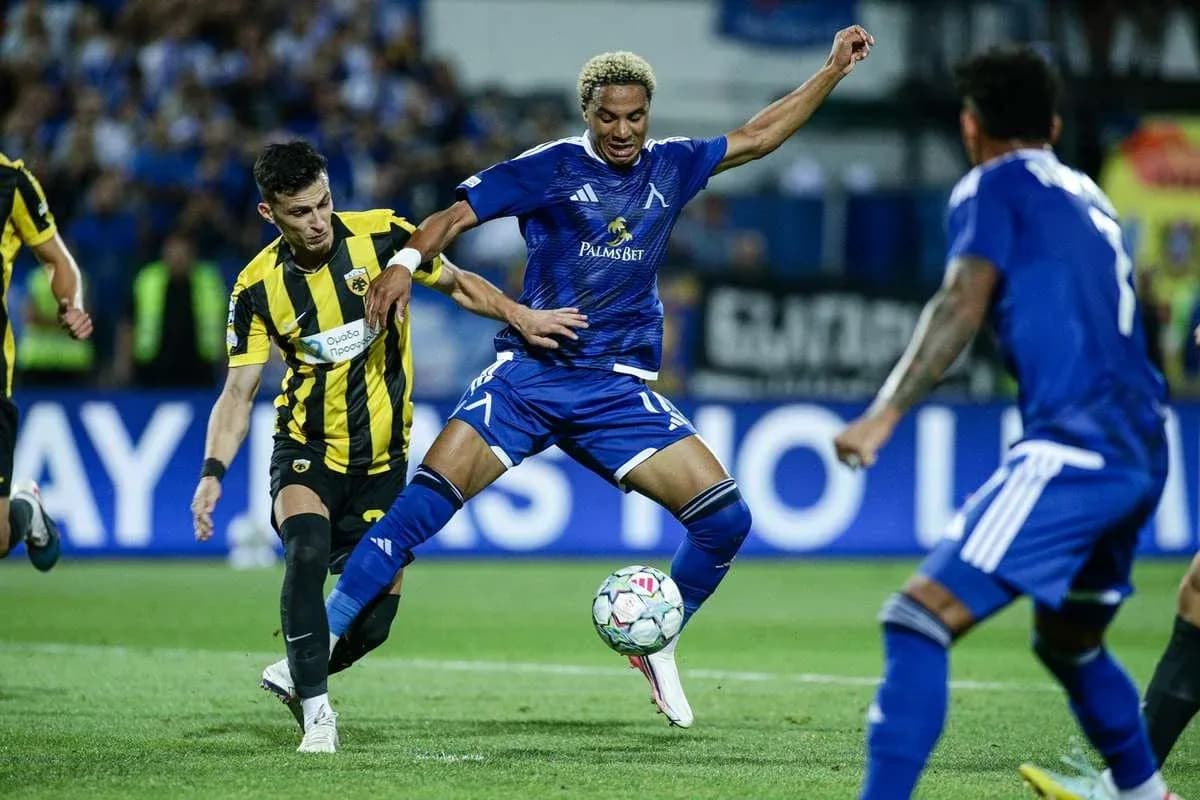
Levski Sofia and AEK Athens FC produced a finely poised tactical stalemate at Georgi Asparuhov Stadium, a 0-0 that was far more about structure and control than penalty-box chaos. In a Champions League Play-offs tie where away goals no longer define the narrative, both coaches leaned into their core identities: Julio Velazquez with a 4-2-3-1 built on controlled possession and layered buildup, Marko Nikolic with a compact 4-4-2 aimed at vertical transitions and physical duels.
Levski’s 4-2-3-1 was clearly designed to dominate the ball and progress methodically. They finished with 52% possession, 485 total passes and an impressive 428 accurate (88%), reflecting a side comfortable circulating under pressure. The double pivot of M. Moubarik and Maicon provided the platform: one dropping to assist first-phase buildup, the other stepping into the half-spaces to connect with the trio behind Reinaldo. With A. Centelles and A. Neves as full-backs, Levski tried to stretch AEK’s 4-4-2 horizontally, creating pockets between full-back and wide midfielder for A. Oko-Flex and Everton Bala (before and after his substitution) to receive on the turn.
The shot profile underlines that Levski’s possession had some territorial bite but lacked incision. They produced 15 total shots to AEK’s 12, with 6 from inside the box and 9 from distance. However, only 3 of those efforts tested T. Strakosha (AEK Athens FC), and 4 were blocked. AEK’s back four, particularly the central pairing of H. Moukoudi and F. Relvas, held a relatively deep line, preferring to protect the area rather than aggressively step into midfield. This forced Levski to settle for longer-range efforts when their wide overloads failed to break the last line.
AEK’s 4-4-2, by contrast, was built around compactness and counter-attacking lanes. With 48% possession and 453 passes (394 accurate, 87%), they did not simply sit off; instead, they accepted spells without the ball but were ready to play when they recovered it. The central trio of L. Majer, R. Marin and K. Kairinen controlled the middle defensively, screening passes into Reinaldo’s feet and forcing Levski to recycle wide. Offensively, the front pairing of Zini and L. Jovic provided depth, looking to exploit the space behind Levski’s advancing full-backs.
AEK’s shot map speaks to a more selective, transition-based threat. They took 12 shots, 5 from inside the box and 7 from outside, but only 1 was on target. That single effort required a save from S. Vutsov (Levski Sofia), whose statistical line – 1 goalkeeper save – reflects how well his defensive block protected the central corridor. Levski’s back four, marshalled by K. Dimitrov and N. Serafimov, kept AEK’s forwards mostly facing away from goal, limiting clear-cut looks despite AEK’s attempts to break quickly.
In goal, the contrast in workload is subtle but telling. S. Vutsov (Levski Sofia) made 1 save, a product of his team’s ability to keep AEK at arm’s length. At the other end, T. Strakosha (AEK Athens FC) was called into action more often, with 3 saves. That discrepancy mirrors the territorial edge Levski enjoyed, but the lack of a breakthrough underlines AEK’s discipline in the box and their willingness to absorb crosses and shots from suboptimal angles.
The substitution patterns reveal how both coaches tried to tilt a finely balanced tactical battle. On 57 minutes, Nikolic reshaped his attacking structure: P. Mantalos (IN) came on for L. Majer (OUT), and B. Varga (IN) came on for L. Jovic (OUT). This shifted AEK towards a slightly more flexible 4-4-1-1/4-2-3-1 hybrid, with Mantalos offering more creativity between the lines and Varga providing fresh legs and aerial presence up front. Later, at 81 minutes, M. Gacinovic (IN) came on for A. Koita (OUT), and O. Zubkov (IN) came on for Zini (OUT), injecting more technical quality and pace into the wide and forward zones for the closing phase. These changes were aimed at improving AEK’s ability to hold the ball in advanced areas and threaten in transition without losing their defensive compactness.
Velazquez’s response came slightly later and was more aggressive in attacking intent. At 67 minutes, J. Perea (IN) came on for A. Oko-Flex (OUT), adding a more direct, penalty-box-oriented presence behind or alongside Reinaldo. Then, in the 79th minute, he doubled down: M. Soula (IN) for Everton Bala (OUT) and A. Mitkov (IN) for Reinaldo (OUT) signalled a refresh of the entire attacking axis, maintaining intensity and pressing capacity against a tiring AEK back line. In the final stages, S. Hevertton (IN) for A. Neves (OUT) at 88 minutes and S. Stoyanchov (IN) for Maicon (OUT) at 89 minutes suggested a last tactical tweak: fresh legs at full-back and in midfield to sustain pressure and guard against late counters while pushing numbers forward.
Statistically, the defensive discipline of both sides stands out. Levski committed only 8 fouls to AEK’s 17, reflecting their preference for controlled pressing and positional play rather than constant duels. AEK’s higher foul count aligns with a more combative, interruption-based defensive plan, breaking Levski’s rhythm whenever central spaces were threatened. Corners were scarce (1 for Levski, 2 for AEK), another indicator that both teams limited sustained siege situations around their own box.
With no recorded yellow or red cards in the data and no penalties or extra-time, the tactical story is one of two well-drilled sides cancelling each other out. Levski’s slightly superior volume of shots and possession was offset by AEK’s compact 4-4-2 block and the reliability of T. Strakosha (AEK Athens FC). Conversely, AEK’s transition ideas rarely translated into clear chances against a disciplined Levski back line and the assured presence of S. Vutsov (Levski Sofia).
As a first-leg-style Play-offs encounter, this 0-0 sets up a second match where marginal tactical adjustments – especially in how Levski convert possession into higher-quality box entries and how AEK turn their transitions into more shots on goal – will likely decide who advances.