.svg&w=384&q=75 "GoalGist logo")
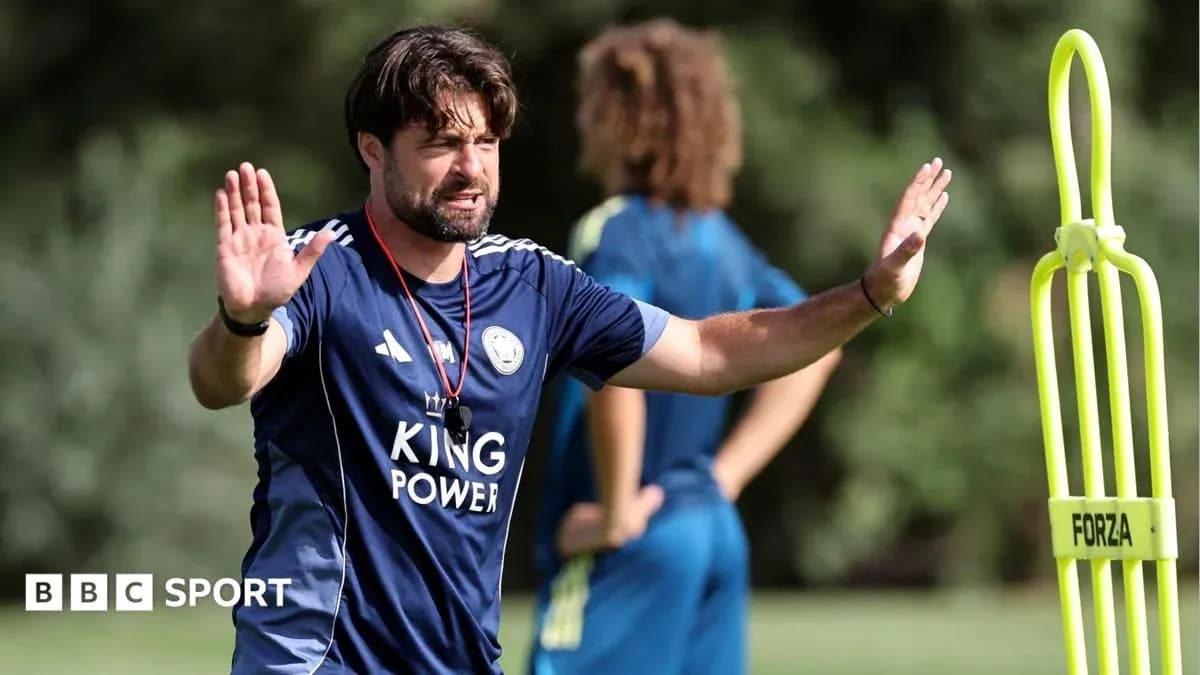
Leicester City: A New Era Under Russell Martin
Leicester City know all about history. It hangs from the King Power rafters, etched into every mention of 5,000-1 and that improbable Premier League title. It sits in the memory of an FA Cup lifted at Wembley in 2021.
It also lurks in the double relegation that has dumped them into League One.
Russell Martin walked straight into that contradiction and, from the outset, wanted no part of being measured against ghosts.
“We have to find our own way and then be judged on that,” he told BBC Radio Leicester, making it clear that neither Claudio Ranieri’s miracle nor the club’s recent collapse will dictate his future. “Hopefully I’ll be judged on the job I do here and not on my previous job and all that stuff.”
This is a reset – for Leicester, and for Martin himself.
A manager rebuilding his name
Two years ago, Martin’s stock was high. He had guided Southampton back to the Premier League, his possession-heavy football earning admirers and a promotion on his CV. Then came Rangers.
It lasted 123 days. A turbulent spell, a bruised reputation, and a manager suddenly facing questions about whether his ideas could survive the demands of a big club.
Now he has dropped into England’s third tier, just as Leicester have. Both are trying to restore credibility in a division neither believes they belong in.
“I know the club got relegated but, prior to that, that club had amazing success over a sustained period of time – like, huge,” Martin said. “Of course maybe you get judged based on that.”
He is refusing to do that. Refusing to judge the players on the last two years, refusing to judge the hierarchy on the anger that has built up around them.
A new power structure under pressure
Martin’s arrival was the first major call taken since James McCarron stepped in as sporting director last season. McCarron operates beneath chief football officer Jon Rudkin, a long-serving figure at Leicester who, along with owner and chairman Khun Aiyawatt “Top” Srivaddhanaprabha, has become a lightning rod for fan frustration.
Years of decline, missteps in recruitment, a points deduction for breaching spending rules – supporters have not been shy in identifying where they think the blame lies.
Martin, though, has been struck by something else: honesty.
“There was real honesty about what’s gone on, but now there’s real honesty and openness and willingness to move forward,” he said. “I can’t judge anything that has gone on before because I’ve not been here.”
He has watched the club unravel from afar, like everyone else. The difference now is that he has chosen to step inside the storm.
“You watch it from the outside, and people will make assumptions, but I’ve been really open to being surprised since I got here and people have been great.”
Promotion or bust
There is no mystery about the target. No soft landing. No gentle talk of transition.
“It’s to get promoted, first and foremost,” Martin said. That is the brief, stripped of spin.
But he wants more than a result on the league table. He wants identity.
To “play in a way that everyone understands and believes in, feels connected to and makes the fans proud,” is how he put it. Style, clarity, connection. The familiar pillars of his coaching philosophy, now applied to a club that once shocked the world by defying every footballing logic.
Whether League One will allow that kind of control and purity is another question entirely.
A squad stripped back
If Martin’s ideas are clear, the squad he will use to deliver them is anything but. Leicester’s summer has been dominated by exits, not arrivals.
The club have been forced to cut deep into the wage bill and move on some of the most recognisable faces from the side that slid from the Premier League to the Championship and then out of it.
- Jannik Vestergaard, the Denmark international defender, saw his contract terminated by mutual consent.
- Harry Winks, once tipped as the future of England’s midfield, has gone to Cagliari.
- Abdul Fatawu’s permanent move to Ipswich Town brought in around £20m.
Those sales were not just about footballing decisions. Leicester’s financial reality has been laid bare. Historical breaches of spending rules led to a points penalty last season, and the need to balance the books has driven a more ruthless approach in the transfer market.
That has extended to some of the club’s brightest prospects. Jeremy Monga, a 17-year-old forward regarded as one of the most promising talents in the academy, has been sold to Manchester City. For a fanbase already hurting, seeing a homegrown hope leave before he has even had the chance to make his mark in the first team cuts deep.
Then came the clear-out at the end of the season. Ten out-of-contract players gone. When the dust settled, Leicester found themselves without a senior striker on the books. Patson Daka had moved on. So had Jordan Ayew.
A club that once boasted Jamie Vardy as the symbol of its rise now faces a League One campaign with the most important position on the pitch still under construction.
Building a new attack
Into that void has stepped Conor Chaplin, one of only two signings since relegation. The former Ipswich Town forward knows this level and knows how to win here – he was top scorer when Ipswich went up from League One four seasons ago.
He is a start, not a solution.
Martin has been clear: Leicester need more. “Ideally, we’d have two or three strikers,” he said. Not just bodies, but variety. Different profiles, different threats. The same goes for the wide areas.
“We don’t just want one of the same, and it’s the same with wingers,” he added. The message is blunt – the days of signing names for the sake of it are gone. Every addition has to fit.
“Whatever we are looking at, whatever profile it is, it has to be right for us. They need to be desperate to come here and play, they need to be desperate to help us to be successful.”
Desperation, in this context, is not a weakness. It is hunger. A refusal to treat Leicester as a soft landing or a comfortable contract in a big stadium. Martin wants players who feel the weight of this rebuild and still choose to carry it.
Leicester, a club that once climbed from the Championship to the summit of English football, now stand in League One with a manager determined not to be haunted by that story. The past will always echo around the King Power – but the real question is whether Martin can write a version of Leicester that belongs to this era, not the last.