.svg&w=384&q=75 "GoalGist logo")
Lazio and AC Milan Battle to 2–2 Draw in Serie A Clash
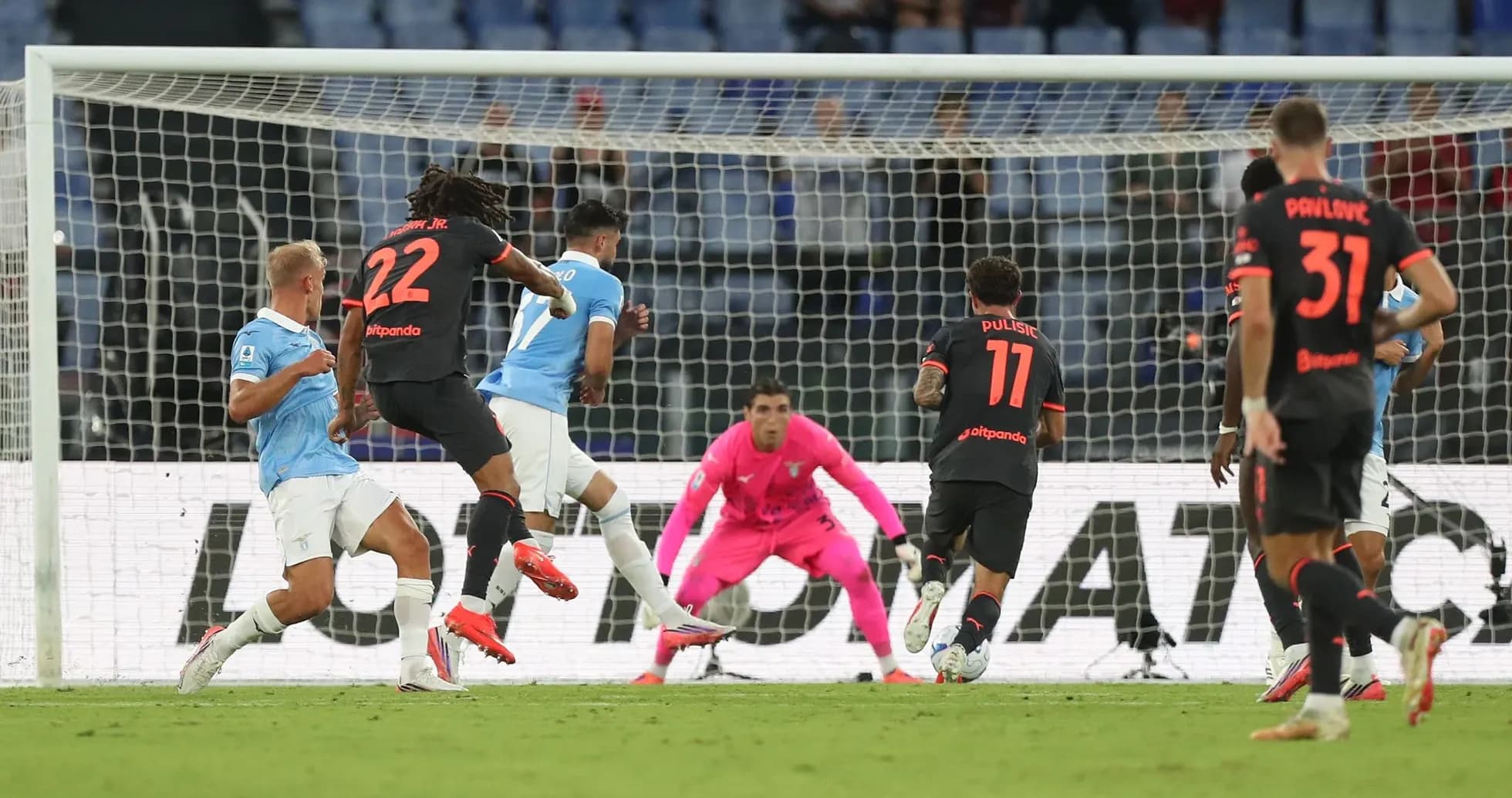
Under the late-summer light of the Stadio Olimpico, Lazio and AC Milan produced a 2–2 draw that felt less like a routine league fixture and more like an early statement about where both clubs are heading in this Serie A season. Heading into this game, Lazio were 4th with 10 points and a goal difference of +3, Milan 6th with 8 points and the same +3 differential. Over 90 minutes, their contrasting footballing identities collided, then slowly bent toward a kind of uneasy equilibrium.
I. The Big Picture – Two projects, one shared ambition
This was Round 4 of the regular season, but the narrative weight was closer to a top-four six-pointer. Lazio arrived unbeaten, with 3 wins and 1 draw from 4 matches. Overall this campaign they had scored 6 and conceded 3; the numbers underline a controlled start: 1.5 goals scored on average both at home and on their travels, and only 0.8 goals conceded on average overall.
AC Milan, under Ruben Amorim, were similarly undefeated with 2 wins and 2 draws from 4, scoring 7 and conceding 4 overall. At home they had been perfect – 2 goals scored, none conceded – but on their travels they were more human: 5 scored and 4 against across 3 away games, an away average of 1.7 goals for and 1.3 against. This match, ending 2–2 after Lazio’s 2–0 half-time lead evaporated, fits that pattern: Milan’s away attacking threat is real, but their defensive line is still a work in progress.
Gattuso’s Lazio stayed faithful to their seasonal blueprint: a 4-3-3, high on intensity, built around vertical midfield runners and wide forwards who double as creators. Amorim’s Milan, in a 3-4-2-1, looked to create overloads in midfield and release their wing-backs and advanced midfielders into the half-spaces.
II. Tactical Voids – Absences and discipline
Lazio’s squad sheet carried the scars of a demanding early season. A cluster of absences – F. Dele-Bashiru (muscle injury), D. Doekhi (hand injury), A. Furlanetto (knee injury), A. Marusic (muscle injury), Patric (ankle injury), L. Pellegrini and N. Rovella (both listed simply with injuries) – stripped Gattuso of depth and some defensive flexibility. The consequence was a back four that had to go the distance together: R. Floriani, J. Sutalo, O. Provstgaard and N. Tavares, with no like-for-like senior alternatives on the bench beyond D. Leite, A. Pedraza and R. Bordon.
This context makes Lazio’s broader disciplinary profile significant. Heading into this game, their yellow cards were spread across the timeline, but with clear spikes: 25.00% between 16–30 minutes, another 25.00% between 31–45, and a further 25.00% between 91–105. That pattern speaks to a side that starts aggressively, then finishes nervy. In a match where they led 2–0 at half-time, those late-game nerves were always going to be a lurking risk.
Milan’s disciplinary curve is even more sharply late-game. All of their yellow cards this season had been shown from 46 minutes onwards, divided evenly: 25.00% in each of the 46–60, 61–75, 76–90 and 91–105 ranges. Amorim’s team tackles more assertively as the match wears on, which dovetails with their tendency to chase or protect results away from home. That aggression helped them wrestle back control in Rome, but also hinted at a side that can be dragged into chaotic, transitional games.
III. Key Matchups – Hunter vs Shield, Engine Room vs Engine Room
Hunter vs Shield
Lazio’s primary scoring threat this season has been an unlikely one: midfielder D. Frattesi. Heading into this game he had 3 goals in 4 appearances, from only 5 shots and 3 on target, with a strong 7.55 average rating. Operating as the third midfielder in the 4-3-3, his late runs from deep are Lazio’s hidden blade.
The responsibility to blunt him fell on Milan’s back three and the screening midfield. S. Pavlović, already one of the league’s standout defenders with 12 tackles, 1 blocked shot and 1 interception, plus 2 yellow cards, is the emotional anchor of that line. Alongside him, K. De Winter and M. Gila form a trio comfortable stepping into midfield. For 45 minutes, Frattesi and Lazio’s midfield timing shredded Milan’s structure; the 2–0 half-time score was the product of that verticality and Milan’s difficulty tracking runners from deep.
On the other side, Milan’s “hunter” was A. Cissé. With 2 goals in 4 appearances and 6 shots (2 on target), he represents a mobile, channel-running threat ahead of G. Ramos. Against a Lazio side that had conceded only 3 goals overall – 2 at home and 1 away – Cissé’s job was to stretch Sutalo and Provstgaard, creating gaps for late arrivals from midfield. As the second half unfolded and Milan clawed their way back to 2–2, those movements, combined with Amorim’s tweaks, forced Lazio’s back line deeper and eroded their compactness.
Engine Room – Creativity vs Control
The true heart of this contest lay in midfield. Lazio’s trio of Frattesi, R. Belahyane and K. Taylor had to balance ball progression with shielding a back four missing several experienced defenders. Frattesi’s 78 passes with 82% accuracy and 6 tackles heading into this match underline his dual role as both runner and breaker of play.
Milan countered with a prestigious and varied midfield band: L. Modrić, A. Rabiot, S. Chukwueze and P. Estupiñán in the 3-4-2-1. Rabiot arrived as one of Serie A’s top assist providers, with 2 assists and 133 passes at 84% accuracy, while Chukwueze had also delivered 2 assists and an impressive 10 key passes with 6 successful dribbles. The plan was clear: use Modrić and Rabiot to control tempo centrally, with Chukwueze as the creative accelerator on the flank.
For 45 minutes, Lazio’s energy overwhelmed that plan. But as legs tired and the game stretched, Milan’s technical quality in the middle third began to tell. The second half felt like a slow turning of the screw: Modrić dictating rhythm, Rabiot stepping higher between the lines, Chukwueze finding pockets where Lazio’s full-backs could no longer press as aggressively.
On the flanks, M. Zaccagni was Lazio’s creative metronome. Heading into this match he had 2 assists, 8 key passes, 10 shots (6 on target) and 10 dribble attempts with 4 successes, plus 2 yellow cards and a reputation for playing on the edge. His duel with Milan’s wide defenders and wing-backs, especially Estupiñán and Pavlović when dragged wide, was central to Lazio’s first-half dominance. Zaccagni’s work rate – 6 tackles, 1 blocked shot and 8 interceptions – also underpinned Lazio’s pressing traps.
IV. Statistical Prognosis – What this 2–2 really says
Following this result, the numbers tell a story of two sides that are closer than the table might suggest. Lazio remain unbeaten, their overall defensive record still strong at 3 goals conceded from 4 matches, but the second-half collapse from 2–0 up raises questions about game management and depth in a squad hit by injuries. Their habit of collecting cards in the middle and late phases of matches hints at a side that can lose control emotionally just as the physical intensity drops.
Milan, meanwhile, extend an unbeaten run that reflects both resilience and structural flaws. On their travels this campaign they have now conceded 4 goals from 3 away games, and the 2 they shipped in Rome fit the pattern of a back line that can be exposed by well-timed runs and wide overloads. Yet their attacking output – 7 goals overall, with creative hubs like Chukwueze and Rabiot already influential – suggests that their xG profile is likely trending upwards. They do not rely on penalties, with no spot-kicks taken or missed, instead building chances through open-play combinations.
In tactical terms, this 2–2 feels like a preview of the season-long arc for both. Lazio, with their 4-3-3 and high-tempo running, look like a Champions League contender if they can better protect leads and manage the emotional temperature late on. Milan, with their 3-4-2-1 and layered midfield, have the tools to grind out results away from home, but must refine their defensive spacing if they are to climb from “Play-offs” territory into the automatic Champions League positions.
On a night where momentum swung wildly, the Olimpico witnessed not just a draw, but the sketch of two evolving identities – one forged in intensity, the other in control – both clearly destined to shape the top of Serie A as this season unfolds.