.svg&w=384&q=75 "GoalGist logo")
KuPS vs Universitatea Craiova: Tactical Analysis of the 1-1 Draw
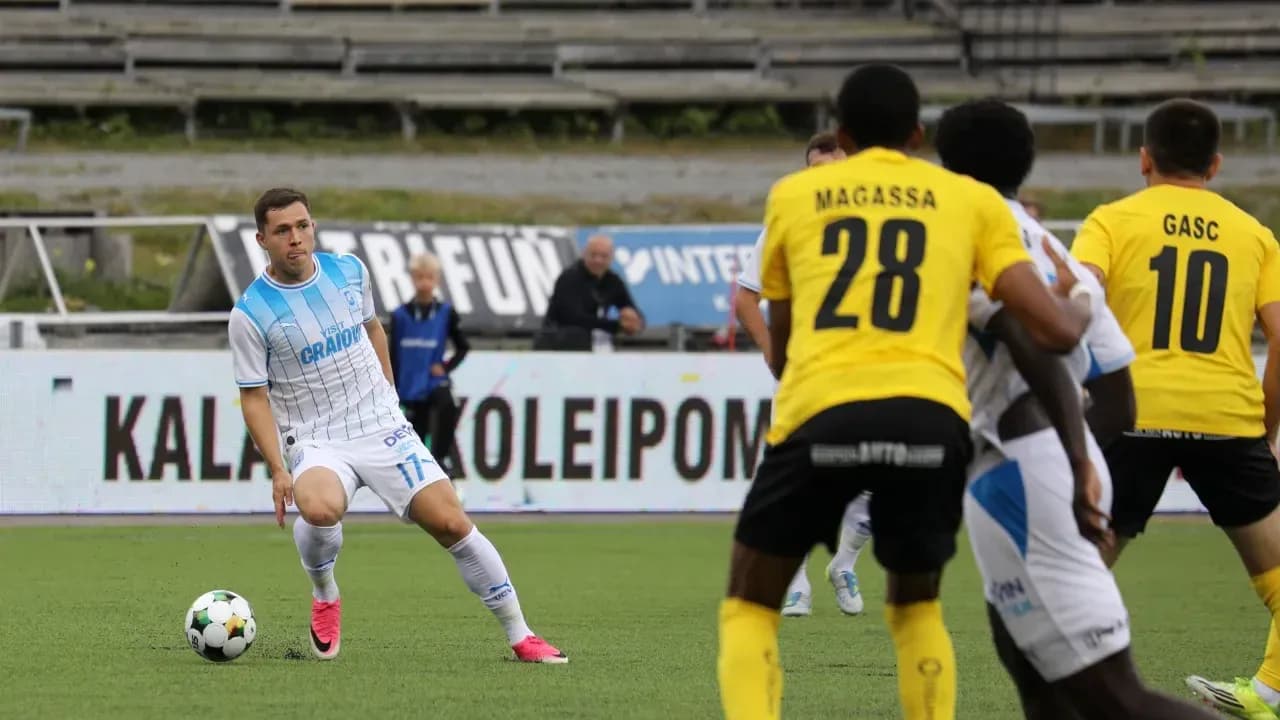
KuPS approached this UEFA Europa League 3rd Qualifying Round leg at Savon Sanomat Areena in a clear 4-2-3-1 structure, and the tactical story of the 1-1 draw is written in how they used that platform to control phases of the game without turning control into volume of chances. With 53% possession, the Finns had the territorial and ball dominance they wanted, but their final-third mechanisms produced only 1 shot on goal from a modest shooting profile (2 shots off goal, 1 blocked). The shape was stable and methodical rather than explosive, and that tension between control and threat defined their evening.
Out of possession, the KuPS back four of Clinton Antwi, K. Adams, B. Magassa and B. Armah (before his substitution) operated in a fairly orthodox medium block, with the double pivot of V. R. Gasc and S. Touray screening in front. The high foul count (19) and 7 offsides conceded underline a proactive, sometimes over-aggressive line: KuPS tried to squeeze the pitch, stepping up to catch Universitatea Craiova’s front three offside and breaking up transitions early, but at the cost of repeated defensive interventions and risk in the channels.
Universitatea Craiova’s 3-4-3 under Filipe Coelho was built to exploit exactly those spaces. With A. Rus, N. Stevanovic and V. Screciu as the back three and wing-backs C. Mora and N. Bancu, the Romanians were comfortable without the ball (47% possession) and set up to spring forward quickly. Their attacking output was more incisive: 4 shots on goal, 3 off goal and 1 blocked from fewer overall attacking phases. The structure gave them consistent three-lane occupation up front through M. Etim, S. Nsimba and S. Baiaram, and the first half in particular showed how they could turn limited territory into clear looks at goal.
Opening Goal
The opening goal on 38 minutes, S. Baiaram finishing from an assist by A. Rus, was a direct product of this design. Rus’s involvement from the back three highlights how Craiova used one centre-back to step into midfield or wide zones when KuPS’s first line of pressure was bypassed. With KuPS’s full-backs often advanced to support their own wide players, that left exploitable half-spaces for Baiaram to attack, and the 0-1 at half-time reflected Craiova’s greater vertical clarity rather than overall control.
Second Half Adjustments
Miika Nuutinen’s in-game management was decisive after the break. The triple substitution on 60 minutes — S. Savolainen (IN) for V. R. Gasc (OUT), C. Kabuye (IN) for B. Armah (OUT), and P. Parzyszek (IN) for A. Puukko (OUT) — effectively rebalanced KuPS’s structure. Savolainen brought fresher legs and more direct intent from midfield, Kabuye gave extra width and 1v1 threat, while Parzyszek provided a more traditional focal point higher up the pitch. These changes tilted the game’s momentum, aligning with KuPS’s statistical edge in corners (6 to 2) as they began to pin Craiova deeper and generate more set-piece pressure, even if it did not translate into a flood of shots.
Craiova’s response was pre-emptive. At 59 minutes, they had already reshaped their front and midfield lines with three substitutions: A. Al Hamlawi (IN) for S. Nsimba (OUT), Teles (IN) for A. Cicaldau (OUT), and D. Matei (IN) for S. Baiaram (OUT). This triple change suggested a shift from the more fluid, technical front three of the first half toward a more conservative, hard-working unit to protect the lead and manage KuPS’s growing possession. The late change at 90+5', with T. Baluta (IN) for A. Mekvabishvili (OUT), further underlined a game-management mindset, adding fresh energy in central areas to close down spaces and contest second balls.
Equaliser
The equaliser on 72 minutes, J. J. Moreno Ciorciari scoring from a pass by T. Jyry, was the logical endpoint of KuPS’s tactical adjustments. With extra presence in the box from Parzyszek and more aggressive wide play from Kabuye, Craiova’s back three and wing-backs were forced deeper, compressing their own box. Jyry’s role as a connector in the second line became more pronounced; his assist reflects KuPS finally managing to position runners between Craiova’s lines and in front of their back three, rather than circulating harmlessly in deeper zones.
Discipline and Duels
Discipline and duels also shaped the tactical tone. KuPS picked up two yellow cards — Clinton Antwi on 36' and Saku Heiskanen on 88' — while Craiova had one for Adrian Rus on 68'. The timing is telling: Antwi’s first-half booking came as KuPS tried to deal with Craiova’s transition threat down the flanks, while Rus’s card arrived just as KuPS were ramping up pressure, a sign of the away side being forced into more reactive defending. Heiskanen’s late caution, shortly after coming on for Antwi at 83', reflects the intensity of KuPS’s late push and the physical edge they brought to recover possession high.
In goal, the statistical fields for goalkeeper saves and goals prevented are absent for both H. Riihimaki (KuPS) and L. Popescu (Universitatea Craiova), so their impact is best inferred structurally rather than numerically. Riihimaki operated behind a high, sometimes risky defensive line that sought to compress the middle third; Popescu, by contrast, was protected by a deeper-lying back three in the second half, with Craiova increasingly prioritising compactness over pressing.
Overall, the 1-1 reflects a clash of styles: KuPS’s possession-based 4-2-3-1, designed to control rhythm and territory, against Universitatea Craiova’s more vertical, transition-oriented 3-4-3. The Romanians generated more shots on goal from fewer attacking phases, while KuPS turned their possession edge into territorial pressure, set-pieces and eventually the equaliser. Tactically, both coaches’ use of triple substitutions around the hour mark was pivotal, turning a first half tilted toward Craiova into a second half where KuPS’s structural and personnel adjustments earned them parity and kept the tie finely balanced heading into the return leg.