.svg&w=384&q=75 "GoalGist logo")
Jose Mourinho's Emotional Goodbye at Chelsea
The day Jose Mourinho walked back into the Chelsea dressing room to say goodbye, the noise died instantly.
Frank Lampard remembers the silence first. Then the words.
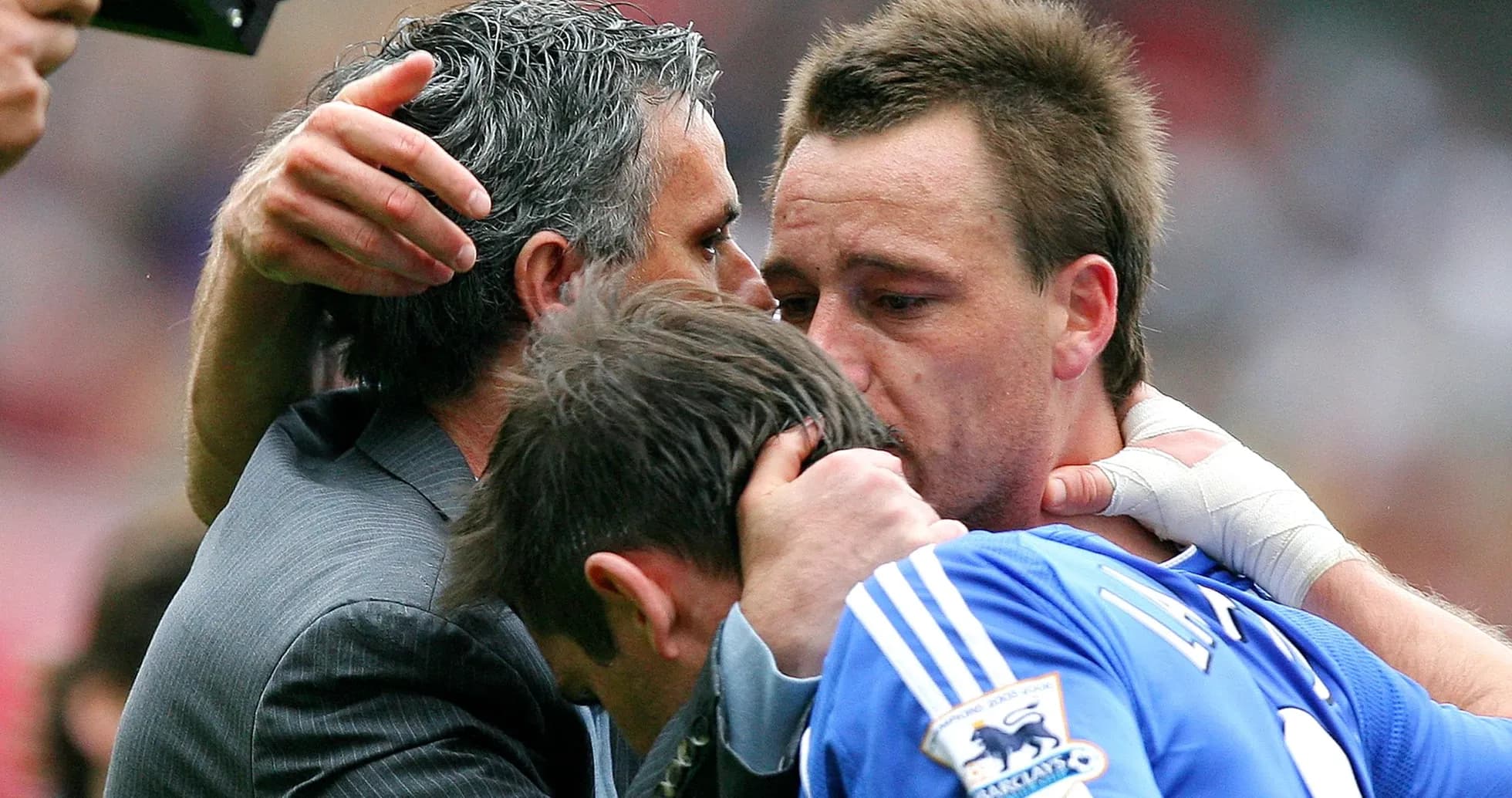
“I remember him coming into the dressing room and he said to me that he’d been sacked,” the former midfielder recalled. “I couldn’t think about how much this man had helped my career, how much I loved working with him. There were tears, which is not normal in the dressing room when a manager leaves.”
This was not the usual handshake-and-move-on farewell that football so often serves up. This was grief. Real, raw, and shared by players who had built their careers and identities under Mourinho’s glare and guidance.
John Terry felt it just as deeply, and still carries the weight of it.
“I would leave that pitch in a coffin for him,” the former Chelsea captain said. “You’ve got grown men, tears running down their face, not really understanding why. And even still today I’m like, that’s my fault.”
The moment he’s talking about is that 1-1 Champions League draw with Rosenborg at Stamford Bridge, the match widely seen as the tipping point in Mourinho’s first spell. Chelsea laboured, failed to kill the game, and conceded. For Terry, the details of that goal have never really left him.
“When we drew the Champions League game, my man scored,” he said. “If I didn’t let that person score, would he have lasted another couple of years? Who knows? I still feel kind of responsible for that, if that makes sense. It’s just disappointing how it all ended, if I’m honest. I absolutely loved him and adored him and was more upset than anyone, to be honest.”
While the dressing room drowned in emotion, the fracture higher up at the club had been building for some time. Mourinho, never shy about lifting the curtain, laid out how the power lines at Chelsea began to blur.
In the early days, he says, it was simple. “In my work, the triangle: Jose, Peter Kenyon, Roman was invaded by strangers,” he revealed. That triangle – manager, chief executive, owner – had driven Chelsea’s surge to the top of English and European football.
But the faces in the owner’s box began to change.
“In the beginning, you play at Stamford Bridge, you look to the box, Roman, his wife, with one or two persons of his confidence,” Mourinho said. “A few seasons later: former players, agents. These kinds of people, they know where the money is.”
The message was clear. The tighter, football-focused structure that had underpinned Chelsea’s rise under Mourinho started to loosen. New voices appeared, new interests circled, and the manager felt the ground shifting beneath him.
One request from Roman Abramovich, as Mourinho tells it, captured just how far apart their priorities had drifted.
“I think Roman changed,” Mourinho said. “For example, one day Peter came to me quite embarrassed and he told me, ‘Jose, I have to tell you something. The boss is in Sardinia with these boats, and the people that work in these boats they play football against guys from the hotel, and they are losing. Can you go there to win a game for him?’”
It sounds absurd, almost comic, but for Mourinho it was deadly serious. It cut to the heart of what he believed his job to be.
“‘No, Peter, I have training today. I have to prepare for tomorrow; I cannot go’,” he replied. “And he was not happy with that.”
That refusal, grounded in a manager’s obsession with preparation and control, did not land well with an owner used to getting what he wanted. The bond that had once powered Chelsea’s dominance began to fray.
So the story of Mourinho’s first Chelsea exit is not just about a 1-1 draw with Rosenborg, or a misjudged defensive moment that still haunts Terry. It is about a dressing room in tears, a manager who refused to bend his principles, and an empire that started to invite too many voices into the room.
The players still talk about that day as if it happened yesterday. The question that lingers is simpler, and sharper: if the triangle had held, how much more might they all have won together?

