.svg&w=384&q=75 "GoalGist logo")
Ifeanyi Ndukwe: Liverpool’s Giant Centre-Back Stuck in Limbo
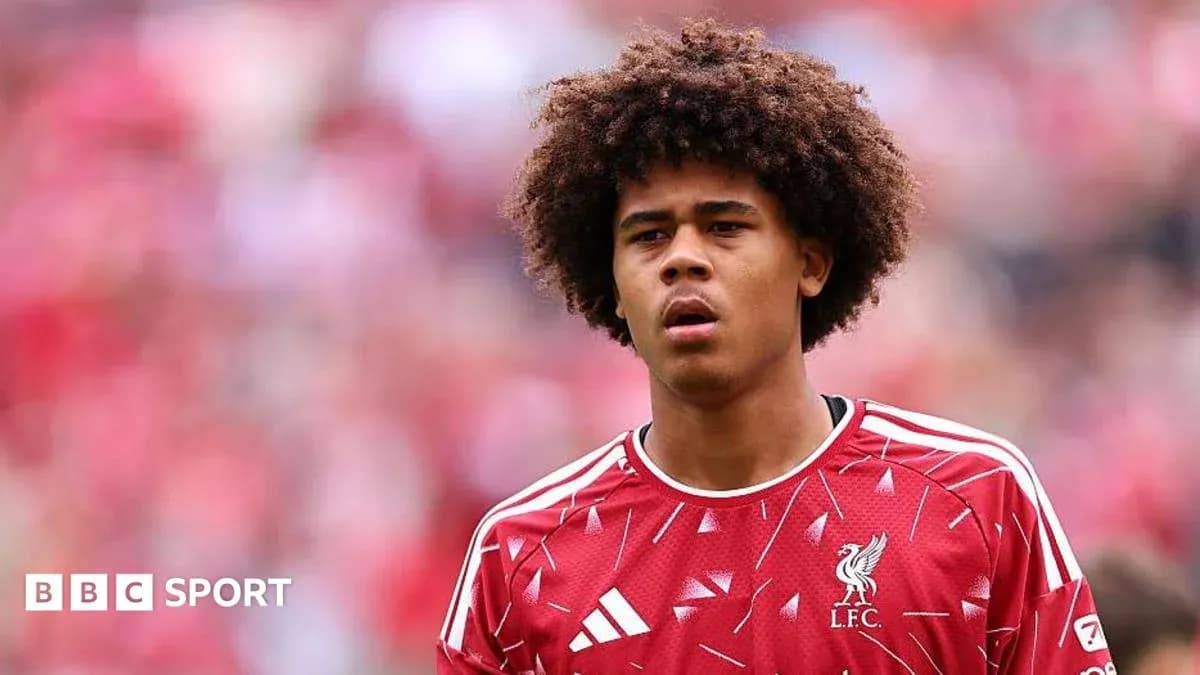
Liverpool’s new era under Andoni Iraola has started with more questions than answers, but one story has cut through the noise: an 18-year-old centre-back from Austria, standing 6ft 6in, playing like he owns Anfield – and yet not allowed to kick a ball for Liverpool in a competitive game.
A giant steps into the spotlight
Ifeanyi Ndukwe was supposed to be a project. A long-term bet. Instead, a bruising pre-season has pushed him straight into the spotlight.
Liverpool’s four friendlies so far have been chaotic: wins over Sunderland and Wrexham, but two-goal leads squandered against Leeds and Monaco. The defending has looked raw, the structure still forming, the gaps at centre-back painfully obvious.
Joe Gomez limped out of the first game. £60m signing Jeremy Jacquet has been nursing a stubborn knee problem. Giovanni Leoni is still working his way back from serious knee damage. That left Iraola short of senior bodies and forced him to turn to a teenager who had barely unpacked his bags.
Ndukwe didn’t blink.
He has already logged two full 90-minute outings and another 80-minute shift. On Sunday, he walked out at Anfield alongside Virgil van Dijk to face Monaco, not as a token academy inclusion, but as a starting centre-half for Liverpool.
Within minutes, he had the crowd on their feet. A sharp backheel to wrong-foot Mika Biereth, then a series of clean, commanding defensive duels. The kind of presence that makes supporters sit up and ask, “Who is this kid?”
Van Dijk has seen enough centre-backs come and go to choose his words carefully. After the Monaco game, he called Ndukwe a “big talent”, a “big guy” who wants to learn, and spoke openly about the plan: he has to go on loan, he has to come back better, and he has to be ready to stay.
The problem is not football. It’s paperwork.
The Brexit wall
On the pitch, Ndukwe looks ready to compete. Off it, he is stuck behind a wall built in Whitehall, not Melwood.
Post-Brexit rules mean Ndukwe cannot play a competitive minute for Liverpool in 2026 unless he hits the points threshold required for a UK work permit. Right now, he falls short.
Since the UK left the European Union, every foreign signing must fit into a tighter, more complex system. Players need a Governing Body Endorsement (GBE) to obtain a work visa, with points awarded for factors such as league strength, minutes played, and international appearances. Ndukwe, an Austria youth international who has only just stepped out of Austria Vienna’s reserves and made a single senior appearance, simply doesn’t have the numbers yet.
There is a second door: the Elite Significant Contribution (ESC) slots. These are designed for high-potential foreign players who don’t meet the standard GBE criteria but are deemed important enough to bend the rules for.
Clubs in the Premier League and Championship can have up to four ESC players, but that maximum is conditional. It depends on how many minutes they give to England Qualified Players (EQP) over the previous season. Hit 35% of minutes with EQPs and you unlock all four ESC slots. Fall below that and the number drops.
Liverpool fell short.
Last season, only Freddie Woodman, Gomez, Rhys Williams, Curtis Jones, Trey Nyoni and Rio Ngumoha represented the English core in the squad, combining for 83 Premier League appearances. With Trent Alexander-Arnold and Jarell Quansah gone, Tyler Morton moved on, and Harvey Elliott loaned out, the EQP share slid. The cost is clear: Liverpool are entitled to just one ESC place.
That single golden ticket has already been used on 18-year-old Senegalese forward Mor Talla Ndiaye.
So even as Ndukwe impresses in a red shirt, he is locked out of the competitive season. A player Liverpool have just paid £2.6m for, who has walked into pre-season and looked at home next to Van Dijk, cannot be registered to play in the Premier League.
From Vienna to Anfield – and straight back out?
Ndukwe’s route to this strange limbo has been rapid.
He came through the Austria Vienna academy, broke into the reserve side, and did enough to catch the eye of his national selectors. At the Under-17 World Cup last November, he stood out. Liverpool moved quickly.
A deal in principle was struck in January. It became official this summer when he turned 18, the Reds gambling that they could shape a raw, towering defender into a long-term option at centre-back.
Pre-season has only strengthened that belief. Against senior opposition, he has looked composed, aggressive, and technically confident. Fans have already started asking when they will see him in competitive action.
The answer is: not yet.
He will be allowed to feature in Liverpool’s final friendly against Como on 16 August. After that, the curtain comes down on his Anfield appearances for a while. The next time he plays in red may depend on the success of a loan move that has not yet been finalised.
His agent, Georg Lederer, has been clear on the plan. Speaking in July, he said a loan club would be found where Ndukwe could gain experience “at a very high level” and described the situation as a “great opportunity”, with several top international clubs already showing concrete interest. On Monday, he confirmed they are still weighing up options across Europe.
Chasing points, chasing time
To qualify automatically for a visa, Ndukwe must accumulate 15 points while out on loan. Those points come from where he plays, how much he plays, and what level he plays at.
The logic is brutal in its simplicity: the stronger the league, the more points he earns. Regular minutes in a top division count for more than sporadic appearances in a weaker competition. Appearances for Austria’s youth sides add weight, but the real acceleration comes from club football at a serious level.
If Liverpool and Ndukwe pick the right destination, the maths could fall into place quickly. It is understood that, with the correct move, he could reach the required tally by January.
That opens up a tantalising possibility. If he hits 15 points, secures his GBE, and Liverpool choose to recall him, Ndukwe could yet feature in competitive games for the club this season, after the turn of the year.
For Liverpool, that would be a win: a promising young centre-back, already schooled alongside Van Dijk, returning mid-season with eligibility issues solved. For any club taking him on loan, it is less straightforward.
Why build your defence around a player who might disappear in January?
That tension will shape the next fortnight. Liverpool need a club willing to trust the talent and accept the risk. Ndukwe needs a league strong enough to rack up points quickly but a team prepared to give him real minutes.
The irony is sharp. In a pre-season where Liverpool have visibly lacked depth at centre-back, one of their most impressive defenders cannot be used when it matters. A teenager who has looked ready for the Premier League will have to prove it somewhere else first.
The only question now is where he goes to earn the right to come back.